
The promise sounds tempting: two ingredients, a homemade face mask, and firmer skin in just a few days. The problem is that this expectation often ends in frustration, because dryness persists, fine lines don’t disappear, and sensitive skin can even become more irritated. Furthermore, when a viral recipe promises “collagen” as if it were magic, it’s easy to mistake temporary hydration for real repair. The good news is that there are simpler, better-supported ways to care for your skin without falling for exaggerated promises, and I’ll show you the smartest order in which to do it.
“Homemade collagen” does not mean manufacturing collagen inside the skin
Collagen is a structural protein that the body produces naturally and that helps support the skin. It is found primarily in deeper layers of the skin, not on the surface. Therefore, applying a cooking mixture to your face does not mean that the mixture will turn into new collagen fibers.
And here’s the key point: hydrating the skin is one thing, but remodeling its structure is quite another . Hydration can make the skin look smoother for a while. Collagen remodeling, on the other hand, is a slower and more complex biological process.
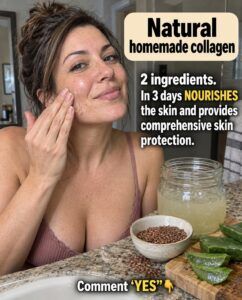
The skin may look better in minutes, but that doesn’t mean it has changed on the inside.
Why can a homemade face mask provide temporary relief?
The American Academy of Dermatology (AAD) explains that moisturizers lock in water and can temporarily reduce the appearance of some fine lines. This means that a moisturizing or emollient mask could leave your skin feeling nice and comfortable, especially if your skin is dry or tight.
But this improvement doesn’t prove that new collagen fibers have formed. In fact, many “before and after” photos can also be misleading due to lighting, angle, facial expression, or simply because the skin was more hydrated in the second photo.

The truth is that well-hydrated skin can look more rested, and that’s already valuable. But it shouldn’t be marketed as if it were a deep anti-aging treatment.
Can aloe and seeds help?
Without seeing the exact recipe, it’s impossible to know what ingredients were used or how they were processed. Even so, some natural components can provide a temporary feeling of softness. Aloe, for example, is often associated with freshness and light hydration for some people.
But that doesn’t make any mixture a safe or effective treatment for all skin types. Natural ingredients can also cause irritation, burning, itching, or allergies, especially in sensitive skin.

The AAD recommends testing new products on a small area before applying them to your entire face. This is especially important if your skin is already dry, reactive, or prone to redness.
Signs you should stop using a homemade face mask
Remove the mixture and wash the area if any of these signs appear:
– Intense or persistent burning
– Severe itching
– Redness that doesn’t go away
– Swelling
– Sensation of heat or discomfort when touching the skin

If the reaction is severe, don’t ignore it thinking it’s normal. Irritated skin often looks worse and can take longer to recover.
Three days is too short a time to change the structure of the skin
This is where many viral claims fall apart. A moisturizer can indeed make skin look plumper quickly, but that doesn’t equate to a profound change. According to the AAD, most anti-aging products need at least six weeks to show results, and some require close to three months.
That means any promise of “new collagen in 3 days” deserves skepticism. Skin may look better due to hydration, but not because a homemade recipe has rebuilt its internal support structure.
If something sounds too fast to be true, it almost always is.
What does work best for preserving collagen
If the goal is to maintain firmer, healthier skin over time, there’s a much less flashy but better-supported measure: protecting it from the sun every day. Ultraviolet exposure accelerates photoaging, promotes age spots, wrinkles, and loss of elasticity.
The AAD considers sunscreen and moisturizer to be two of the most effective anti-aging products to start a skincare routine. It recommends using a broad-spectrum, water-resistant sunscreen with SPF 30 or higher.
A simple routine that is worthwhile
In the morning:
– Gentle cleansing
– Moisturizer if skin needs it
– Sunscreen SPF 30 or higher
At night:
– Gentle cleansing
– Moisturizing
There’s no need to complicate things with five serums, three masks, and several acids at the same time. In fact, using too many products can irritate your skin and make it look more tired or sensitive.
Ingredients with better support for fine lines
If, after moisturizing and protecting your skin from the sun, you still want to treat fine lines, there are more proven options than a home remedy. One of the best-known is retinoids, derivatives of vitamin A.
The AAD explains that retinoids promote the renewal of surface cells and can help stimulate collagen, improve texture, and reduce fine lines and wrinkles. However, they don’t work in three days, and initially, they can cause dryness or irritation.
Quick comparison
Homemade face mask: can provide temporary softness if it moisturizes and does not irritate.
Sunscreen: helps prevent cumulative damage and visible aging.
Retinoids: can improve fine lines with consistent use and patience.
Dermatological treatments: these usually offer more intense changes, depending on the case.
The choice depends on what concerns you most: fine lines, blemishes, texture, or sagging. Not all problems are treated the same way, and not everything requires an aggressive solution.
Practical tips for taking care of your skin starting today
If you want to do something worthwhile without falling into empty promises, start with simple, sustainable steps. Here’s a clear guide:
Step 1: Wash your face with a gentle cleanser, without scrubbing too hard.
Step 2: Apply a moisturizer if you feel tightness, dryness, or sensitivity.
Step 3: Use sunscreen every day, even if it’s cloudy or if you’re only going out for a short time.
Step 4: If you want to treat fine lines, find out if a retinoid is right for you.
Step 5: If you are trying a homemade face mask, do a test on a small area of skin first.
Step 6: Stop using any product that burns, irritates, or leaves your skin redder.
The most important thing is consistency. Skin responds better to repeated habits than to intense but sporadic solutions.
What you should remember before believing in a viral recipe
A homemade mixture can temporarily hydrate and make skin look smoother. That’s possible. But there’s a big difference between that and saying it produces new collagen, rebuilds the dermis, or replaces sunscreen.
The most effective strategy is less flashy but far more reliable: daily sunscreen, consistent hydration, gentle cleansing, and evidence-based active ingredients when truly needed. Furthermore, the AAD points out that no single topical product offers all the results of a dermatological procedure.
The best routine isn’t the most viral; it’s the one your skin can tolerate and sustain.
Conclusion
If a homemade face mask leaves your skin feeling softer, great—that might just be temporary hydration. What you shouldn’t assume is that this improvement means “homemade collagen” or a profound transformation in just three days. To truly care for your skin, the smartest thing to do is protect it from the sun, keep it hydrated, and use proven ingredients when necessary.
And if a homemade preparation irritates your skin, stop using it. Healthy skin doesn’t need to suffer to look its best.
Frequently Asked Questions
Can I make collagen for skin with two ingredients?
Not in the way many viral posts suggest. A mixture can hydrate the surface, but that doesn’t mean it’s creating new collagen fibers within the skin.
Can a homemade face mask make your skin look better?
Yes, it can provide temporary improvement if it hydrates and if the skin tolerates it well. But that effect is usually superficial and is not equivalent to a deep anti-aging treatment.
What is most important to prevent visible aging?
Daily sun protection is essential. The AAD recommends using a broad-spectrum sunscreen with SPF 30 or higher, along with a basic cleansing and moisturizing routine.
Medical disclaimer: This content is for educational purposes only and is not a substitute for dermatological consultation. Natural ingredients may also cause irritation or allergies; discontinue use if a reaction occurs and consult a professional if new, changing, bleeding, or non-healing lesions appear.


