
Many people worry when they notice their vision isn’t what it used to be: reading becomes more difficult, lights are blinding, and glasses don’t seem to help much. Then a video appears promising that raw onion can “clean” a cataract in no time, and the idea sounds tempting when you want to avoid doctor’s appointments, expenses, or surgery. The problem is that a cataract isn’t on the surface of the eye, but inside the lens, and putting onion directly in the eye can irritate it more than help. What seems like a quick fix can actually delay the correct treatment; and at the end of this article, you’ll see a little-known sign that helps distinguish between a myth and a real eye emergency.
The cataract is not on the eye: it is inside the lens.
To understand why onions can’t “erase” a cataract, we first need to locate the problem in the right place. Inside the eye, there’s a transparent structure called the lens, whose function is to focus light so we can see clearly.
With age, the proteins in the lens can change and clump together. Over time, this natural lens becomes cloudy. That’s a cataract. Mayo Clinic compares it to looking through a fogged or frosted window.
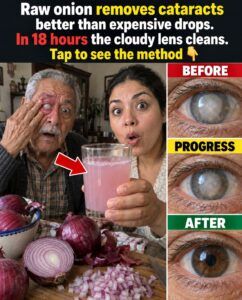
And here’s the key: it’s not just dirt stuck to the surface, but an internal change. That’s why no homemade juice, infusion, or herbal mixture has been shown to reverse it.
Can raw onion eliminate a cataract in 18 hours?
There is no reliable clinical evidence to show that raw onions can eliminate cataracts in 18 hours, a few days, or even several weeks. The claim sounds powerful, but it doesn’t align with what is known about the disease.
Onions contain compounds that are nutritionally interesting, but eating them is not the same as applying them to your eye. A cataract involves structural changes in the lens, and these changes have not been shown to be reversible with home remedies.

The sensation of “something strong” doesn’t necessarily mean something is working. In fact, it often just means irritation.
What does happen when the onion touches the eye
When you cut an onion, many people experience watering, burning, and redness. This doesn’t mean the eye is being “cleansed.” It means that certain volatile compounds are irritating the surface of the eye.
In other words, the reaction is one of defense, not healing.

| What can happen | What it does not prove |
|---|---|
| Intense tearing | That the waterfall disappeared |
| Ardor temporal | That the lens was cleared |
| Red eye | The remedy worked. |
| Vision momentarily altered by tears | That the cataract improved |
Putting onion directly in the eye can be risky
This is the most important point. The eye is a delicate organ and should not be exposed to juices, oils, vinegar, lemon, honey, or non-sterile homemade mixtures. Even if they seem “natural,” they may contain particles, bacteria, or irritants.
Furthermore, the concentration of these preparations is not controlled. This increases the risk of burning, inflammation, and damage to the surface of the eye.
If something accidentally gets into your eye and causes discomfort, rinse it thoroughly with clean water and don’t try any other remedies. If there is significant pain, persistent redness, intense sensitivity to light, or decreased vision, medical evaluation is necessary.

Waterfalls advance slowly, and that’s why they are so confusing.
Cataracts usually develop slowly. At first, many people don’t notice a clear change. Then the details begin to appear: increased difficulty reading, a need for more light, dull colors, or headlights that are too dazzling.
According to the National Eye Institute, common symptoms include blurred vision, light sensitivity, difficulty seeing at night, halos around lights, and frequent changes in eyeglass prescription.
But that’s not all. After age 40, presbyopia, which makes it difficult to see up close, is also common. Therefore, not every vision problem is a cataract.
Common symptoms that may appear
- Blurred or cloudy vision.
- Colors that look faded.
- Increased sensitivity to light.
- Difficulty driving at night.
- Halos around the lights.
- Frequent changes in prescription.
How is a cataract actually confirmed?
It cannot be confirmed with an internet photo or a home test. The evaluation usually includes a visual acuity test and a dilated eye exam. The National Eye Institute identifies this exam as a fundamental tool for diagnosing cataracts.
Using specialized instruments, the eye doctor can examine the lens and other structures of the eye. This is important because not all blurred vision is due to cataracts. There may also be retinal problems, glaucoma, or corneal abnormalities.
An eye can have a cataract and, at the same time, another vision problem. Therefore, assuming that “everything is due to age” can lead to mistakes.
What does work is when the cataract already affects daily life
Currently, the only way to remove a cataract is through surgery. In this procedure, the cloudy lens is removed and replaced with an intraocular lens.
The National Eye Institute explains that surgery is the only way to remove cataracts and that approximately 9 out of 10 people see better after the procedure.
That doesn’t mean everyone needs surgery right away. In the early stages, some measures can help you continue functioning better while your condition is monitored.
Useful measures in early stages
- Use an up-to-date prescription.
- Improve the lighting for reading.
- Reduce glare at home.
- Use magnifying glasses if needed.
- Avoid driving at night if visibility is no longer safe.
Habits that do help take care of eye health
Instead of looking for a cure that “dissolves” cataracts, it’s best to protect your eyes holistically. Science shows that some factors are associated with a higher risk of cataracts, and there is room for action in these areas.
First, use sun protection when outdoors. Second, avoid smoking. Third, if you have diabetes, maintain the recommended control and monitoring.
It also helps to have regular eye exams, especially if you notice gradual changes in your vision. Sometimes you get used to seeing worse and don’t realize how much it has changed until you compare both eyes.
Practical guide: what to do today if you suspect a cataract
If your vision is failing, don’t wait for a viral remedy to work miracles. You can follow these simple steps:
- Note whether the problem is at a distance, up close, or at both distances.
- Note if there are halos, glare, or difficulty seeing at night.
- Check if your glasses are still useful or outdated.
- Avoid putting household substances in your eyes.
- Schedule an evaluation with a vision health professional.
If the cataract is mild, adjustments to lenses, better lighting, and tracking may suffice. If it interferes with reading, driving, or recognizing faces, surgical options are worth discussing.
When you shouldn’t wait
There’s an important detail that many people overlook: cataracts usually progress gradually and are not typically painful. Therefore, a sudden loss of vision shouldn’t automatically be attributed to a cataract.
Mayo Clinic recommends seeking immediate medical attention if you experience sudden changes such as sudden double vision, flashes of light, sudden eye pain, or severe headache with visual changes.
If you no longer drive safely, stumble more, can no longer read comfortably, or cannot recognize faces from a distance, it’s time to consult a doctor.
The question is not whether the cataract “looks ugly”; the question is whether it is already limiting your life.
Frequently asked questions about onions and cataracts
Can raw onion eliminate a cataract?
No. There is no reliable clinical evidence that onions, onion juice, or any home remedy can remove cataracts. The only proven way to remove a cataract is through surgery.
Are there drops that dissolve cataracts?
Currently, there are no commonly used eye drops that can eliminate an established cataract. Some measures can help improve vision in the early stages, but they do not reverse the clouding of the lens.
Do all cataracts require surgery?
Not necessarily immediately. Surgery is considered when vision already affects activities such as reading, driving, or working normally. In the meantime, there may be monitoring and visual adjustments.
In summary
The idea that raw onion “erases” cataracts confuses a superficial irritation with a real change inside the eye. Onion makes you cry because it irritates, not because it cleans the lens.
A cataract is an internal clouding of the eye that usually progresses slowly. When it begins to affect daily life, surgery is the proven treatment. In the meantime, protecting yourself from the sun, not smoking, managing diabetes, and getting regular eye exams can make a difference.
And here’s the important point to remember: if your vision changes suddenly, if you experience pain, or if you see flashes of light, don’t wait for a home remedy to work. That requires professional attention.
Conclusion
Viral remedies often sound easier than a consultation, but your eye health deserves better than a gamble. If you suspect cataracts, the safe route isn’t onions or any home remedy: it’s a complete eye exam.
With reliable information, proper follow-up, and timely treatment, many people regain quality of life and stop living with the frustration of seeing worse and worse.
Medical notice: This content is for informational purposes only and is not a substitute for an ophthalmologist’s evaluation. Do not apply juices, extracts, or homemade preparations directly into the eyes.


