
After 80, it’s very common to notice thinner, drier, and less firm skin, which makes any viral remedy sound tempting. The problem is that many “miracle” promises prey on the hope of seeing a quick change, just when the face already feels more fragile and sensitive. And that’s where the confusion arises: more hydrated skin might look better for a few hours, but that doesn’t mean the lost collagen has been recovered. The good news is that there are real ways to improve the appearance of your skin, but not in three days or with a homemade red onion formula. At the end, I’ll show you what can actually produce a visible change without irritating mature skin.
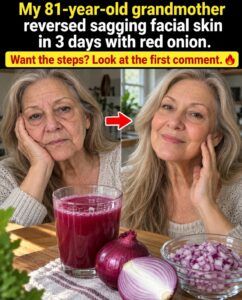
The short answer: no, red onion does not tighten sagging skin in 3 days
There is no solid clinical evidence that drinking or applying red onion reverses facial sagging in 72 hours. Onions may be a healthy food, but there’s a difference between nutrition and achieving a profound cosmetic effect on the skin.
Sagging skin doesn’t appear due to a lack of a single ingredient. It happens as a result of years of loss of collagen, elastin, facial fat, and structural support. That’s why a quick fix often sounds more appealing than it actually is.
Why does skin change so much after 80?
As we age, our skin loses water more easily, becomes thinner, and often shows more pronounced wrinkles, creases, and age spots. The American Academy of Dermatology explains that these changes are common from the age of 60 and 70 and continue to progress over time.
In women, the decline in estrogen around menopause also accelerates collagen loss. According to the AAD, women’s skin can lose about 30% of its collagen in the first five years after menopause and about 2% per year for the next two decades.
This helps to understand why signs like these appear:

- Less firm cheeks
- more droopy jawline
- Folds around the nose and mouth
- Thinner skin around the eyes
- More permanent wrinkles
Simply put, a drink can’t rebuild all that architecture in three days.
What does red onion really contain?
Red onions do provide beneficial compounds, such as water, fiber, and natural antioxidants, including flavonoids like quercetin. From a nutritional standpoint, they can be part of a healthy diet.
But here’s the detail that’s often misunderstood: just because a food contains antioxidants doesn’t mean it will tighten your skin, instantly produce collagen, or erase deep wrinkles. Science doesn’t back up those claims.

A food can be good for your health without functioning as a cosmetic treatment. And that difference is key.
Are there any studies on onions and skin?
Yes, but they don’t prove what many viral videos claim. For example, one study evaluated a cream containing onion extract, Centella asiatica, and hyaluronic acid over 12 weeks to improve reddish stretch marks. Improvements in appearance and texture were observed, but that doesn’t mean onions alone work miracles.
There are three huge differences between that study and the viral idea:

- It was a formulated cream, not homemade onion juice.
- It contained other active ingredients, not just onion.
- The study was conducted over 12 weeks and focused on stretch marks, not facial sagging.
In other words: that study does not prove that applying onion or drinking its juice tightens the face in three days.
Hydration can change your appearance quickly, but it’s not a facelift.
This is the point that confuses people the most. When skin is dry, fine lines are more noticeable. If a suitable moisturizer is applied, the surface layer retains water, and the skin can temporarily appear smoother and plumper.
The AAD explains that moisturizers can provide a superficial “plumping” effect. This may make some fine lines less noticeable, but the effect is temporary and does not lift the deeper tissues.
In other words: looking better is not the same as repairing the skin’s structure.
What a cream can and cannot do
“Firming” creams typically offer subtle results. The AAD points out that a cream does not penetrate deeply enough to produce a true lifting effect, as a surgical procedure would.
That helps set realistic expectations. If even a cosmetic formula designed for skin has limitations, a homemade onion mixture is even less likely to produce a dramatic change.
Here’s a simple comparison:
| Viral promise | What can really happen |
|---|---|
| Tighten sagging skin in 3 days | Not proven |
| Look temporarily more hydrated | Yeah |
| Eliminate deep wrinkles | No |
| Recover lost collagen in 72 hours | No |
| Rejuvenate decades | No |
| Consuming onions as part of a healthy diet | Yeah |
Ingredients with better support for fine lines
If the goal is to improve texture, fine lines, and some signs of aging, retinoids are among the best-studied ingredients. The AAD explains that retinol and other retinoids can accelerate surface cell renewal and stimulate collagen production over time.
But here’s the important part: they don’t work in 72 hours. Furthermore, they can cause irritation, especially on dry, sensitive, or very mature skin.
That’s why, after 80, it’s usually wiser to start gently and protect the skin barrier before trying more intense active ingredients.
Sunscreen is still important at 81.
There’s a common misconception that sun protection is no longer important after a certain age. That’s not true. Ultraviolet radiation continues to degrade collagen and accelerate photoaging.
The AAD recommends using broad-spectrum sunscreen with SPF 30 or higher to help prevent further dark spots, skin thinning, and additional damage. This remains relevant even after age 80.
If the goal is to preserve what remains of collagen, protecting the skin from the sun may be more helpful than searching for a miracle drink.
A simple routine often helps more than a viral formula.
Mature skin responds best to a consistent, gentle, and irritant-free routine. It doesn’t need aggression; it needs support. And that can make a real difference in comfort, texture, and overall appearance.
A basic routine may include:
- Gently cleanse with warm water and a fragrance-free cleanser.
- Daily hydration with cream or ointment for dry skin.
- Sunscreen SPF 30 or higher every day.
- A specific treatment, such as retinol, should only be used if the skin tolerates it and a professional recommends it.
- Avoid aggressive exfoliation and irritating homemade mixtures.
The key is not to do a lot, but to do the right thing consistently.
Practical steps you can start today
If you want to improve the appearance of mature skin without falling for empty promises, follow these simple steps.
Step 1: Wash your face with a gentle, fragrance-free cleanser, and use lukewarm water, never hot.
Step 2: Apply a thick moisturizer right after drying your skin with gentle tapping motions.
Step 3: In the morning, apply broad-spectrum sunscreen even if you don’t go out much.
Step 4: If you want to try retinol or retinoid, start a few nights a week and watch for irritation.
Step 5: If a home remedy burns, stings, or reddens the skin, stop using it immediately.
Step 6: Maintain a varied diet with sufficient protein, fruits, vegetables, and healthy fats.
Eating well does help, but not in the way a viral video promises.
A balanced diet promotes overall skin health. The AAD recommends fruits, vegetables, lean protein, and healthy fats as part of a lifestyle that supports healthy skin aging.
Protein deserves special attention in older adults because the body needs it to maintain tissues and muscle mass. That doesn’t mean eating onions will give you a facelift, but good nutrition does help your skin look and feel better.
The difference is important: supporting skin health is not the same as reversing structural sagging.
Applying raw onion to the face can cause irritation.
Raw onions contain compounds that can cause burning, tearing, and irritation. In an 80-year-old’s skin, which is typically thinner and more sensitive, the risk of redness or dermatitis is higher.
Irritating the skin doesn’t mean it’s “activating collagen.” It means the skin barrier is suffering. And that, in mature skin, is precisely what you want to avoid.
If a homemade mixture causes burning, itching, or inflammation, it is not a treatment: it is a warning sign.
What if the sagging is more pronounced?
When skin is truly sagging, there are medical and aesthetic options with varying levels of effectiveness. Some non-invasive or minimally invasive technologies can gradually stimulate collagen production in certain patients.
The AAD also points out that a surgical facelift produces more significant changes than any cream. Even so, that doesn’t mean everyone should seek such procedures.
The decision depends on overall health, expectations, risks, and personal preferences. For many people, comfortable, hydrated, and protected skin is already a valuable goal.
Be wary of promises of “10 or 20 years less”
The AAD recommends being wary of products that promise extreme overnight transformations. Genuine anti-aging products typically deliver modest improvements, not dramatic changes.
The same rule applies to home remedies. The more dramatic and rapid the promise, the more evidence we should demand before believing it.
Phrases like “three days” or “rejuvenates decades” are just the kind of claims that deserve caution.
Conclusion
Red onions are a nutritious food and can be part of a healthy diet after age 80. But the claim that an onion formula reverses sagging facial skin and makes a person look decades younger in three days is not supported by clinical evidence.
Age-related sagging occurs due to years of loss of collagen, elasticity, and support. In women, some of that process accelerates around menopause. Good hydration can temporarily improve its appearance, retinoids can help over time, and sunscreen protects what remains. But none of those strategies will transform 81-year-old skin into skin several decades younger in 72 hours.
The most useful thing is not to pursue an impossible transformation, but to care for the skin with consistency, gentleness and realistic expectations.
Frequently Asked Questions
Does drinking onion juice improve wrinkles?
There are no solid clinical trials that prove drinking onion juice eliminates wrinkles or tightens sagging skin. It can be part of a healthy diet, but it doesn’t work as a facelift.
Can I put onion directly on my face?
It’s not recommended, as it can cause irritation, especially on dry, sensitive, or very mature skin. Gentle moisturizers and sunscreen are better for improving dryness and overall appearance.
Can skin be improved after 80?
Yes. Hydration, comfort, surface texture, and some signs of photoaging can be improved. But expectations should be realistic: a cream or food cannot completely reverse structural sagging.
Disclaimer: This content is educational and is not a substitute for medical or dermatological advice. Avoid applying raw onion or other irritating mixtures to sensitive skin, around the eyes, or on broken skin; if a spot changes, bleeds, or does not heal, it should be evaluated by a professional.


