
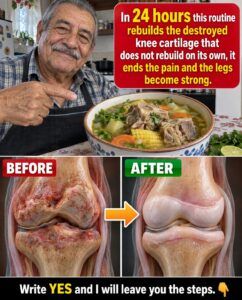
Knee pain can make even the simplest things exhausting: getting up from a chair, walking a few blocks, or climbing stairs. That’s why, when a promise to “rebuild cartilage” in just 24 hours appears, it’s easy to get carried away. The problem is that this idea sounds faster than actual biology, and it often ends up generating false expectations and frustration. The good news is that there are strategies that can reduce pain, improve mobility, and protect the knee, but the real solution is rarely miraculous. And at the end of this article, I’ll show you what actually makes sense to do starting today, without falling for empty promises.
The short answer: no, cartilage does not regenerate in 24 hours
Articular cartilage is the smooth tissue that covers the ends of bones within a joint. Its function is to help the knee glide with less friction. When it wears down, as occurs in osteoarthritis, the joint not only loses cartilage but can also be affected by the bone, synovial membrane, and other tissues.
This means that a damaged knee doesn’t “rebuild” itself overnight with soup, a supplement, or a home workout routine. Evidence-based medicine doesn’t support that idea. In fact, the NIAMS explains that managing osteoarthritis focuses on reducing pain and stiffness and improving function through exercise, strengthening, weight management when appropriate, and other treatments.
Why a “miraculous” promise sounds so convincing
Because it taps into a very human need: the desire to walk again without pain and without depending on anyone. Furthermore, when someone has already tried several remedies without success, it’s normal to cling to any option that promises quick relief. But that urgency can also make us vulnerable to exaggerated messages.
The uncomfortable truth is this: relieving symptoms is not the same as regenerating tissue. You may feel better after resting, using heat or cold, doing gentle exercises, or taking prescribed medication, and yet the cartilage may still remain the same. That doesn’t invalidate the improvement; it just means that the pain and the structure don’t always change at the same rate.
What can be improved in a short time
There are real changes that can appear in days or weeks, even if they aren’t as dramatic as “creating new cartilage.” Pain may decrease, stiffness may lessen, and confidence in movement may increase. That’s already a huge victory for many older adults.

According to the NIAMS, exercise can reduce pain and stiffness, as well as improve flexibility, muscle strength, and endurance. And that matters a lot, because a more stable knee usually feels safer when walking.
Improvements that are possible
Among the more realistic benefits are:
- Less pain when walking or getting up.
- More strength in thighs and hips.
- Better balance and stability.
- Less stiffness in the morning.
- Easier to go up or down steps.
But here’s the important point: these improvements don’t mean the cartilage has grown back. They mean the knee’s function is improving, and that matters too.

Bone soup does not rebuild the knee
A nutritious soup can provide protein, minerals, and fluids. That’s fine. The problem arises when it’s claimed that this food “repairs” damaged cartilage. There’s no solid evidence that the collagen or gelatin in soup travels directly to the knee and becomes new cartilage within 24 hours.
The body digests proteins and breaks them down into amino acids. These nutrients can help maintain tissues, but they don’t magically repair damaged joints. Therefore, it’s important to distinguish between two different concepts: nourishing the body properly and regenerating cartilage .
Muscle can be just as important as joint
After age 70, many people feel their knees “giving out,” but sometimes the problem isn’t just the cartilage. The quadriceps, the thigh muscle, helps stabilize the knee. When it’s weak, getting up from a chair or walking can become more difficult.

The good news is that strength can be trained. The NIAMS recommends strengthening exercises with weights or resistance bands to support joints affected by osteoarthritis. This can reduce the load on the knee and improve mobility.
Exercises that are usually recommended
The exercises should be adapted to the condition of the knee and the person’s overall health. Among the most commonly used options are:
- Gentle walking, if tolerated.
- Stationary bike.
- Swimming or aquatic exercises.
- Tai chi.
- Work of balance and agility.
- Strengthening with elastic bands or light weights.
The key is to start slowly. An overly intense program can worsen pain and cause the person to give up. If there is significant weakness, recent falls, or severe pain, a physical therapist can help choose safer exercises.
Body weight also influences the knee
The knee bears weight every time we walk. Therefore, when overweight or obese, losing some weight can reduce stress on the joint. The NIAMS notes that weight management can help reduce pain and improve mobility.
But this doesn’t mean that everyone with knee pain should lose weight. In very thin older adults or those with muscle loss, the problem can be the opposite: lack of muscle mass and low physical reserve. Therefore, it’s not advisable to apply the same recommendation to everyone.
What about glucosamine and chondroitin?
These supplements are popular because they are related to cartilage. This has led many people to believe that taking them helps rebuild the joint. However, the evidence is not so clear.
The NCCIH explains that studies on glucosamine and chondroitin in knee osteoarthritis have yielded inconsistent results. Even when structural changes have been assessed over years, the findings have been inconclusive. If, after so much time, the evidence remains questionable, it is unreasonable to promise a 24-hour reconstruction.
| Viral claim | What the evidence shows |
|---|---|
| A soup rebuilds cartilage in 24 hours | Not proven |
| Protein helps maintain muscle | Yeah |
| Strengthening muscles helps the knee | Yeah |
| Exercise reduces pain and stiffness. | Yeah |
| Glucosamine regenerates cartilage | It has not been proven |
Note: “natural” does not always mean “safe”
Some supplements can interact with medications. The NCCIH warns, for example, that glucosamine and chondroitin can interfere with warfarin, a blood thinning agent frequently used in older adults. Furthermore, supplements do not always have the same quality, dosage, or purity.
This is especially important if the person is taking multiple medications. Before starting any supplement, it’s best to consult a doctor or pharmacist. Sometimes, what seems like a helpful remedy ends up creating a new problem.
When to consider something more serious than “normal wear and tear”
Not all knee pain after age 70 is osteoarthritis. It could also be bursitis, tendinitis, a meniscus tear, gout, inflammatory arthritis, infection, or even a fracture. That’s why sudden pain requires a different evaluation than pain that has been developing gradually for years.
If your knee is very red, hot, extremely swollen, or if you have a fever, you should seek medical attention as soon as possible. And if you fell or can’t put weight on your leg, it’s also important to have it assessed immediately.
What to do today if your knee hurts and limits your daily life
Effective medicine doesn’t always sound spectacular, but it works better than a viral promise. If the goal is to walk more safely and with less pain, these steps often make more sense than searching for a miracle cure.
- Confirm the cause of the pain with a healthcare professional.
- Begin gentle, low-impact strengthening exercises.
- Check if body weight is increasing the load on the knee.
- Ask about appropriate physiotherapy, supports, or medications.
- Consider surgery only if pain and limitations remain significant despite treatment.
The realistic goal is not to have a “like new” knee tomorrow; it is to regain function, safety and autonomy step by step.
The most important thing to remember
The idea of rebuilding knee cartilage in 24 hours is not supported by science. A soup, a supplement, or a viral workout routine may be part of a healthy lifestyle, but they don’t replace real biological processes or individualized medical treatment.
What is supported by evidence is less flashy, but far more useful: progressive exercise, muscle strengthening, low-impact activity, weight management when appropriate, and proper medical evaluation. This can help reduce pain, improve mobility, and maintain independence.
Frequently Asked Questions
Does bone broth regenerate cartilage?
There is no evidence that bone broth rebuilds lost cartilage. It may provide nutrients, but that doesn’t equate to regenerating a damaged joint.
Is it possible to improve a knee without surgery?
Yes. Many people improve with exercise, strengthening, physical therapy, weight management when appropriate, and medication prescribed by a healthcare professional. Surgery is reserved for cases where other measures have not been sufficient.
Does glucosamine rebuild cartilage?
It has not been proven. Studies on glucosamine and chondroitin have shown inconsistent results for both symptoms and potential structural changes.
Conclusion
If someone promises to rebuild knee cartilage in 24 hours, be wary. Biology doesn’t work that fast. What does work, albeit more slowly, is a realistic and personalized approach: improve your mobility, strengthen the muscles that support your knee, manage your weight when necessary, and seek medical attention if the pain becomes too debilitating.
In other words, the goal isn’t to find a magic bullet. It’s to gradually reclaim daily life, step by step, with strategies that are backed by science.
Medical disclaimer: This content is for educational purposes only and is not a substitute for professional medical advice. Consult a doctor if knee pain worsens, limits mobility, or occurs with severe swelling, redness, warmth, fever, inability to bear weight on the leg, or after a fall.


