
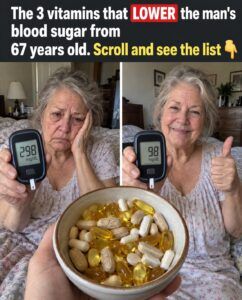
A blood sugar level near 300 mg/dL can be frightening for anyone, especially when social media promises that “three vitamins” will lower it quickly and safely. The problem is that this type of message oversimplifies a potentially serious situation, particularly for people with diabetes or those over 65. Yes, vitamins are important for health, but such a high level cannot be safely corrected with miracle capsules. And here’s what almost no one mentions: chasing a quick drop without understanding the underlying cause can actually worsen the problem.
A glucose level of 298 mg/dL is not something to ignore.
A glucometer shows your glucose level at that moment, not your complete history. That reading can rise due to recent food intake, an infection, stress, certain medications, or poorly controlled diabetes. Therefore, a single reading shouldn’t be taken as a death sentence, but neither should it be considered unimportant.
The reality is simpler and more serious: repeatedly high glucose levels warrant medical attention. In older adults, the goal isn’t always to reach the “perfect” number, but rather to maintain a safe level and avoid immediate complications.
What the evidence says about vitamins and blood sugar
The idea that vitamins C, D, and E can normalize glucose levels within 24 hours is not supported by scientific evidence. Institutions such as the National Center for Complementary and Integrative Health (NCCIH) have reviewed studies on supplements in diabetes and concluded that, although some findings show small changes, the quality of the evidence is generally low and the effects are not comparable to those of established treatments.
The key is not whether a vitamin “sounds” healthy, but whether it actually lowers glucose in a clinically useful way.
And that’s the point: one thing is to correct a nutritional deficiency, and quite another is to use vitamins as if they were insulin or diabetes medication.

Vitamin D: useful if there is a deficiency, but it is not a quick fix.
Vitamin D plays a role in many bodily functions, and correcting a deficiency can be important. Low vitamin D levels have also been linked to an increased risk of type 2 diabetes. However, this association doesn’t mean that taking more vitamin D will quickly or effectively lower blood sugar.
Some studies have found small improvements in A1C or glucose levels when supplementation lasts for weeks or months, not hours. That difference matters a lot. A modest, long-term improvement is not an immediate solution for a glucose level of 298 mg/dL.
Vitamin C: necessary, but does not replace treatment
Vitamin C is essential and easily obtained from foods like citrus fruits, guava, bell peppers, tomatoes, and various other fruits and vegetables. However, its health benefits do not make it a treatment for diabetes.

The studies reviewed so far do not support the claim that vitamin C lowers blood glucose quickly or sufficiently to replace medication. Taking more does not mean you get more benefit. In fact, when trying to “fix” high blood glucose with supplements, the risk is delaying appropriate treatment.
Vitamin E: antioxidant, not sugar “quencher”
Vitamin E also plays important roles in the body and has been studied for its antioxidant properties. However, its interesting biological mechanism does not prove that it significantly reduces glucose levels.
The available evidence does not support using vitamin E as a routine strategy for managing diabetes. In other words, it can be part of a balanced diet, but it does not eliminate excess sugar from the body.

Be careful with chromium, magnesium, and alpha-lipoic acid.
Many viral posts mix vitamins with minerals and other compounds to sell the idea of a “natural combo” against sugar. But not everything in a bottle is a vitamin, and not everything marketed as natural is safe.
For example, chromium is a mineral, not a vitamin. Some studies suggest possible small improvements in glucose or insulin resistance, but the results are inconsistent. Furthermore, high doses have been linked in some cases to kidney or liver damage.
Alpha-lipoic acid is also heavily promoted. However, reviews of studies have not shown it to be any better than a placebo at reliably lowering glucose. In other words, it may sound promising, but the evidence doesn’t support it as many advertisements suggest.
Quick comparison: viral promise vs. real evidence
| Viral promise | What the evidence shows |
|---|---|
| “Three vitamins lower blood sugar in 24 hours” | Not proven |
| “They work faster than medications” | Not proven |
| “Correcting a deficiency can help” | Yes, when there is a deficiency |
| “They replace diabetes treatment” | No |
The difference between “it might help a little” and “it works as a treatment” is enormous. And in health, that difference can completely change the outcome.
After age 65, the target is not always 98 mg/dL
This point is especially important. In older adults, glucose goals should be individualized. The American Diabetes Association (ADA) recommends adjusting targets based on overall health, frailty, other medical conditions, cognitive function, and risk of hypoglycemia.
For some relatively healthy older adults, closer monitoring may be reasonable. But for others, the priority is avoiding dangerous drops and troublesome symptoms. It’s not about reaching the lowest possible number, but the safest one for that individual.
A “nice” reading on the glucometer is not always a healthy reading if it was achieved at the cost of hypoglycemia.
Lowering blood sugar too quickly can also be dangerous.
When blood glucose levels drop too low, especially below 70 mg/dL, symptoms such as tremors, sweating, hunger, weakness, dizziness, confusion, and even loss of consciousness can occur. In older adults, these episodes can be more severe and more difficult to detect early.
Therefore, the goal should not be to “lower it at all costs.” The goal is to correct the cause of hyperglycemia safely, with follow-up and, when necessary, with well-adjusted medications.
What really helps control diabetes
The good news is that there are concrete actions that truly help. They’re not magic, but they work better than relying on viral sensationalism.
Here are the most important ones:
- Take the medications exactly as prescribed.
- Review the treatment if the numbers remain high.
- Reduce sugary drinks and large portions of refined carbohydrates.
- Choose foods with more fiber, such as vegetables, legumes, and whole grains.
- Do physical activity adapted to each person’s ability.
- Sleep well and control stress, infections, and other illnesses.
- Review A1C and blood glucose levels with your healthcare professional.
And yes, vitamins can be part of this plan when there is a real need. But they don’t replace the primary treatment for diabetes.
Practical steps if your glucose is high today
If a reading comes back very high, the first thing to do is not to panic. The second is not to assume that a supplement will fix it on its own. The most helpful thing is to act systematically.
- Repeat the measurement to confirm the result.
- Check if you ate recently, if you are sick, or if there was severe stress.
- Drink water if you have no medical restriction on fluids.
- Do not stop taking insulin or other medications on your own.
- Contact your doctor if the numbers remain high or recur.
- Seek urgent care if there is vomiting, confusion, difficulty breathing, dehydration, or marked drowsiness.
This order matters because persistently high glucose levels can be a sign of imbalance, not a vitamin deficiency.
Supplements can also interact with medications
Another common mistake is thinking that “natural” equals “safe.” This isn’t always the case. Some supplements can interact with medications for diabetes, blood pressure, or kidney disease. Others can affect the liver or kidneys, which is especially concerning for people with diabetes.
If you take vitamins, minerals, concentrated teas, powders, or products to “control blood sugar,” it’s a good idea to tell your doctor or pharmacist. This information can help prevent interactions and adverse effects.
Conclusion
There is no solid evidence that three vitamins can lower very high blood sugar to normal levels within 24 hours or that they work faster than diabetes medication. Vitamin D may be helpful if there is a deficiency, and some vitamins or minerals have shown small benefits in studies, but that doesn’t make them a primary treatment.
If blood glucose levels approach 300 mg/dL, the important thing is not to look for a miracle pill, but to understand why they are so high and adjust management safely. In older adults, goals should also be individualized to avoid both hyperglycemia and hypoglycemia.
Vitamins correct deficiencies. Treating diabetes, however, requires strategy, monitoring, and evidence-based decisions.
Frequently Asked Questions
Which vitamin lowers blood sugar the fastest?
No vitamin has been shown to reliably lower high blood sugar quickly. Some may offer modest help in certain cases, but they are not a substitute for medical treatment for diabetes.
Does vitamin D help if I have diabetes?
It may be helpful if there is a vitamin D deficiency. However, evidence does not show that it quickly normalizes glucose levels. Its effect, when it occurs, is usually small and long-term.
Can I stop taking my medication if I start taking vitamins?
No. Stopping or reducing diabetes medication on your own is not recommended. Doing so can increase the risk of serious complications.
Medical notice: This content is educational and does not replace the evaluation of a healthcare professional. If your blood sugar remains very high or you experience vomiting, difficulty breathing, dehydration, confusion, or drowsiness, seek urgent medical attention.


