
You watch the video, see the “before and after,” and for a moment you feel like maybe there really is a quick way to get your skin back. But when you try it at home, the reality is usually quite different: burning, oiliness, dryness, or simply no real change. And the worst part is that you often end up blaming yourself, when the problem wasn’t your face, but the exaggerated promise of the ad. The good news is that there is a sensible way to use petroleum jelly without resorting to tricks that irritate your skin. And there’s an important detail that almost no one explains, and it can completely change how you use it at night…
Why does that ad become so convincing?
Viral images aren’t meant to educate, but to shock. A photo with studio lighting, a filter, and freshly moisturized skin might make fine lines appear less noticeable for a few hours, but that doesn’t mean the skin has “turned back in time.”
The truth is, the brain responds strongly to visual comparison. If you already feel tired, dry, or worried about wrinkles, an ad like this strikes a very sensitive emotional chord: the idea of looking better effortlessly. And of course, that sells.
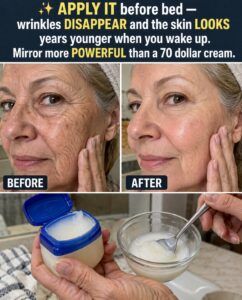
But that’s not the same as a real and sustained result.
Simply put, petroleum jelly doesn’t erase deep wrinkles. What it does is form a layer that helps prevent water from escaping the skin as quickly. This can make your face look smoother when you wake up, but it doesn’t change the skin’s structure overnight.
What does petroleum jelly actually do to the skin?
Pharmacy-grade petrolatum contains purified petrolatum, an ingredient considered occlusive in dermatology. This means it acts as a protective film on the skin and reduces water loss.

Several dermatological studies and reviews have shown that petrolatum is one of the most effective occlusives for helping to retain moisture. Simply put: if your skin already has moisture, petroleum jelly helps to “seal it in.”
However, the effect is temporary and depends on the condition of your skin before applying it. If your face is very dry, irritated, or dehydrated, petroleum jelly alone won’t solve the underlying problem.
In other words, it can be helpful, but it’s not a miracle anti-aging treatment.

What it can help achieve
When used correctly, petroleum jelly can:
• Reduces the feeling of tightness in dry skin.
• Makes skin look smoother upon waking.
• Helps protect very dry or sensitive areas.
• Serves as a final step after applying a moisturizer.
What you cannot do
And here it is important to be very clear:

• It doesn’t produce new collagen.
• It doesn’t erase deep wrinkles.
• It doesn’t replace sunscreen.
• It doesn’t correct accumulated sun damage.
• It doesn’t turn a neglected routine into an effective anti-aging routine.
Why mature skin looks more tired over time
Over the years, skin produces less natural oil, loses water more easily, and becomes thinner. In women, menopause can accentuate dryness due to decreased estrogen levels, which also affects collagen and elasticity.
Added to this is something very common in Mexico and much of Latin America: intense sun, heat, dry air, fans, air conditioning, and harsh cleansing routines. All of this gradually wears down the skin’s barrier.
Skin doesn’t look tired for just one reason, but for the sum of several small habits.
And here’s an uncomfortable truth: often it’s not that the skin is “ruined,” but rather that it’s being treated as if it were resistant to everything. Very hot water, harsh soap, toweling, and unremoved makeup can make your face look worse, not better, in the morning.
The viral mix with salt or sugar: why it’s not a good idea
One of the most dangerous mistakes is mixing petroleum jelly with salt, sugar, or other grains to “exfoliate and seal” at the same time. It sounds practical, but on mature skin, it can be a bad idea.
Salt and sugar are abrasive. When rubbed on the face, they can cause micro-irritations, redness, and increased sensitivity the next day. And if an oily layer is applied on top, the skin may feel “smooth” for a few hours, even though it’s actually irritated.
The feeling of smooth skin doesn’t always mean healthy skin. Sometimes it means the skin is inflamed or temporarily overhydrated.
According to dermatological logic, a good nighttime routine should protect the skin barrier, not irritate it. Therefore, if something burns or itches, it’s not a sign that it’s “working”; it’s a sign that you should stop.
How to safely use petroleum jelly on your face
If your skin tolerates it, petroleum jelly can be used as a final step, in a very thin layer, especially on dry areas. You don’t need to apply much to notice the occlusive effect.
The key is in the order. First, gently cleanse the skin, then apply a moisturizer, and if necessary, finally apply a small amount of petroleum jelly to seal in the moisture.
That order matters more than it seems. Putting Vaseline on dirty, irritated skin or skin with makeup residue doesn’t fix anything; it just seals in what was already there.
A simple nighttime routine that actually makes sense
1. Remove makeup and powder with a gentle cleanser or micellar water.
2. Wash your face with lukewarm water, never hot.
3. Pat dry gently, without rubbing.
4. Apply a simple moisturizer that your skin already tolerates.
5. If your skin is very dry, apply a thin layer of petroleum jelly at the end, just as a seal.
If you are undergoing treatment prescribed by a dermatologist, you should follow the doctor’s instructions for that product. Petroleum jelly does not replace or improve professional treatment on its own.
Common mistakes that dry out your face without you noticing
Often the problem isn’t the petroleum jelly itself, but everything done before and after applying it. And that’s important because correcting these details can improve your skin much more than following a viral video.
Here are some common mistakes:
• Using very hot water on your face.
• Washing your face with body soap or laundry soap.
• Rubbing your face with a towel as if you were scrubbing a garment.
• Sleeping with makeup or foundation on.
• Exposing yourself to the sun without daily sunscreen.
• Thinking that more product always means better results.
Air conditioning, direct fan use, smoking, and lack of sleep also contribute to dry or irritated skin. All of these factors dry out or irritate the skin more than many people realize.
What you can do to look less tired
The interesting part is this: the most visible changes usually come from simple, consistent habits, not from a one-night trick.
If you want to start today, do this:
• Gently cleanse your face at night.
• Switch from hot water to lukewarm water.
• Use a basic moisturizer that won’t sting.
• If needed, seal in a thin layer of petroleum jelly.
• Apply sunscreen every morning, even if it’s cloudy.
• Get plenty of sleep, because your skin repairs itself while you sleep.
Dermatological studies have shown that the skin barrier responds better when constant irritation is reduced. In other words, the skin improves more by ceasing to irritate it than by trying to forcefully “fix” it.
The routine that actually works is usually boring, but it’s also the most reliable.
Quick comparison: viral ad vs. useful routine
To see it more clearly, compare this:
• Viral ad: promises immediate change.
• Helpful routine: gradual and realistic improvement.
• Viral ad: mixes ingredients without context.
• Helpful routine: respects the skin barrier.
• Viral ad: aims to impress.
• Helpful routine: aims to care.
The difference may seem small, but in practice it makes all the difference. One sells quick hope; the other protects your skin in the long run.
Conclusion
Petroleum jelly can help seal in moisture and temporarily soften dry skin, but it doesn’t erase wrinkles or reverse aging. If used alone, on damaged skin, or mixed with salt or sugar, it can cause more irritation than benefit.
The best strategy is simple: cleanse gently, moisturize well, seal in product only if needed, and protect your skin from the sun every day. That delivers more real results than any viral video.
If you want to look less tired, start by taking care of your skin barrier. That’s the change that will really show over time.
Frequently Asked Questions
Can I use Vaseline on my face every night?
Yes, many people with dry skin tolerate it well in a thin layer, especially as the last step after moisturizing. If you experience breakouts, it feels heavy, or it irritates your skin, you should stop using it or only use it on dry areas.
Does petroleum jelly remove wrinkles?
It doesn’t remove deep wrinkles. What it does is retain moisture and temporarily improve the appearance of fine lines caused by dryness.
Is it a good idea to mix petroleum jelly with sugar or salt?
It’s not recommended, especially for mature or sensitive skin. The bumps can scratch and irritate, which can worsen dryness or redness.
Disclaimer: This content is for informational purposes only and is not a substitute for professional medical or dermatological advice. If you have rosacea, dermatitis, wounds, persistent burning, or a new skin reaction, seek professional help before using any product on your face.


