
Seeing hair in the shower, on your pillow, or in your brush can be frustrating and even alarming. And when someone promises a “quick fix” with papaya leaves, it’s easy to get carried away with hope. The problem is that hair loss often has several causes, which makes miracle cures sound tempting just when we feel most vulnerable. The good news is that there are habits, ingredients, and care practices that can support a healthier scalp without resorting to exaggerated promises. Stick around, because at the end I’m going to show you how to distinguish what really helps from what’s just selling wishful thinking.
Why does hair fall out and why shouldn’t you rely on “magic solutions”?
Hair loss can be caused by stress, hormonal changes, tight hairstyles, excessive heat, nutritional deficiencies, or simply genetics. For many people, the problem isn’t a lack of a specific product, but rather a combination of factors at play.
That’s why, when you see posts promising spectacular results in minutes, it’s worth pausing for a second. The reality is that hair doesn’t visibly and permanently change in 20 minutes. What can happen, however, is that a cosmetic treatment leaves hair softer, shinier, or easier to style.
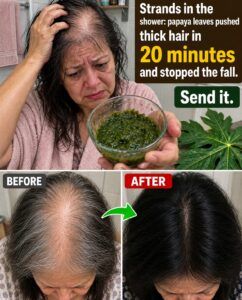
That doesn’t mean it’s solving the underlying cause.
Are papaya leaves good for hair?
Papaya is a fruit known for containing enzymes like papain, as well as antioxidants and other plant compounds. While it’s often touted online for its benefits to the skin and scalp, direct scientific evidence regarding its ability to stop hair loss is limited.
Some natural ingredients can provide a pleasant cosmetic sensation, which explains why some people feel their hair is “softer” after using them. But a temporary sensation is not the same as a real change in hair density.

According to scientific reviews on hair health, the most reliable results usually come from identifying the cause of hair loss and addressing it, not from relying on isolated home remedies. In other words: if something sounds too good to be true, it probably is.
What a properly used homemade face mask can do
However, not everything natural is useless. A well-formulated homemade hair mask can help improve hair texture, reduce dryness, and make hairstyles look neater. That’s valuable to many people.
But there is an important difference between cosmetic care and treating a medical or nutritional cause . The former improves appearance; the latter requires evaluating the root of the problem.
These are some of the things that good hair care can provide:
- Less friction when combing.
- Hair with a shinier appearance.
- Less dryness in the mid-lengths and ends.
- A more comfortable scalp feeling.
Signs that hair loss needs more attention
Not all hair loss is the same. Sometimes it’s temporary, but in other cases, it’s advisable to seek professional advice. If you notice a significant or persistent change, don’t normalize it.
Pay attention if any of these situations occur:
- More hair than usual falls out for several weeks.
- You see areas with less density or more visible areas.
- Hair breaks easily.
- There is itching, burning, flaking, or redness on the scalp.
- The hair loss appeared after an illness, childbirth, a very restrictive diet, or a lot of stress.
The Mayo Clinic and other reputable medical sources indicate that hair loss can have multiple causes, and identifying the pattern helps in choosing the right approach. That’s key to saving time and money.
Quick comparison: viral remedy vs. helpful approach
This chart helps you see the difference between an eye-catching promise and more realistic care.
| Viral remedy | Useful approach |
|---|---|
| It promises quick results. | It aims to improve hair gradually. |
| It focuses on a single mix. | Consider diet, stress, and habits |
| He talks about extreme “before and after” situations. | Evaluate real and sustainable changes |
| It sounds miraculous | It sounds simple, but it’s more reliable |
How to care for your hair from today without going overboard
The most useful part of all this is that you can make concrete changes starting today. You don’t need a complicated routine or expensive products. The important thing is to be consistent.
Step 1: Wash your hair as often as your scalp needs. If it gets oily quickly, don’t leave it for days on end for fear of “stripping it of its natural oils.”
Step 2: Use a lightweight conditioner on the mid-lengths and ends to reduce breakage and friction.
Step 3: Avoid very tight hairstyles, because repeated tension can weaken hair over time.
Step 4: Reduce the use of intense heat. If you use a hairdryer or iron, apply heat protectant and lower the temperature.
Step 5: Review your diet. Hair needs sufficient protein, iron, zinc, and other nutrients to grow normally.
Step 6: If the hair loss is persistent, seek a professional evaluation to identify the cause. This saves months of trial and error.
What if you want to try something natural?
If you like using natural ingredients, do so with realistic expectations. Use them as a cosmetic aid, not as a promise to “restore” your hair overnight. And always test on a small area of skin first to rule out irritation.
Also, avoid applying homemade mixtures to an irritated, wounded, or very sensitive scalp. Natural remedies can also cause discomfort if not used carefully.
The key is not to believe every video, but to choose what makes sense for your situation.
What the evidence says about hair growth and loss
Scientific research on hair shows that hair growth is influenced by genetics, hormones, nutrition, scalp inflammation, and hair care habits. Therefore, the most reliable solutions are usually those that address the problem holistically.
Some dermatological reviews have found that certain ingredients and treatments can support hair health in specific contexts, but there is no one-size-fits-all solution. That’s why it’s wise to be wary of sweeping generalizations.
In short: if content promises density, volume, and a drop-off time in minutes, it’s oversimplifying a complex problem.
A practical summary so you don’t get lost among so many tips
If you’re worried about hair loss today, remember this: first, identify whether the problem is occasional or persistent; then, review your habits, diet, and daily care; and finally, if the hair loss continues, seek professional advice. That’s much more helpful than chasing a viral promise.
Papaya leaves may sound interesting, but on their own they don’t replace a proper evaluation or guarantee real changes in your hair. What does work is a consistent, simple, and evidence-based strategy.
Frequently Asked Questions
Do papaya leaves really stop hair loss?
There is no solid evidence to show that papaya leaves reliably stop hair loss. They can be part of a cosmetic treatment, but should not be seen as a primary solution.
When should I worry about hair loss?
If you notice significant hair loss for several weeks, areas with less density, itching, flaking, or sudden changes, it is advisable to seek professional guidance.
What’s the first thing I can do at home?
Start by reviewing your routine: avoid tight hairstyles, reduce heat, use conditioner, take care of your diet, and see if the hair loss changes over time.
Disclaimer: This content is for informational purposes only and does not replace the evaluation of a healthcare professional; if you have persistent hair loss or scalp symptoms, consult a specialist.


