
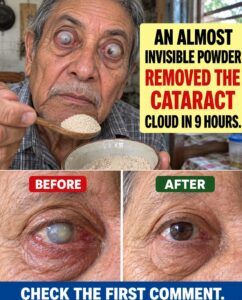
Seeing an ad that promises to remove the “clouding” of cataracts in hours immediately sparks hope. And fear, too, because when your vision starts to fail, any quick fix sounds tempting. The problem is that many viral posts combine shocking images with overly optimistic promises. This is confusing, delays proper care, and leads many people to waste time and money on something that isn’t well-supported. The good news is that there are real ways to care for your vision and understand what’s true, what’s exaggeration, and what signs you shouldn’t ignore. At the end of this article, I’ll reveal how to detect in seconds whether a cataract “cure” is reliable or just marketing in disguise.
What are waterfalls really?
Cataracts are not a “spot” that can be wiped off with powder or dirt that can be peeled off the eye. They are a clouding of the lens, the eye’s natural lens. When this lens becomes cloudier, vision can appear blurry, dull, or as if there is a veil in front of the eyes.
This usually progresses gradually. That’s why many people get used to seeing poorly and don’t realize how much they’ve lost until they have trouble reading, driving at night, or recognizing faces.
Yes, it’s frustrating. But understanding this helps you avoid falling for misleading promises.
Why do “before and after” ads attract so much attention?
Before-and-after photos trigger a strong emotional response. The brain thinks, “If it worked that quickly, I want that too.” And that’s the trick. A visual testimonial alone doesn’t prove that a product is safe, useful, or approved.
Furthermore, social media uses phrases like “almost invisible,” “in 9 hours,” or “look at the first comment” to pique curiosity. That’s not medical evidence. It’s a strategy to get you to click before you think.
The reality is this: when something sounds too fast, too easy, and too spectacular, it deserves a more careful review.
Is there a powder that removes cataracts?
To date, there is no solid scientific evidence to support any homemade or commercially available powder that eliminates cataracts in a matter of hours. Medical and ophthalmological organizations agree that cataracts do not disappear with “instant” remedies.
Serious clinical studies do not show that any miracle supplement, powder, or drop can reverse an existing cataract. Some substances may help with overall eye health, but that’s not the same as clearing a cloudy lens.
In other words: supporting visual health is one thing, but promising a quick reversal of an eye condition is quite another.
What reliable medical sources do say
The American Academy of Ophthalmology and other recognized medical sources indicate that the definitive treatment for advanced cataracts is usually surgical, when the doctor determines that vision is already affecting daily life. They also explain that there are no proven eye drops to “dissolve” established cataracts.
Some studies have explored antioxidants, lifestyle habits, and managing diseases like diabetes to reduce risks or slow progression, but that doesn’t equate to a miracle cure. And here’s the important point: preventing or slowing is not the same as curing.
Warning signs in viral eye products
If a product promises spectacular results, check for these signs:
- It promises changes in hours or a few days.
- Use emotional testimonials instead of clinical data.
- It does not explain the ingredients clearly.
- It does not mention health approval or verifiable evidence.
- It pressures you with phrases like “only today” or “look at the pinned comment”.
When several of these signs appear at the same time, it’s worth pausing. Your eye health is worth more than an impulsive purchase.
What you can do if you notice blurred vision
If you feel like your vision is blurry, don’t panic, but don’t ignore it either. Blurry vision can have several causes: cataracts, dry eye, changes in prescription, diabetes, or other eye problems. Only a professional eye exam can tell you what’s going on.
Meanwhile, there are simple actions that do help take care of your eyes:
- Schedule an appointment with an ophthalmologist or optometrist.
- Use glasses with the correct prescription if you have already been prescribed them.
- Protect your eyes from the sun with UV filter lenses.
- It controls diseases such as diabetes and hypertension.
- Do not use drops or powders without professional guidance.
These measures don’t promise miracles, but they do reduce risks and bring you closer to a real solution.
The difference between preventing, relieving, and treating
This part is key because many publications confuse the terms. Prevention means reducing the risk of something appearing or progressing. Relief means lessening discomfort. Treatment means addressing the underlying cause or the problem that is already present.
A product can help with general prevention, but that doesn’t mean it treats cataracts. And if an advertisement mixes those ideas, it’s probably exaggerating.
| Aim | What does it mean | Realistic example |
|---|---|---|
| Prevent | Reduce the risk | Wear UV sunglasses and monitor your glucose levels |
| Relieve | Reduce discomfort | Treat dry eye if present |
| Treat | Take action on the problem | Medical evaluation and, if appropriate, cataract surgery |
What to do step by step if you saw an ad like this
If you’ve come across a video or post promising quick results, follow this simple plan:
1. Pause before sharing or buying. Don’t make impulsive decisions.
2. Look for the source. Check if the product has real medical backing, not just reviews.
3. Check the language. If it promises “in hours” or “without fail,” be suspicious.
4. Consult a professional. If you have symptoms, a check-up is worth more than any advertising.
5. Save your money for what’s useful. Examinations, proper lenses, and medical follow-up are often much more valuable than a dubious remedy.
This is the point that many overlook: not everything natural, viral or “homemade” is safe for the eyes, and the eyes do not forgive experiments.
When should you seek medical attention soon?
If you experience sudden blurred vision, eye pain, severe sensitivity to light, flashes of light, vision loss, or a rapid change in your vision, seek medical attention as soon as possible. Don’t wait for an internet product to “work.”
It’s also a good idea to have your eyes checked if you have diabetes, a family history of cataracts, or if you notice that light dazzles you more than usual.
Conclusion
Advertisements promising to remove cataracts with a nearly invisible powder in just a few hours often rely on emotion, not evidence. Cataracts are a real problem with the lens of the eye, and their treatment should be based on reliable information and professional evaluation. If something seems too good to be true because it’s so quick and spectacular, stop and investigate. Your eyesight deserves careful decisions, not viral promises.
Frequently Asked Questions
Can cataracts be removed with drops or powders? There is no solid evidence that drops or powders remove cataracts that have already formed. A medical evaluation is essential.
Do cataracts always require surgery? Not always immediately. It depends on how much they affect your daily life and what the ophthalmologist recommends.
What can I do to protect my eyesight if I’m at risk for cataracts? Use UV protection, manage conditions like diabetes, avoid smoking, and get regular eye exams.
Medical note: This content is for informational purposes only and does not replace the evaluation, diagnosis, or treatment of a healthcare professional.


