
What Is Vicks VapoRub?
Vicks VapoRub is a topical ointment traditionally used to provide temporary relief from cough associated with the common cold and minor aches and pains in muscles and joints.
Its active ingredients include camphor, eucalyptus oil, and menthol. These ingredients create the familiar cooling and aromatic sensation associated with VapoRub.
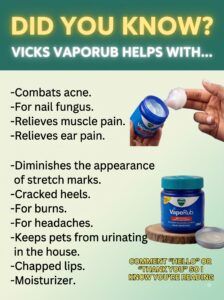
Because the product has been around for generations, many people also use it for purposes that go beyond its labeled indications. Some of these uses are popular household remedies, but they do not necessarily have the same level of evidence or official approval as the labeled uses.
Here are some things worth knowing.
1. It Can Provide Temporary Relief From Minor Muscle Aches
One of the established uses of Vicks VapoRub is topical relief of minor muscle and joint aches and pains.
A small amount can be massaged onto the affected area according to the product directions. The menthol and camphor can create a cooling or warming sensation that may make minor discomfort feel more manageable.
The official VapoRub directions indicate that it can be applied to sore muscles and joints several times a day as directed on the label.
2. It Is Commonly Used for Cold-Related Cough
Vicks VapoRub is primarily formulated as a cough suppressant.
When applied to the chest and throat as directed, the vapors from ingredients such as menthol, camphor, and eucalyptus oil can provide temporary relief from cough associated with a common cold.
It is important to follow the product label rather than applying it to areas that are not recommended.
3. Menthol Creates a Cooling Sensation
One reason VapoRub feels distinctive on the skin is its menthol content.
Menthol produces a noticeable cooling sensation when applied topically. This sensory effect can make an area feel refreshed and may temporarily change how minor discomfort is perceived.
However, a cooling sensation does not necessarily mean that an underlying condition has been treated.
4. What About Cracked Heels?
You may see Vicks VapoRub recommended online as a home remedy for dry or cracked heels.
Because VapoRub contains an ointment base, some people use it as part of a nighttime foot-care routine. However, VapoRub is not officially indicated as a treatment for cracked heels, and it should not be applied to open, damaged, or irritated skin.
For seriously cracked heels, a dedicated foot moisturizer containing ingredients such as urea or petrolatum may be more appropriate.
5. What About Acne?
Another popular internet claim is that Vicks VapoRub can help with pimples.
This is not an established use of Vicks VapoRub. The product contains ingredients such as camphor, menthol, and eucalyptus oil that can irritate sensitive facial skin.
If you have acne, it is generally better to use products specifically formulated for acne-prone skin rather than experimenting with medicated chest rubs.
6. What About Nail Fungus?
You may also find online recommendations suggesting Vicks VapoRub for toenail fungus.
Although this is a popular home-remedy claim, VapoRub’s official labeling does not list nail fungus as an indication.
A persistent thick, discolored, or brittle nail can have several causes. If fungal infection is suspected, an appropriate antifungal treatment and professional evaluation may be more suitable.
7. Should You Use It on Burns?
This is an important point.
Vicks VapoRub should not be used on burns or damaged skin.
The official labeling specifically says not to use the product on wounds or damaged skin.
For a burn, appropriate first aid depends on the severity and type of injury. Avoid applying household ointments that are not intended for burns.
8. What About Earaches?
Some online posts recommend putting Vicks or similar products around the ear for ear discomfort.
However, Vicks VapoRub is not labeled as an earache treatment, and it should not be placed inside the ear canal.
Ear pain can be caused by several different conditions, including ear infections, wax buildup, or irritation. Persistent or severe ear pain should be evaluated by a healthcare professional.
9. Can It Be Used as an Everyday Moisturizer?
VapoRub contains an ointment base that gives it a thick, greasy texture.
That can make some people think of it as a general-purpose moisturizer. However, it is formulated as a medicated topical product, not as a regular facial or body moisturizer.
For everyday dry skin, choose a moisturizer designed specifically for that purpose.
10. A Few Important Vicks VapoRub Safety Rules
Before using VapoRub, keep these precautions in mind:
- For external use only.
- Avoid contact with the eyes.
- Do not swallow it.
- Do not put it inside the nostrils.
- Do not apply it to wounds or damaged skin.
- Do not cover it with tight bandages.
- Do not heat or microwave the product.
- Keep it out of reach of children.
- The product is intended for adults and children 2 years and older, according to Vicks’ current guidance.
If accidentally swallowed, medical help or Poison Control should be contacted promptly.
What Does Vicks VapoRub Actually Help With?
The most important distinction is between officially labeled uses and popular household remedies.
Officially labeled uses include:
✔ Temporary relief of cough associated with the common cold
✔ Temporary relief of minor muscle and joint aches and pains
These are the uses supported by the current product labeling.
Other claims circulating online—such as using VapoRub for acne, nail fungus, burns, earaches, cracked heels, or pet behavior—should not automatically be treated as established medical uses.
Final Thoughts
Vicks VapoRub is much more than a familiar blue jar in the medicine cabinet, but it is also important to separate popular home remedies from the product’s documented uses.
Its active ingredients—camphor, menthol, and eucalyptus oil—are responsible for its characteristic aroma and topical effects. When used according to the label, VapoRub can provide temporary relief from cold-related cough and minor muscle and joint aches.
If you see claims online about using it for skin problems, nail fungus, burns, ear pain, or other conditions, check the product label and consider whether there is appropriate evidence before trying them.
A familiar household remedy isn’t necessarily suitable for every problem. Using it for the purpose it was designed for—and following the safety instructions—is the safest approach.


