
Hair loss can be frustrating, especially when you see more hair on your pillow, in the shower, or in your comb. And when a “fast fix” promise pops up online, it’s easy to get excited and try it without thinking too much. But that’s also where many people end up disappointed, or worse, irritating their scalp with remedies that aren’t right for them. The good news is that there is a smarter way to understand papaya leaves, what they actually offer, and how to use them with realistic expectations. At the end, I’ll show you a little-known detail that completely changes how you try them.
Why are so many people talking about papaya leaves?
Papaya leaves have become popular because they perfectly align with what people want to hear: something natural, affordable, and easy to prepare at home. Furthermore, they’re often featured on social media alongside “before and after” photos, making them seem like an almost instant solution. However, what’s shared online is one thing, and what you can actually expect from a home remedy is quite another.
The truth is that papaya, especially its leaves, contains plant compounds that have been studied for their antioxidant and anti-inflammatory activity. That sounds promising, and in fact, some preliminary studies have explored these components. But that doesn’t mean that papaya leaves alone will guarantee to stop hair loss or stimulate hair follicles.
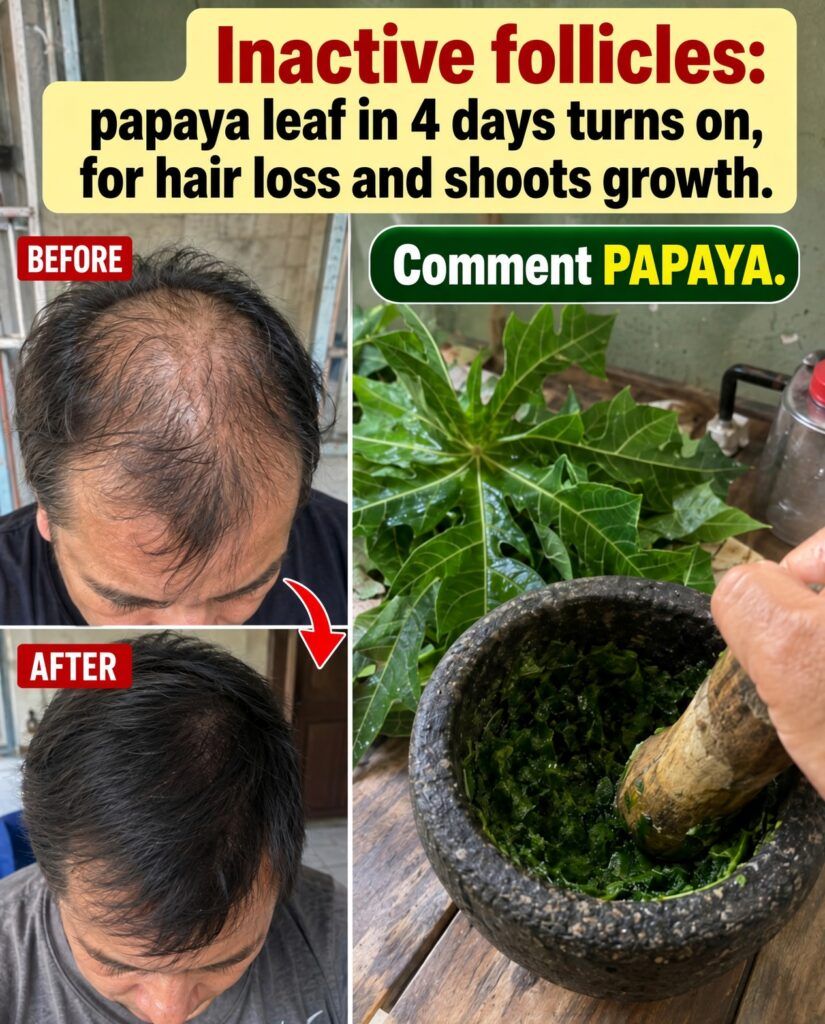
The key is to separate viral enthusiasm from what actually makes sense for scalp care.
What is really known about the papaya leaf
Papaya leaves contain enzymes, flavonoids, and other natural compounds. Simply put, these components may help soothe minor irritation and provide a cleansing sensation to the scalp. This explains why some people feel it “works” for them.
But here’s the important point: feeling a cooler scalp isn’t the same as achieving real hair growth. Hair growth depends on many factors, such as genetics, hormones, nutrition, stress, sleep, and overall health. That’s why, when a product promises spectacular results in 4 days, it’s best to be skeptical.

According to scientific reviews on hair and its growth cycle, visible changes usually take weeks or months, not just a few days. So if someone tries to sell you an instant solution, it’s wise to see it as a red flag, not a guarantee.
Papaya leaf: potential benefits and real limitations
To understand this better, think of papaya leaf as a cosmetic or care aid, not a medical treatment. It may be helpful for some people, but it doesn’t replace evaluating the underlying cause of hair loss.
Here’s a simple comparison:

| What the internet promises | That is something that can reasonably be expected |
|---|---|
| “Activates dormant follicles” | It can provide a feeling of cleanliness and freshness. |
| “Stops the fall in 4 days” | Real changes usually take longer. |
| “It makes new hair grow” | There is no solid evidence that it does so on its own. |
| “It’s useful for everyone” | Not everyone reacts the same way |
And that doesn’t diminish its value. It simply puts it in its proper perspective. A home remedy can be part of a routine, but it shouldn’t become the sole strategy when hair loss is persistent.
Signs your hair loss needs more attention
There are times when it’s no longer advisable to keep trying random recipes. If you notice that hair loss is more intense or that your hair is visibly thinning, it’s worth taking a broader view.
Pay attention if any of these points occur:

- You notice more hair than usual in the shower or on your pillow for several weeks.
- You see areas with less density at the hairline or on the crown.
- Your scalp is very irritated, with frequent itching or flaking.
- The hair loss began after severe stress, a strict diet, fever, or a hormonal change.
- There is a family history of hair thinning.
The truth is that identifying the cause is more important than chasing the latest fad remedy. Often, temporary hair loss improves when the trigger is addressed, while other cases require a more consistent and personalized strategy.
How to use papaya leaves more safely
If you still want to try it, do so with caution. Don’t apply it aggressively or leave it on for hours just because someone on social media recommended it. Your scalp can also become irritated with natural ingredients.
Follow these basic steps:
- Wash the leaves very well before preparing them.
- Do a small test on an area of skin, such as behind the ear, for 24 hours.
- If there is no redness or burning, use a small amount on the scalp.
- Leave it on for a short time at the beginning, between 10 and 15 minutes.
- Rinse with plenty of water and avoid rubbing hard.
If you experience burning, intense itching, redness, or a stinging sensation, discontinue use. This does not mean it is “working”; it means your skin is not tolerating it well.
The part that almost no one tells you: hair grows better with consistency, not with miracles.
This is the most important point of the entire article. Hair doesn’t respond well to the pressure of immediate results. It responds better to sustainable routines, gentle scalp care, and correcting habits that negatively impact its health.
Therefore, if you want to make a real difference starting today, think about a comprehensive strategy, not just a one-off fix. This includes eating a balanced diet, avoiding pulling or tight hairstyles, washing your hair properly, and, if hair loss is significant, seeking a professional assessment.
The most honest promise is not “grow in 4 days”, but “start taking care of your scalp intelligently from today”.
Practical actions you can start today
If you want to move forward without complicating things, here’s a simple and realistic plan:
1. Observe your hair loss for 2 weeks. Take note of when you lose the most hair, if there is stress, changes in diet, or new products.
2. Use a mild shampoo. Avoid harsh formulas if your scalp is sensitive.
3. Reduce excessive heat. Flat irons, very hot hair dryers, and frequent bleaching can weaken hair.
4. Review your diet. Hair needs sufficient protein, iron, zinc, and overall energy to stay strong.
5. Don’t get fixated on just one remedy. Papaya leaf can be a complement, but not the main focus.
6. Seek help if the hair loss persists. If it lasts for several weeks or worsens, a professional checkup can save you time and frustration.
So, does papaya leaf work or not?
The honest answer is: it can be part of a home care routine, but there’s no solid evidence to support it as a quick fix or miracle cure . Some people try it and feel an improvement in their scalp, but that doesn’t equate to proven hair regrowth.
If you’re drawn to it because it’s natural, you can use it sparingly. If your goal is to stop significant hair loss, the smartest approach is not to rely solely on a viral remedy. For hair health, what usually helps most is consistency, a proper assessment, and a routine that doesn’t irritate your skin.
Conclusion
The papaya leaf has become famous because it offers a tempting idea: a simple solution to a common problem. But there’s a big difference between viral marketing and reality. It might be a home remedy, yes, but it’s not a miracle cure.
If you decide to try it, do so carefully, observe how your scalp reacts, and don’t ignore any signs of persistent hair loss. Sometimes, the best approach isn’t to look for the quickest fix, but to understand what your hair truly needs.
FAQ
Does papaya leaf really make hair grow?
There is no solid evidence that it, on its own, makes hair grow in a proven way. It may provide a feeling of care or freshness, but it should not be seen as a guaranteed solution.
How long does it take to see results with the papaya leaf?
If used as a cosmetic aid, some people notice changes in scalp feel within a few days. But actual changes in hair growth usually take weeks or months.
Is it safe for all scalp types?
Not necessarily. Although it’s natural, it can irritate people with sensitive skin. It’s best to do a small patch test before applying it to your entire head.
Disclaimer: This content is for informational purposes only and is not a substitute for professional medical advice; if hair loss is severe, persistent, or accompanied by other symptoms, consult a specialist.


