
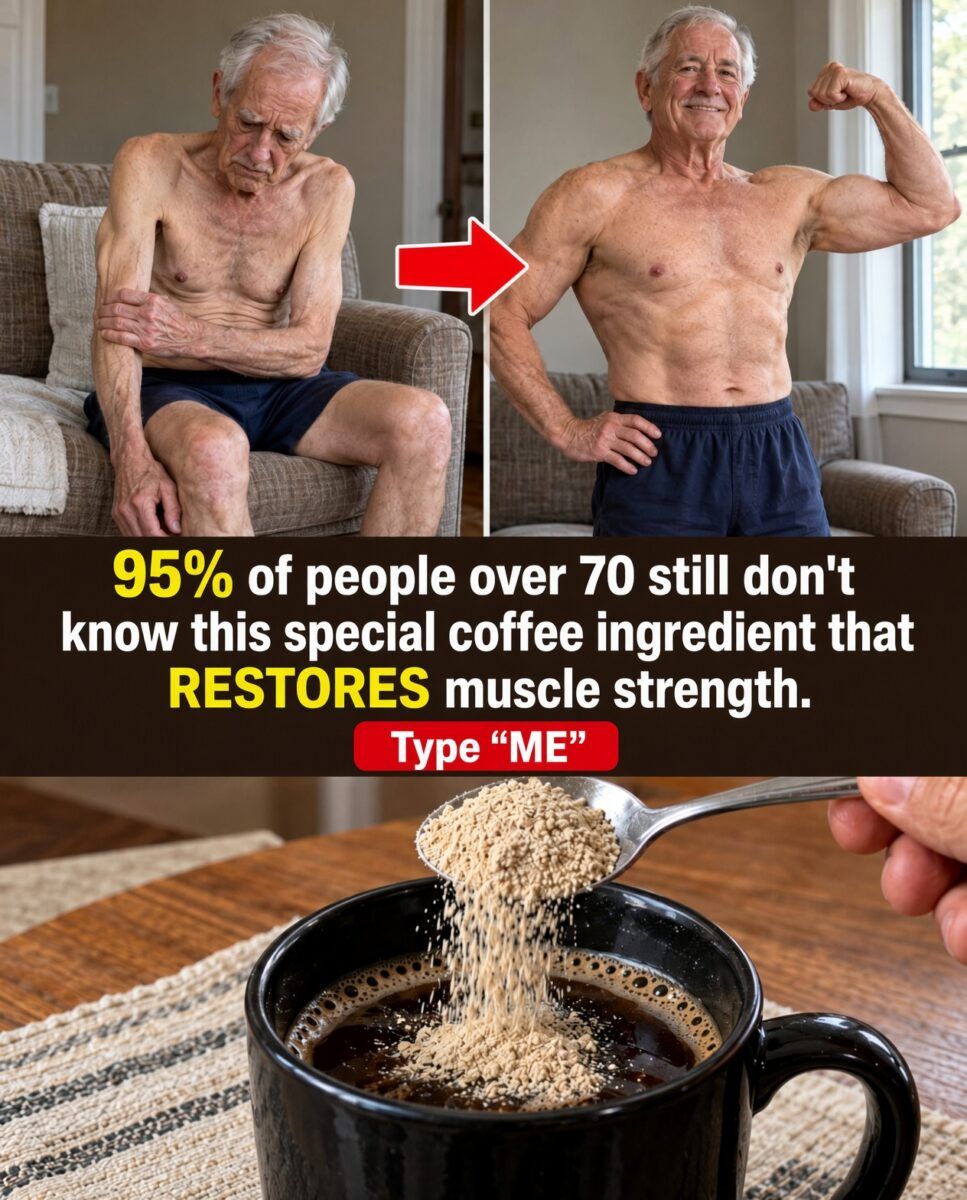
After 70, many people feel the body no longer answers the way it used to: it takes more effort to get up, walking feels heavier, and even breakfast does not seem to be enough to start the day. The problem is that it is not always just “age” — it is a combination of too little protein, less movement, and a routine that weakens without anyone noticing. The good news is that simple adjustments can help, and one of them is sitting in the cup you drink every morning.
The muscle responds to use. What is not used gets lost faster.
Why the Body Feels Weaker Even Though the Coffee Is the Same
Over the years, muscle does not disappear all at once. It is lost little by little — sarcopenia, the loss of muscle mass, strength, and function, linked by medical studies to a higher risk of falls, less independence, and more difficulty with everyday tasks.
The truth is this: coffee can help you feel awake, but it does not rebuild muscle. Caffeine stimulates the nervous system, but it does not provide the amino acids or the energy the muscle needs to lift you out of the chair, climb steps, or carry a grocery bag.
That is not laziness. It is biological adaptation: if you eat little breakfast, move less because you “feel tired,” and then sit down again, the body interprets that it does not need to keep so much strength.
The Mistake of Leaving Coffee Alone on the Table
In many homes, breakfast ends up being coffee, sweet bread, and a rush. It sounds familiar and tastes good, but it leaves an important gap: protein. Without enough protein, the body has less material to maintain and repair muscle.
But that is not all. Drinking coffee on an empty stomach can also increase irritation, speed up the pulse, or open up more appetite for something sweet later. That does not mean coffee is bad. It means it should not be the whole breakfast.
These are habits that usually appear when the morning falls short:
- Black coffee and nothing else until noon.
- White bread, cookies, or sweet bread as the only accompaniment.
- Little water during the morning.
- Sitting down again as soon as the cup is finished.
- Assuming weakness is “just normal at my age.”
Yes, coffee is not the villain. The problem appears when it replaces breakfast instead of accompanying it.
What Powder People Add and What the Evidence Says
On social media and in ads, a “miracle” powder to mix with coffee often appears. In practice, the most common ones are protein powder, creatine monohydrate, or sometimes collagen. None of them turns the cup into an instant remedy. None changes the body in a few hours.
Creatine is a substance the body produces and also gets from animal foods. Its main function is to help the muscle have quick energy. Scientific reviews in older adults have found that, when combined with strength training, it can be associated with more lean mass and a modest improvement in strength.
A recent meta-analysis reported about 1.18 kg more lean tissue when creatine is used together with strength training, compared with training alone and placebo. That is not magic, but it is a measurable difference. The key: the effect usually shows up with consistency, not in a single morning.
Protein matters too. Many guidelines for older people suggest around 1.0 to 1.2 grams per kilo of body weight per day, divided among meals, unless a doctor says otherwise. A scoop in the coffee can help if you eat little breakfast, but it does not replace the egg, beans, chicken, fish, or yogurt of the rest of the day.
Collagen, for its part, provides amino acids that differ from those of a complete protein. It can be a complement, but it should not be the base of breakfast.
Quick Comparison So You Don’t Fall for Exaggerated Promises
| Option | What it provides | What it does NOT do |
|---|---|---|
| Coffee alone | Wakefulness | No protein and no muscle support |
| Coffee with protein powder | Useful amino acids if the portion is right | Does not replace a complete meal |
| Coffee with creatine | Supports the muscle’s energy reserve with consistent use | Does not work as an instant change |
| Coffee with collagen | Partial protein complement | Does not replace complete protein |
And something important: creatine and coffee can coexist in many people. There is no solid evidence that a cup of coffee cancels out creatine. If it feels heavy on your stomach, the best is to separate them.
What the Powder Can’t Do If the Legs Stay Still
This is the point most often forgotten. The muscle needs stimulus. Sitting longer and adding a powder to the coffee is not enough. Scientific reviews agree that creatine usually gives better results when accompanied by resistance training, even simple home training.
No expensive gym needed. What is needed is repetition. The body responds to clear signals, not one-day tricks.
Some useful options:
- Stand up from the chair five times, slowly and with support if needed.
- Walk to the corner and back.
- Step up and down one step safely.
- Use an elastic band at home.
- Do two or three short sessions per week.
But that is not all. Sleeping little, drinking little water, and eating too much sugar also slow recovery. The body does not separate the cup from the rest of the day: if the night was bad, the morning feels heavier even if the coffee is strong.
If you notice warning signs — struggling to rise without using your hands, a shorter or shuffling step, a recent fall, a visibly thinner calf, kidney disease, or many medications — discuss them with your doctor rather than assuming everything is “normal.”
How to Build Your Morning Coffee Without Falling for the Miracle Story
The secret is not a magic powder. It is the order of your habits. The coffee can stay, but it must be accompanied by something that actually helps the muscle.
Here is a practical way to do it:
Step 1. Prepare your coffee as always and let the temperature drop a bit — powders dissolve better when it is not boiling.
Step 2. If your doctor has not forbidden it, add a measured portion of unflavored protein or creatine monohydrate. Many studies use between 3 and 5 grams of creatine per day.
Step 3. Stir well. If there is grit at the bottom, it did not mix correctly.
Step 4. Accompany the coffee with real food: egg, beans, panela cheese, yogurt, or shredded chicken if that suits you.
Step 5. Before sitting down again, do five chair squats or a short walk inside the house.
Step 6. Repeat the habit most days. Strength is built with consistency, not with one heroic cup.
The best combination is not coffee plus powder. It is coffee plus enough protein, plus movement, plus regularity.
What changes your legs the most is not a secret ingredient, but the sum of small habits repeated.
If after 70 you feel weaker, you are not condemned to live like that. Coffee can help you wake up, but the muscle needs protein, movement, and consistency. A powder can add, yes, but it does not replace breakfast or strength exercise. The best strategy is simple: improve your cup, improve your plate, and move your legs every day.
This article is for informational purposes only and does not replace professional medical advice. Consult your trusted doctor for personalized guidance.


