
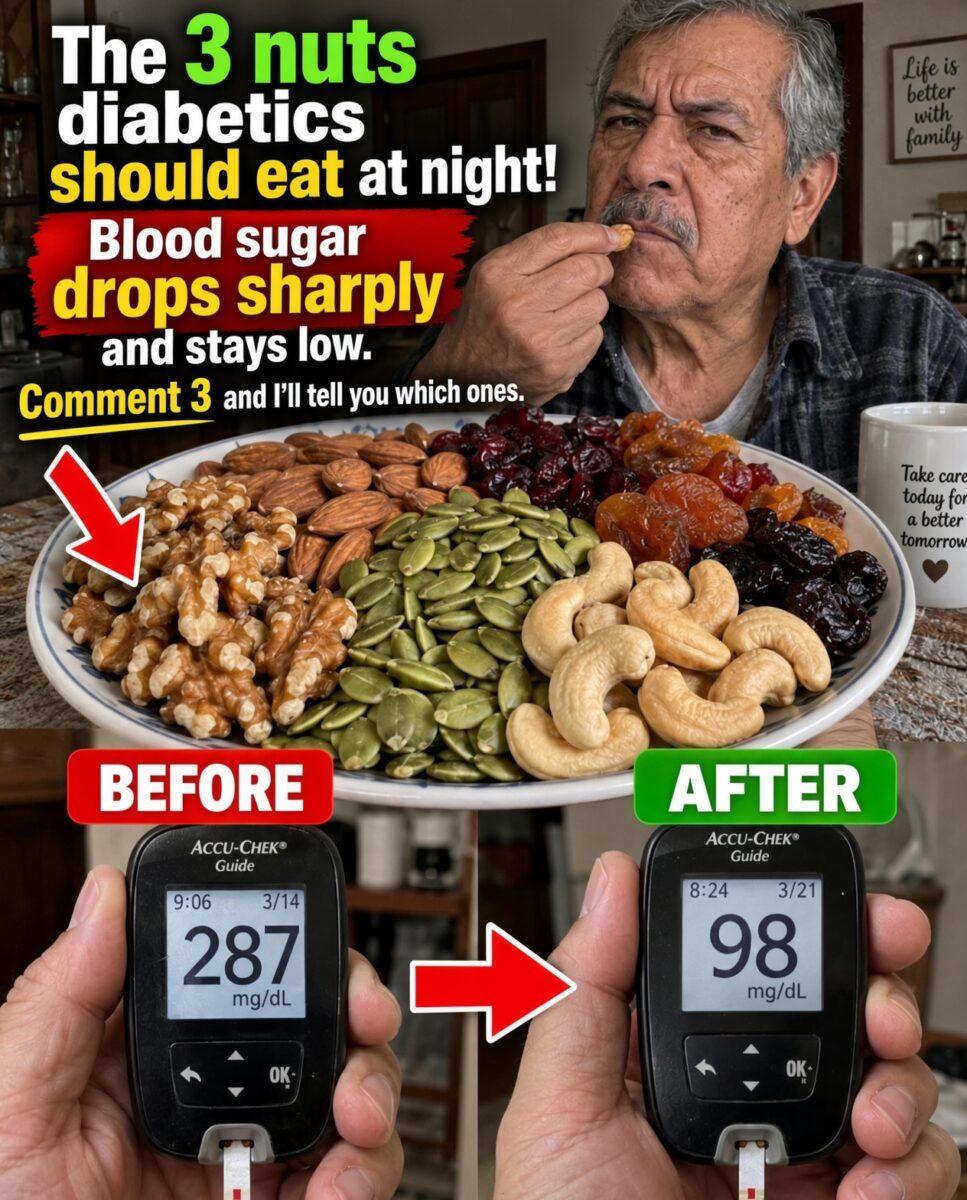
When someone sees high glucose and then hears that “three nuts at night” can lower it, it is easy to feel hope… and also confusion. The problem is that in diabetes not everything natural is innocent, nor is everything viral true. Eating something small before bed can help in certain cases, but it can also worsen control if used without context. The good news is that walnuts, almonds, and pistachios really can fit into a plan that supports glucose — with one detail almost nobody mentions that can completely change the interpretation.
The useful idea is not to seek a sharp drop, but a stable and safe control.
The Short Answer: No, There Is No Evidence That Three Nuts Lower Sugar Magically
Walnuts, almonds, pistachios, and seeds can indeed be part of a healthy diet for people with diabetes. They provide healthy fats, fiber, and some protein, which helps with satiety and can prevent sharp glucose spikes when they replace snacks with sugar or refined flours.
But that does not mean they work like a medication. There is no solid evidence that eating exactly “three nuts” before bed makes glucose drop sharply or keeps it low all night.
Why a 287-to-98 mg/dL Photo Does Not Prove the Food Worked
An image with two glucose numbers can look convincing, but alone it proves nothing. To know if a food had a real effect, key data is missing: how much time passed between measurements, if it was the same person, if they had eaten before, if they used insulin or medications, if they exercised, and even if they washed their hands before measuring.
Also, the CDC notes typical ranges of 80 to 130 mg/dL before eating and under 180 mg/dL one or two hours after starting a meal. That is why a glucose of 287 mg/dL deserves attention, not viral experiments — and why a reading of 98 mg/dL can be good or not, depending on the moment and the personal goal.
What Walnuts, Almonds, and Pistachios Actually Do
Here is the part that is actually worth using. Nuts can be useful because they combine unsaturated fat, fiber, and, in some cases, protein. That helps digestion be slower and glucose rise less quickly than with other snacks.
The American Diabetes Association includes walnuts, almonds, pistachios, peanuts, and seeds among options that can fit into a healthy pattern for diabetes. It also highlights that these foods can support cardiovascular health, something especially important because people with diabetes have a higher risk of heart problems.
But the key is this: they are a good option within the diet, not a quick solution to “lower sugar.”
Real Benefits of Including Them With Measure
If used well, they can help:
- Replace ultra-processed snacks with added sugar.
- Increase satiety and reduce nighttime cravings.
- Provide healthy fats and fiber.
- Improve the overall quality of the snack.
But: portion matters. Nuts are small, but very energy-dense. As a practical reference, one portion is about one ounce — around 28 grams — so separate it before sitting down to eat and do not improvise it when hungry.
The 3 Options That Are Usually the Most Practical
If we talk about foods and not treatments, there are three common options that usually fit well in many diabetes meal plans.
1. Walnuts
Walnuts provide unsaturated fats, fiber, and are one of the best-known plant sources of omega 3 — interesting for heart health and for replacing less healthy snacks.
2. Almonds
Almonds have fiber, monounsaturated fat, and a texture that helps feel satiety with a small portion; the ADA mentions them among options for a balanced diet.
3. Pistachios
Pistachios provide fiber, fat, and protein, and are usually consumed in moderate portions that help control hunger without nighttime sweets.
The difference is not that one “lowers” glucose and another does not; the difference is in how they fit into your total day.
Watch the Mix: Natural Nuts Are Not the Same as Trail Mix
This point is often overlooked. Many commercial mixes do not contain only nuts. They can also include raisins, sweetened cranberries, chocolate, honey, or candied fruit.
That changes the effect on glucose quite a bit. Dried fruit concentrates carbohydrates in little volume, and if it also has added sugar, it can raise glucose more than expected.
The ADA recommends watching the portion and total carbohydrates, because those impact glucose the most. That is why “natural nuts” and “nut mix” are not the same. On the label, check for no added sugar, little or no sodium, a reasonable portion, and total carbohydrates that are not high from dried fruit or added chocolate.
Is It Better to Eat Them Before Bed?
Not necessarily. There is no universal recommendation saying every person with diabetes must eat nuts before lying down.
The need for a nighttime snack depends on the type of diabetes, medications, dinner time, the day’s physical activity, the nocturnal glucose pattern, and the risk of hypoglycemia.
In some people, eating before bed without need only adds calories. In others, especially if they use insulin or certain medications, a snack can be part of the plan to prevent drops.
The key is to individualize, not to copy a viral trick.
What Really Matters: The Complete Pattern of the Day
Glucose is not defined by a single food or a single night. Dinner, exercise, stress, sleep, medications, and even the time of measurement all influence.
So instead of asking “which nut lowers sugar fastest?”, think: “what combination of food, schedule, and treatment keeps me stable?” That is much more useful — and much safer.
If Glucose Swings Too High or Too Low
Morning glucose can rise for several reasons: late dinner, high-carbohydrate food, early-morning hormones, lack of sleep, stress, or medication adjustments.
An isolated value is not enough to draw conclusions. The important thing is to see if it repeats and in what context.
The CDC recommends recording measurements and discussing them with the health team to interpret what they mean in your particular case.
This is crucial too: if glucose is below 70 mg/dL, it is considered hypoglycemia — tremor, sweating, hunger, dizziness, confusion, and in severe cases loss of consciousness. In that situation, nuts do not correct the problem quickly; fast-acting carbohydrates like glucose tablets or gel are needed. The NIDDK recommends 15 to 20 grams of fast carbohydrates, waiting 15 minutes, and measuring again. If there is fainting, seizures, or unsafe swallowing, it is an emergency.
Practical Tips You Can Apply Starting Today
Choose a single option (natural walnuts, almonds, pistachios, or peanuts) with no added sugar or excess salt, separate a small portion of about 28 grams, use it to replace a less healthy snack rather than adding extra calories, record nighttime changes, and never adjust insulin or medications on your own.
This approach is simple, but much more useful than following a trend without context.
Conclusion
Walnuts, almonds, and pistachios can indeed be part of a healthy diet for people with diabetes. They provide fiber, healthy fats, and satiety, and can replace ultra-processed snacks.
But there is no evidence that “three nuts at night” sharply lower sugar or keep glucose controlled all night on their own.
And in fact, seeking a strong drop is not the goal. What we want is a stable glucose, within a safe and personalized range.
If you have repeated high values, nighttime drops, or doubts about your dinner and medications, the best is to review the complete pattern with your health team.
This article is for informational purposes only and does not replace professional medical advice. Consult your trusted doctor for personalized guidance.


