
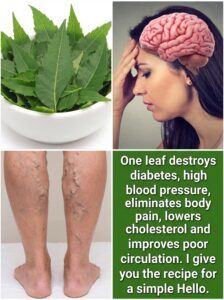
Main ingredient:
Neem — Νιμ (Nim).
Scientific name: Azadirachta indica.
A few fresh neem leaves.
500 ml of water.
Honey — Μέλι (Méli), optional.
Neem is a plant traditionally used in various regions of Asia. Its leaves contain several plant compounds that have been investigated for their antioxidant activity and other biological properties.
However, the evidence in humans is not sufficient to claim that neem tea cures diabetes, improves circulation, eliminates parasites, or treats other diseases.
☕ Preparation
Wash the neem leaves carefully — Νιμ (Nim).
Place 500 ml of water in a pot.
Add a small amount of leaves.
Bring the water to a boil and let it boil for a few minutes.
Remove from heat and let it rest.
Strain thoroughly before consuming.
If you wish to soften the bitter taste, you can add a small amount of honey — Μέλι (Méli).
🌱 What has it traditionally been used for?
Neem has had numerous traditional uses, especially related to skin care and hygiene. Its leaves have also been investigated for their potential antioxidant, antimicrobial, and anti-inflammatory properties.
However, the results obtained in laboratory or animal studies do not demonstrate that a neem infusion has the same effects on people.
🧴 Traditional external use
An alternative is to use neem products specifically formulated for topical use. Neem preparations have traditionally been used for skin care.
If you use a homemade preparation on your skin, first test it on a small area and discontinue use if irritation occurs.
⚠️ An important precaution
I do not recommend drinking neem tea two or three times a day for extended periods as if it were a medicinal treatment. The safety of regular oral consumption of neem is not well established.
Special caution should be exercised during pregnancy and breastfeeding, and also if glucose control medications or other medications are used.
Do not use neem to replace diabetes medications or other prescribed treatments.
And remember: just because a plant has a long history of traditional use does not automatically mean that it is safe or effective for treating a disease.
This article is for educational purposes and does not replace consultation with a healthcare professional.


