
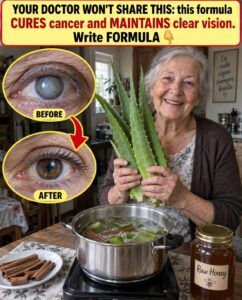
When a viral post promises that aloe vera can “cure” cancer and clear cataracts at the same time, it’s normal for many people to get excited and want to believe it. The problem is that these kinds of messages play on fear, hope, and the urgency to find a quick fix. And when that happens, people may delay treatments that are actually backed by evidence. The good news is that science has already reviewed this concoction, and there are important details that are almost never mentioned; at the end, I’ll show you how to identify these claims before they waste your time.
The idea sounds natural, but that doesn’t make it true.
Aloe vera, honey, and cinnamon have been used for years in cooking and some home remedies. This makes the combination seem innocent, even “wise” or “traditional.” But using ingredients in food is one thing, and attributing medicinal effects against complex diseases to them is quite another.
The reality is that cancer isn’t a single disease, and cataracts aren’t cured with a drink. They are different problems, with different causes and different treatments. That’s why a universal formula should already raise suspicions.
Can aloe vera cure cancer?
The short answer is no. To date, there is no solid clinical evidence that consuming aloe vera cures, controls, or eliminates cancer in humans. The National Cancer Institute states that no single food, herb, vitamin, or supplement has been shown to cure cancer or prevent it from recurring.
That doesn’t mean aloe vera hasn’t been studied. It has been investigated in laboratories and in some medical settings, but observing activity on a plate is one thing, and demonstrating real benefit in patients is another. To discuss its use as a treatment, clinical trials are needed to measure safety, dosage, tumor response, and survival.
What can happen with “natural” products
And here’s the most delicate point: some herbal products can interfere with cancer medications or increase adverse effects. They aren’t always dangerous, but they aren’t automatically safe either. The risk increases when using concentrated extracts, high doses, or mixtures without supervision.
Natural does not mean harmless, nor does it mean effective.
A cataract is not dirt in the eye
Many people imagine that a cataract is something that can be “washed out” or cleaned with eye drops, juices, or home remedies. But that’s not the case. A cataract is a clouding of the lens, which is the eye’s natural lens. When it becomes cloudy, vision becomes blurry, colors appear dull, and night vision can be difficult.
The National Eye Institute explains that surgery is the only way to remove a cataract once it requires treatment. This procedure involves removing the cloudy lens and replacing it with an artificial one. No mixture of aloe vera, honey, or cinnamon can do the job.

What can help in early stages
Not all cataracts require immediate surgery. In the early stages, some people find improvement with a new prescription, better lighting, anti-reflective lenses, or magnifying glasses. But these only improve vision temporarily; they don’t eliminate the cataract.
Why are “before and after” photos so misleading?
Viral posts often show an opaque eye followed by a clear one, as if it were definitive proof. But a photo alone doesn’t prove that someone actually had a cataract, or that a treatment cured it. Lighting, focus, camera glare, and even digital editing can completely change the appearance.
Furthermore, it’s not always the same eye, the same person, or the same moment. The image may be impressive, yes, but it doesn’t replace an eye exam.
| Factor | How can a photo be deceiving? |
|---|---|
| Lightning | It makes an opacity appear more or less intense. |
| Approach | It changes the sharpness and the appearance of transparency. |
| Camera reflection | It can hide or exaggerate details of the eye |
| Digital Edition | It can erase stains, redness, or dullness. |
| Different eyes | They do not prove the evolution of the same person. |
And honey and cinnamon? Yes, but with realistic expectations.
Honey can be part of a healthy diet, and cinnamon is a common spice. The problem arises when they are attributed with healing powers that they haven’t been proven to have. Neither has been shown to eliminate cataracts or control existing cancer.
Furthermore, if someone has diabetes or high blood sugar, consuming large amounts of honey as a “remedy” can add unnecessary sugar. Something that seems healthy because it’s natural can end up being counterproductive.
The most common warning signs of a viral cure
Deceptive publications often follow the same script. First, they sow distrust in doctors or hospitals. Then, they promise extraordinary and rapid results. Next, they show testimonials or photos instead of serious studies. And finally, they encourage people to abandon treatment.
Science works differently. A real treatment is tested, compared, monitored, and adjusted. It’s not sold as a closely guarded secret.
- It promises to be effective for many different diseases at the same time.
- He says, “The doctors don’t want you to know this.”
- It offers quick cures for chronic problems.
- It only shows testimonials, not clinical trials.
- It asks you to stop taking medication or attending appointments.
The biggest risk: delaying the correct treatment
This is the most important point. When a person with cancer switches from medical treatment to a home remedy, they can lose valuable time. And in oncology, time matters a great deal. The National Cancer Institute explains that conventional treatments are studied to assess their effectiveness and safety, while many alternative therapies lack that level of evidence.
Complementary therapy can be used alongside standard treatment in some cases. But alternative therapy is used instead of medical treatment. That difference can change the prognosis.
The problem is not using something natural as a support; the problem is using it as a substitute for what actually works.
What to do if your vision is blurry
Blurred vision doesn’t always mean cataracts. It can also be caused by glaucoma, macular degeneration, diabetic retinopathy, refractive errors, or dry eye. Each cause requires a different approach.
That’s why it’s not a good idea to try “one-size-fits-all” remedies. The same drink can’t correct such different mechanisms.
Signs to consult an ophthalmologist
Seek medical evaluation if you notice any of these changes:
- Blurred vision that gradually worsens.
- Difficulty seeing at night.
- Colors more muted than normal.
- Strong sensitivity to light.
- Frequent need to change lenses.
What can a person do to take care of their eyesight?
Proper prevention doesn’t promise miracles, but it does help preserve vision for longer. The National Eye Institute recommends that people over 60 have a dilated eye exam every one to two years, unless their eye care professional advises otherwise.
In addition, managing diabetes and blood pressure, not smoking, and using sunscreen to protect your eyes can make a significant difference. Good eye health is built on consistent habits, not a viral fad.
Practical steps you can start today
If you want to realistically protect your eyesight, follow this simple plan:
- Schedule an eye exam if it’s been more than a year since your last checkup.
- If you have diabetes or high blood pressure, keep up with your checkups.
- Do not put home remedies inside the eye.
- Wear sunglasses or sunscreen if your doctor recommended them.
- If you take supplements or herbs, discuss it with your doctor.
If you are undergoing cancer treatment, this is something you should know.
Nutrition does matter during cancer treatment, not because it cures the disease, but because it helps maintain strength, weight, and energy. Depending on the treatment, nausea, changes in taste, constipation, diarrhea, or loss of appetite may occur. In these cases, an oncology dietitian can be much more helpful than a restrictive viral diet.
If you already use herbal products, it’s best not to hide them. Keep a list with the name, dosage, and frequency, or even a photo of the packaging. This way, the medical team can review potential interactions and tell you if there’s a risk.
When you shouldn’t expect
If a person with cancer experiences fever, significant bleeding, confusion, difficulty breathing, or new severe pain, they should follow the urgent instructions of their oncology team. And if they experience sudden vision loss, severe eye pain, or a very red eye with blurred vision, they need prompt medical attention.
Don’t wait to see if a homemade drink “works.” In those cases, time can be crucial.
Conclusion
Aloe vera, honey, and cinnamon may have a place in the kitchen, but there is no evidence that this mixture cures cancer or eliminates cataracts. Cancer requires specific treatment depending on its type and stage. Cataracts, when removal is necessary, are treated with surgery.
Viral formulas are often dangerous not because they’re natural, but because they sell hope without evidence. If something promises too much, treats too many illnesses at once, and distrusts doctors, it deserves caution.
Frequently Asked Questions
Does aloe vera eliminate cancer cells?
There is no clinical evidence that aloe vera cures or controls cancer in humans. The National Cancer Institute states that no single food, herb, vitamin, or supplement has been shown to cure cancer or prevent it from recurring.
Can aloe vera remove a cataract?
No. A cataract is a clouding of the lens, and the only way to remove it is through surgery when it is indicated.
Can I use natural remedies along with my treatment?
It depends on the product and the treatment you’re receiving. Some may be compatible, but others can interfere with medications or cause adverse effects. That’s why it’s a good idea to discuss them with your oncologist, nurse, or pharmacist.
Medical advice: This content is for informational purposes only and is not a substitute for professional medical advice. Do not discontinue treatments, medications, or eye drops because of the use of aloe vera, honey, cinnamon, or other natural remedies, and seek urgent medical attention for severe symptoms or sudden vision loss.


