
Avocado Seed Tea: Could This Often-Discarded Seed Have Wellness Benefits?
When you eat an avocado, the creamy green flesh usually gets all the attention. The large seed in the middle, however, often goes straight into the trash.
Recently, avocado seed tea has attracted attention as a natural drink made from a part of the fruit that is normally discarded.
Avocado seeds contain a variety of compounds, including polyphenols, starch, fiber, carotenoids, and other phytochemicals. Research has investigated their antioxidant properties and potential applications in functional foods.
But does that mean avocado seed tea can treat diseases?
Not necessarily.
Most research on avocado seeds has been conducted in laboratory or experimental settings rather than large human clinical trials. Therefore, it is better to view avocado seed tea as an experimental or traditional wellness beverage, rather than a treatment for a medical condition.
Let’s take a closer look.
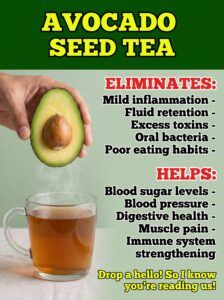
1. Avocado Seeds Contain Antioxidant Compounds
One of the most interesting characteristics of avocado seeds is their phytochemical content.
Studies have identified various phenolic compounds and other bioactive substances in avocado seeds. These compounds have demonstrated antioxidant activity in laboratory research.
Antioxidants are compounds that can help protect cells from oxidative stress.
This is one reason researchers are exploring avocado seeds as potential ingredients for functional foods and beverages.
However, antioxidant activity measured in a laboratory does not automatically mean that drinking avocado seed tea will produce the same effects in humans.
2. It May Support Overall Wellness
A warm herbal-style drink can be an enjoyable addition to a balanced lifestyle.
Avocado seed contains several naturally occurring plant compounds that are being investigated for their potential biological activity. Researchers have explored avocado seed extracts for antioxidant and antimicrobial properties, among others.
Still, there is currently not enough clinical evidence to say that avocado seed tea prevents or treats specific diseases.
For wellness content, it is more accurate to describe the drink as a potential source of plant compounds rather than a natural medicine.
3. Researchers Are Studying Its Potential Antioxidant Activity
Scientific interest in avocado seeds has increased partly because the seeds are normally treated as food waste.
Research reviews report that avocado seeds can contain significant amounts of bioactive compounds and show antioxidant activity in experimental studies.
A 2025 review also described avocado peel and seed as promising sources of phenolic compounds with antioxidant capacity, while emphasizing the need for further research into safety, bioavailability, and practical food applications.
This means the seed is scientifically interesting—but researchers are still determining how useful it can be as a food ingredient.
4. Can Avocado Seed Tea Help With Inflammation?
Inflammation is involved in many health conditions, which is why natural plant compounds with potential anti-inflammatory activity attract scientific interest.
Some experimental research has investigated compounds found in avocado and its by-products in relation to oxidative stress and inflammatory pathways. However, this should not be interpreted as evidence that avocado seed tea can treat an inflammatory disease.
More human research is needed before specific health claims can be made.
5. What About Blood Sugar and Metabolic Health?
Avocado seeds have also been investigated in experimental research involving metabolic processes.
However, evidence from animal studies or isolated extracts cannot be directly translated into a recommendation to drink avocado seed tea for blood sugar control.
If you have diabetes or take medication that affects blood glucose, it is particularly important not to replace prescribed treatment with an unproven herbal drink.
6. Can It Improve Digestion?
Avocado seeds contain fiber and other plant compounds, which has led to interest in their potential nutritional applications.
However, there is currently insufficient human evidence to establish avocado seed tea as a digestive treatment.
If your goal is simply to support digestive wellness, adequate fiber from established food sources, enough fluids, regular physical activity, and a varied diet have a much stronger nutritional foundation.
7. How to Make Avocado Seed Tea
If you want to experiment with avocado seed tea, keep the preparation simple.
Ingredients
- 1 avocado seed
- 2–3 cups of water
- Optional: a small amount of lemon for flavor
Preparation
- Wash the avocado seed thoroughly.
- Allow it to dry.
- Cut or grate it into smaller pieces only if you can do so safely.
- Place a small amount in water and bring it to a gentle simmer.
- Allow the water to simmer for several minutes.
- Strain the liquid carefully.
- Let it cool to a comfortable drinking temperature.
Important: There is no well-established evidence-based standard for the amount of avocado seed that is appropriate for making tea. Therefore, stronger is not necessarily better.
8. What Does Science Say About Avocado Seed Safety?
This is one of the most important parts of the topic.
Although avocado seeds have attracted attention as a potential functional-food ingredient, researchers have emphasized that human safety data remain limited.
Some animal studies have also reported toxicity from concentrated avocado seed extracts at sufficiently high doses. One study found significant mortality in animals receiving high doses of an avocado seed extract.
This does not mean that an occasional cup of avocado seed tea has the same effect as a concentrated laboratory extract. It does mean that there is not enough evidence to establish a universally safe dose for homemade avocado seed preparations.
For that reason, caution is appropriate.
9. Who Should Be Especially Careful?
Because research on avocado seed preparations in humans is limited, people should be particularly cautious if they are:
- Pregnant or breastfeeding
- Giving herbal drinks to children
- Taking prescription medications
- Managing a chronic medical condition
- Experiencing liver or kidney problems
- Prone to food or plant allergies
If you fall into one of these groups, talk with a healthcare professional before regularly consuming avocado seed preparations.
10. Avocado Seed Tea Is Not a Replacement for Medical Treatment
You may encounter online claims that avocado seed tea can help with conditions ranging from diabetes and high blood pressure to infections or cancer.
These claims should be treated carefully.
Laboratory studies can show that a plant extract has antioxidant, antimicrobial, or other biological activity. That is an important starting point for research, but it does not prove that drinking a homemade tea will prevent or cure a disease.
For example, researchers have observed potentially interesting biological activity from avocado seed compounds in laboratory studies, including research involving cancer cell lines. But these findings are not equivalent to clinical evidence that avocado seed tea treats cancer in humans.
Avocado Seed Tea vs. Avocado Fruit
It is also important to distinguish the seed from the edible avocado flesh.
The flesh of avocado is a well-established food containing healthy fats, fiber, vitamins, minerals, and other nutrients.
The seed, on the other hand, is not commonly consumed as a conventional food, and research into its use as a food ingredient is still developing. Reviews specifically highlight the need for additional safety and bioavailability research.
So, eating avocado as part of a balanced diet and experimenting with avocado seed tea are two very different things.
Final Thoughts
Avocado seed tea is an interesting example of how researchers are exploring food by-products that are normally thrown away.
Avocado seeds contain polyphenols and other bioactive compounds and have demonstrated antioxidant activity in laboratory research. These properties have generated interest in their potential use in functional foods and beverages.
At the same time, scientific evidence in humans remains limited, and there is no established evidence that avocado seed tea can cure or treat diseases.
If you choose to explore this beverage, think of it as a natural wellness drink—not a medicine. And because the appropriate dose and long-term safety of homemade avocado seed tea have not been firmly established, moderation and caution are important.
The avocado seed may have potential, but science is still working out exactly how—and how safely—it can be used.


