
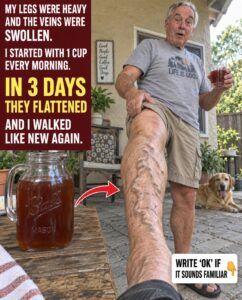
Reaching the end of the day with heavy legs, swollen ankles, and increasingly visible veins can make even walking a few blocks uncomfortable. That’s why it’s tempting to believe that a glass of water each morning will make varicose veins “flatten” in three days, but no beverage has been proven to repair venous valves or make established varicose veins disappear in that time. What can significantly improve the heaviness is helping blood flow back from the legs, and some measures begin to show results before the appearance of the veins changes. And here’s the part that almost no one tells you: there are simple habits that provide more relief than any “miracle cure” promises.
Why do varicose veins and the feeling of heavy legs appear?
The veins in your legs have tiny valves that help blood flow back to the heart. When these valves don’t work properly, some blood can flow backward and pool, increasing the pressure inside the veins.
Over time, the typical dilated, twisted, and prominent veins may appear. But that’s not all: pain, burning, cramps, swelling, and that “lead-like” feeling in the legs that worsens at the end of the day may also occur.
Sitting or standing for long periods often aggravates the problem. The truth is that varicose veins aren’t simply “dirty blood” that needs a cleansing drink; there’s a real mechanical component of pressure and venous reflux.
What do we really know about drinks “for varicose veins”?
Promises of quick fixes abound on social media, but medical evidence does not support the claim that a beverage can eliminate varicose veins in 72 hours. No infusion, juice, or herbal mixture has been shown to repair damaged vein valves or close diseased veins on its own.
That doesn’t mean everything you drink is useless. A beverage without excessive sugar can be part of a healthy diet. However, it’s very different to talk about hydration or nutrition than to claim that a glass of water will rebuild a vein.

The key difference is this: a drink can accompany the treatment, but it does not replace the actual management of venous insufficiency.
| Viral promise | What do we really know? |
|---|---|
| One drink flattens varicose veins in 3 days | It has not been proven |
| Walking can relieve heaviness | Yeah |
| Elevating your legs can decrease venous pressure | Yeah |
| Compression can relieve edema and heaviness. | Yes, in the right people. |
| There are procedures that close diseased veins | Yeah |
Walking does help, but for a very specific reason.
When we walk, the calf muscles contract repeatedly. This action acts like a pump, helping to push venous blood upwards and preventing it from pooling in the legs.
The NHLBI recommends staying physically active because walking and exercise promote blood flow and can reduce the feeling of heaviness. But here’s an important detail: feeling relief doesn’t mean the varicose veins have disappeared.

A person may experience improved symptoms with movement and still have visible veins. That’s normal. The initial goal isn’t to immediately “erase” the vein, but to reduce pressure, pain, and swelling.
Furthermore, some very intense exercises, especially those involving heavy lifting, could worsen discomfort in some people. Therefore, it’s advisable to start gradually if you haven’t been physically active for a while.
Elevating your legs can relieve pressure without taking anything.
This is one of the simplest and least glamorous measures, but also one of the most useful. Lying down with your feet elevated above heart level for a few minutes several times a day can reduce pressure in the veins and promote blood return.

Mayo Clinic also suggests taking short breaks to elevate your legs above your heart. This can be especially helpful if you spend many hours sitting or standing.
And here’s the practical part: you don’t have to wait until the pain is intense. Taking short breaks throughout the day often works better than remaining immobile for hours and then trying to compensate at the end.
How to do it easily
Sit or lie down in a comfortable place.
Elevate your legs on pillows or a backrest, ideally above heart level.
Hold the position for 15 to 20 minutes.
Repeat this several times a day, especially in the afternoon or when you get home.
Compression stockings can make a real difference
Compression therapy uses stockings or bandages designed to apply pressure to the legs. According to the NHLBI, they can relieve pain, swelling, and a feeling of heaviness, especially in people who spend a lot of time sitting or standing.
But let’s be clear: compression helps control symptoms; it doesn’t, on its own, correct the reflux problem that causes many varicose veins. Even so, for many people it provides significant relief in their daily lives.
Not all compression stockings are created equal. They come in different lengths and pressure levels, and for some people with arterial problems or other medical conditions, the choice should be made with professional guidance.
Advantages and limitations of compression
- It can reduce swelling at the end of the day.
- It can reduce the feeling of heaviness and tiredness.
- It can help if you work standing or sitting for many hours.
- It does not eliminate already damaged veins on its own.
A more useful daily routine than waiting three days
If you have known varicose veins and there’s no medical contraindication, combining several measures is usually the most effective approach. The accumulation of small changes often yields better results than seeking a single quick fix.
For example, Mayo Clinic recommends staying active, moderating excess salt if there is a tendency to retain fluid, wearing shoes that allow the calves to work well, and avoiding long periods in the same position.
In other words: it’s not about doing something perfect, but about consistently doing several things right.
Practical 7-step plan
- Walk every day at a pace that is comfortable for you.
- If you work sitting down, get up every 30 to 60 minutes.
- If you work standing up, change position frequently.
- Elevate your legs during short breaks.
- Ask if compression stockings are right for you.
- Maintain a healthy weight if you are overweight.
- Watch for any worsening pain, swelling, or cramps.
This approach doesn’t promise miracles, but it does address the factors that most influence venous symptoms. And that, in practice, is worth much more than a three-day promise.
When varicose veins need more than self-care
If varicose veins cause significant pain, limit walking, or do not improve with basic measures, there are medical treatments specifically targeting the affected veins. These include sclerotherapy, laser therapy, and endovenous catheter procedures such as radiofrequency ablation or laser energy.
Mayo Clinic describes these options as outpatient treatments in many cases. Sclerotherapy, for example, involves injecting a solution or foam into certain veins to close them, and then the body redirects blood flow to other veins.
Before deciding on a procedure, a venous Doppler ultrasound is usually performed. This study allows doctors to see how the blood is circulating and detect problems such as reflux or even a blood clot.
That’s important because a photo can show visible veins, but it doesn’t show whether there’s actually a venous problem that requires treatment.
A leg that suddenly swells up is another story
Not all swelling is due to varicose veins. If one leg suddenly increases in size, especially if there is pain, heat, tenderness, or a change in color, prompt medical evaluation is needed to rule out deep vein thrombosis.
If shortness of breath, chest pain, fainting, or coughing up blood also occurs, this requires emergency medical attention. It’s not advisable to wait and see if “a drink” helps.
A wound that does not heal around the ankle, bleeding from a varicose vein, or pain that increasingly limits walking also warrants consultation.
What to do today if you want to relieve the heaviness
The good news is you can start today with simple steps. You don’t need to wait to buy anything special or find a viral recipe.
Step by step for today
1. Walk for 10 to 20 minutes, if your physical condition allows it.
2. Take a break and elevate your legs for 15 minutes.
3. Avoid remaining immobile for long periods.
4. Reduce your salt intake if you notice fluid retention.
5. If you already wear compression stockings, put them on in the morning.
6. Observe whether the heaviness improves by the end of the day.
If there is partial improvement, that’s already useful information. It means your symptoms are responding to measures that improve venous return. If there is no improvement, or if it worsens, a medical evaluation is worthwhile.
Conclusion
A morning drink may be pleasant, but there is no evidence that it will make varicose veins or heaviness disappear in three days or repair damaged vein valves.
The most effective measures are simpler than they seem: walking, avoiding prolonged periods of immobility, elevating your legs, and using compression when appropriate. If varicose veins continue to cause pain or limitations, a venous evaluation may open the door to treatments such as sclerotherapy, laser therapy, or endovenous procedures.
The goal shouldn’t be simply to see a vein look different in a photo after 72 hours. The important thing is to reduce symptoms, maintain mobility, and detect any vascular problems early that require treatment.
Frequently Asked Questions
What drink eliminates varicose veins?
Currently, there is no proven beverage that can eliminate varicose veins. Management may include physical activity, leg elevation, compression, and, when indicated, medical procedures that close or remove the affected veins.
Is walking good for varicose veins?
Yes. Walking activates the calf muscles and helps blood return from the legs. The NHLBI includes staying physically active among the recommended measures to relieve symptoms and prevent varicose veins from worsening.
Do compression stockings make varicose veins disappear?
Not necessarily. They may reduce pain, swelling, and heaviness in some people, but they primarily relieve symptoms and do not correct the underlying venous reflux.
Sources and scientific support
The aforementioned recommendations align with general guidance from institutions such as the NHLBI and Mayo Clinic, which describe physical activity, leg elevation, compression, and medical procedures (when indicated) as helpful measures. Various studies and clinical guidelines agree that symptomatic relief can be achieved through daily habits, although structural varicose veins do not disappear with quick fixes or other remedies.
Medical disclaimer: This content is for educational purposes only and is not a substitute for professional medical advice. Sudden leg swelling, significant pain, shortness of breath, chest pain, bleeding from a varicose vein, or a wound that does not heal require appropriate medical evaluation.


