
When your knee hurts, swells, and every step feels like a battle, any promise of quick relief sounds tempting. That’s why the idea of eating some Jell-O and being able to walk normally again in 48 hours can seem almost miraculous. The problem is that this promise mixes hope with an expectation that doesn’t align with how a damaged joint actually works. And more importantly, it can cause people to delay the treatment that truly helps. At the end of this article, I’ll show you what can actually improve pain and mobility without falling for false promises.
What really happens when a knee hurts
Knee pain doesn’t always mean osteoarthritis, although that’s one of the most common causes. It can also be due to meniscus tears, ligament problems, tendinitis, bursitis, gout, inflammatory arthritis, or even an infection. That distinction is important because each cause requires a different approach.
Osteoarthritis, also called arthrosis, is a progressive wear and tear of the joint. Over time, it can cause pain, stiffness, swelling, and difficulty moving. But a photo or a viral video alone can’t diagnose what’s happening inside the knee.
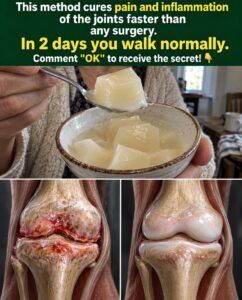
And here’s the first big misconception: feeling less pain doesn’t mean the cartilage has regenerated. They’re two different things.
What is that gelatinous preparation?
The viral image usually shows a translucent, firm substance, resembling gelatin, collagen, or some kind of thick broth. But a photo doesn’t allow you to know for sure what ingredients it contains or what real effect it might have on the body.
Even if that preparation contained gelatin or collagen, it doesn’t mean it will “travel” directly to the knee to rebuild cartilage. During digestion, proteins are broken down into amino acids and peptides that the body uses for many functions. They don’t automatically become a new knee.

Science is quite clear on this: no food has been shown to repair a damaged joint in 2 days .
Why doesn’t cartilage grow back as quickly?
Cartilage isn’t just a simple layer of “jelly” inside the knee. It’s a specialized tissue that works in conjunction with bone, ligaments, muscles, and the synovial membrane. When osteoarthritis is present, the problem is more complex than a single worn-out piece.
Therefore, the idea that a gelatin can repair a joint in 48 hours is not biologically realistic. Even the most studied supplements have not demonstrated rapid and predictable cartilage reconstruction.

According to the NIAMS and NCCIH , the evidence regarding glucosamine and chondroitin remains inconsistent. Some studies show slight improvement in symptoms, others show no significant difference, and as for structural changes in the joint, the evidence remains uncertain.
What can help, even if it doesn’t sound “miraculous”
The interesting thing is that many real improvements don’t come from a single substance, but from a simple, consistent plan. That might sound less dramatic, but it usually works better in the long run.
Scientifically backed options
These measures are frequently used to reduce pain and improve function:

- Low-impact exercise
- Adapted muscle strengthening
- Water activity
- Walking according to tolerance
- Stationary bike
- Swimming
- Balance exercises
- Tai chi
The NIAMS notes that exercise can reduce pain and stiffness, as well as improve flexibility, strength, and endurance. In other words, moving appropriately is often more helpful than remaining completely immobile for fear of pain.
But that’s not all… strengthening the muscles around the knee also greatly changes the way you walk, climb stairs, and get up from a chair.
Exercise: the least glamorous but most useful strategy
When a knee hurts, many people think the best thing to do is stop moving it completely. That reaction is understandable. The problem is that prolonged inactivity can weaken the muscles and worsen function.
The goal isn’t to do intense exercise all at once. The goal is to find a safe and progressive level. A physiotherapist can help choose appropriate movements for each individual.
A basic plan usually includes:
- Smooth movement to reduce stiffness
- Strengthening with bands or light weights
- Balancing act
- Low-impact aerobic activity
- Slow progression according to tolerance
The improvement is not always felt in 2 days, but it can be very significant over time.
Body weight also plays a role.
If you are overweight or obese, losing weight can reduce the strain on your knees and improve pain. The NIAMS notes that even moderate weight loss can make walking more comfortable.
That doesn’t mean everyone with knee pain should lose weight. There are cases where the problem is different, or where the priority is different, such as preventing muscle loss or malnutrition. That’s why treatment should be tailored to the individual, not based on generic advice found online.
The key is this: less workload doesn’t cure osteoarthritis, but it can make daily life more bearable .
Heat or cold? Both can work
Heat often helps to relax, improve local circulation, and reduce stiffness. Cold, on the other hand, can temporarily reduce pain and inflammation.
These measures don’t regenerate cartilage, but they can make symptoms more tolerable. And when someone is in pain, any safe and simple relief can make a real difference.
What about glucosamine and chondroitin?
These are probably the best-known joint supplements. The idea behind them seems logical at first glance: if they are related to cartilage components, perhaps they can help repair it. However, the clinical evidence is not so simple.
The NCCIH indicates that outcomes in knee osteoarthritis are inconsistent. Some people report improvement, others do not, and there is no certainty that they produce significant changes in joint structure.
Furthermore, they are not harmless for everyone. They can interact with warfarin , an anticoagulant, so they should not be taken “just in case” without professional guidance.
| Viral promise | What the evidence says |
|---|---|
| Repairs joints in 2 days | Not proven |
| It makes cartilage grow rapidly | Not proven |
| It cures joint inflammation. | Not proven |
| Glucosamine and chondroitin regenerate the knee | Inconsistent evidence |
| Adapted exercise reduces pain and stiffness | Yeah |
| Strengthening muscles improves function | Yeah |
Feeling better does not mean the joint has regenerated.
This point is crucial. A person may feel better after using heat, taking medication, resting, or starting to move more appropriately. But that doesn’t mean the cartilage has grown back.
The real goals of treatment are more practical: to reduce pain, improve function, and preserve quality of life. And that, while it may not sound as spectacular as a “cure in 48 hours,” does have real medical value.
The truth is that many useful solutions are modest, but consistent.
When does surgery enter the conversation?
Surgery isn’t decided solely because an image looks “ugly.” Many people with osteoarthritis live for years with conservative management. The decision depends on pain, functional limitations, impact on daily life, and response to other treatments.
When the damage is extensive and conservative measures are no longer sufficient, a partial or total knee replacement may be considered. That is a completely different procedure than eating gelatin or taking a supplement.
Comparing both things as if they were equivalent makes no clinical sense.
Warning signs: when not to wait at home
There are situations where a painful knee requires prompt medical evaluation. It’s not advisable to assume it’s osteoarthritis or try to resolve it solely with home remedies.
Seek medical attention promptly if your knee suddenly becomes very red, hot, or swollen, especially if you have a fever. Also seek medical attention if there was a serious injury, a visible deformity, or if you suddenly become unable to bear weight on it.
These signs may indicate infection, a fracture, or a significant inflammatory problem.
Practical steps you can start today
If your goal is to walk better without false promises, try this step-by-step approach:
1. Identify the pattern of the pain. Does it worsen when walking, climbing stairs, or standing up? This information helps pinpoint the cause.
2. Reduce the load, not the movement entirely. Prolonged complete rest usually worsens weakness.
3. Use cold or heat, whichever provides the most relief. Choose what gives you the best comfort for 15 to 20 minutes.
4. Start with gentle exercise. Short walks, gentle cycling, or moving around in water can be a good start.
5. Strengthen your thigh and hip muscles. They are key to stabilizing your knee.
6. Ask about any issues such as being overweight, previous injuries, or persistent pain. A personalized plan usually yields better results.
7. Don’t rely solely on viral photos. An image is not a substitute for a medical evaluation.
Conclusion
No, a gelatin solution has not been proven to repair a damaged joint or allow someone to walk normally in two days. Osteoarthritis and other knee problems require a realistic approach, based on the cause of the pain and scientifically supported treatments.
What does work much more consistently is what often seems too simple: adapting your movements, strengthening muscles, controlling your weight when appropriate, using heat or cold to relieve symptoms, and in some cases, resorting to medication or surgery.
The best question isn’t which jelly “rebuilds” the knee. The best question is which combination of treatments can help you walk better, with less pain and more confidence.
Frequently Asked Questions
Does gelatin rebuild knee cartilage?
No. Eating gelatin may provide protein, but there is no evidence that it regenerates cartilage or repairs a worn-out knee in 48 hours.
Do glucosamine and chondroitin prevent surgery?
It cannot be guaranteed. The evidence is inconsistent and does not show that they replace medical treatments or that they rebuild the joint.
Does walking worsen osteoarthritis?
Not necessarily. Adapted movement is often part of the treatment and can help reduce pain, stiffness, and loss of function.
Medical notice: This content is for informational purposes only and is not a substitute for professional medical advice. If your knee is red, hot, very swollen, you have a fever, or you are unable to bear weight on it, seek medical attention immediately.


