
Seeing your hairline widen or your scalp become more noticeable can be very distressing, especially after 60. The internet is full of promises of a nightly “spoonful” that supposedly rejuvenates hair, but the reality is far less magical. There is no solid evidence that an unknown homemade concoction can regenerate thinning hair overnight, nor that taking it before bed has any special effect on the follicles. The good news is that there are treatable causes, but first, you need to understand what type of hair loss is occurring. And here’s the most important point: not everything that looks like hair loss is true alopecia.
The image blending cannot be identified with certainty.
Viral photos often show a dark, thick mixture with seeds or particles, but that doesn’t tell you for sure what it contains. It could include honey, oils, spices, seeds, or some other popular cooking ingredient.
The problem is that, without knowing the exact formula, it’s impossible to assess the dosage, safety, or potential interactions. And even knowing what it contains, something much more important would still need to be proven: that it actually stops hair loss, promotes new hair growth, or closes a part.
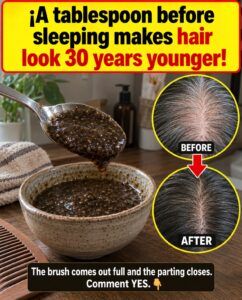
A “before and after” picture does not prove that a remedy regenerates follicles.
More hair on the brush doesn’t always mean baldness
Here’s a very common misconception. The American Academy of Dermatology (AAD) explains that losing between 50 and 100 hairs a day can be normal. When hair loss exceeds that, one possibility is telogen effluvium, which is not the same as hereditary alopecia.
Telogen effluvium can appear months after a severe illness, high fever, surgery, rapid weight loss, or a period of intense stress. In many cases, hair loss decreases once the trigger disappears, and the hair gradually recovers.

Therefore, noticing less hair in the brush after a few days doesn’t prove that a recipe has “revived” the follicles. The truth is that the hair cycle is slower and more complex than viral ads promise.
A widening line does deserve attention
The image also shows a more visible central part, and this pattern can be seen in female pattern hair loss. That doesn’t mean a photo alone is enough to diagnose it, but it is a sign that shouldn’t be ignored.
The AAD notes that, in women, one of the first signs of hereditary alopecia can be a parting that gradually widens or a ponytail that feels thinner. In men, it is usually more noticeable at the temples or crown.

The difference matters because each cause requires a different approach. And this is where many people waste valuable time trying remedies that don’t address the real problem.
What the internet promises vs. what the evidence shows
This contrast helps to lower expectations. Not every natural product is useless, but neither is everything “natural” proven to treat hair loss.
| What the image promises | What we know |
|---|---|
| One tablespoon quickly regenerates thinning hair. | Not proven |
| Taking it before bed improves the follicles | There is no solid evidence |
| A widened parting can be a sign of hair loss | Yeah |
| All falls have the same cause | No |
| Some treatments can help preserve or restore hair | Yeah |
| Real results usually take months. | Yeah |
Hair doesn’t gain real density overnight.
Hair grows in cycles. For a thinning area to appear denser, the follicles must produce new or thicker hairs, and that takes time. It doesn’t happen magically while we sleep.

Even well-studied treatments, such as minoxidil, typically require 6 to 12 months to show visible results. In men with androgenetic alopecia, finasteride can also take around six months to start helping.
If medications that have been studied for decades take months to develop, it’s highly unlikely that a spoonful of a food mixture could transform hair density in just a few days. The science here is quite clear.
Why a “after” photo can be deceiving
A part can appear tighter even without any new hair follicles appearing. Sometimes everything changes due to simple details: the camera angle, the lighting, the hairstyle, whether the hair is wet or dry, or even the distance from the camera.
The volume at the roots and the use of cosmetic fibers also play a role. Moving the part by just a few centimeters can drastically change the appearance. That’s why serious studies use standardized photographs and follow-up over months.
What seems like a quick recovery is often just a change of hairstyle or lighting.
Can natural supplements help?
It depends on the product and, above all, on the cause of the hair loss. One example is saw palmetto, a plant also marketed for male pattern baldness. The NCCIH notes that some small studies have evaluated it orally or topically, but the evidence remains limited.
This teaches an important lesson: just because something is plant-based doesn’t mean it has been proven to regenerate hair. The same applies to many seed, oil, and powder mixtures circulating online.
The key is not to look for the “secret spoonful”, but to identify if the hair loss is hereditary, temporary, due to stress, nutritional deficiency or another medical cause.
Finding the cause is more important than finding a viral cure.
The AAD emphasizes that effective treatment begins with discovering the cause of hair loss. A dermatologist can review how the hair loss started, whether it was gradual or sudden, the pattern of thinning, the condition of the scalp, and any recent medications.
They may also ask about illnesses, fever, surgery, weight changes, or possible hormonal or nutritional imbalances. In some cases, blood tests or even a scalp biopsy may be requested.
This is important because there is no single treatment for all types of alopecia. Treating without a diagnosis can delay the best option.
Five causes that can appear as “thinning hair”
These are some of the most frequent causes that may look similar in the mirror, but are not treated the same way:
- Androgenetic alopecia: It is hereditary and very common. The follicles become miniaturized and produce increasingly finer hairs.
- Telogen effluvium: causes excessive hair loss after illness, surgery, fever, or major stress.
- Alopecia areata: is an immune disease that can cause round areas without hair.
- Damage from hairstyles or chemicals: dyes, perms, excessive heat and constant tension can promote breakage or loss.
- Age-related changes: Over the years, hair growth slows down and some follicles stop producing hair.
The same person can even have more than one cause at the same time. And that explains why treatment must be personalized.
Which treatments have the best evidence?
If you’re dealing with androgenetic alopecia, there are much better-studied options than home remedies. Scientific evidence doesn’t promise miracles, but it does show real results for a significant percentage of people.
Minoxidil
It can stimulate growth and reduce further hair loss in some people. However, it doesn’t necessarily restore a full head of hair and requires consistent use. Results typically take between 6 and 12 months.
Finasteride in selected men
The AAD indicates that it can slow hair loss in many men and, in some cases, promote regrowth. It is a prescription medication and can cause side effects, so it should be discussed with a healthcare professional.
Other procedures
Depending on the case, a dermatologist may consider hair transplantation, platelet-rich plasma (PRP), or other strategies. The choice depends on the diagnosis, age, pattern of hair loss, and realistic expectations.
What to do if you notice less density today
Instead of pursuing a universal nighttime solution, you can follow these practical steps starting today:
- Take a monthly photo with the same light, the same hairstyle, and the same angle.
- Observe whether the hair loss is diffuse, localized, or follows a specific pattern.
- Remember if there was any illness, fever, surgery, severe stress, or weight loss in the last few months.
- Avoid very tight hairstyles and aggressive treatments.
- Check if the weight loss progresses or lasts for several months.
These steps do not replace a consultation, but they do help to determine whether it is a temporary fall or a problem that needs medical treatment.
Most importantly: don’t wait too long
Inherited hair loss typically progresses gradually over years. The AAD explains that treatments tend to work best when started early, while there are still follicles that can respond.
This means that spending months trying viral recipes can be a costly mistake. The longer you let follicle miniaturization progress, the harder it can be to regain density.
The most useful part of this story isn’t the mysterious spoonful. It’s figuring out why your hair is thinning while there’s still time to take action.
Conclusion
The claim that a spoonful before bed makes thinning hair look 30 years younger is not supported by clinical evidence. Furthermore, the mixture in the image cannot be reliably identified based on its appearance alone.
What we do know is that a widening parting can be an early sign of hair loss, and there are several possible causes. Some are temporary, while others, such as androgenetic alopecia, tend to progress without treatment.
For certain types of hair loss, there are evidence-based options, such as minoxidil and, in suitable men, finasteride. But even these treatments need months, not overnight, to show results.
In short, the most useful information is not finding a “secret spoonful”, but discovering the real cause before the hair thins further.
Frequently Asked Questions
Does taking a spoonful before bed make hair grow more?
There is no evidence that nighttime workouts have a special effect on hair growth. Nor is it possible to definitively identify the mixture shown in a viral photo.
Does closing the part mean the hair has grown back?
Not necessarily. Hairstyle, lighting, angle, and volume can significantly alter its appearance. Actual growth is assessed over months, not in a single shot.
Can hair grow back after 60?
In some cases, yes. It depends on the cause and the condition of the follicles. The AAD notes that there are treatments that can reduce hair loss and produce some regrowth in some patients.
Disclaimer: This content is for informational purposes only and is not a substitute for a dermatological evaluation. Consult a professional if hair loss occurs suddenly, forms completely bald patches, affects eyebrows or eyelashes, causes pain, swelling, or scarring, or continues to progress.


