
If your vision has become cloudy with age, it’s normal to look for something quick, natural, and inexpensive that will instantly restore clarity. The problem is that many viral solutions promise too much and end up delaying the kind of care that can truly help. Cucumber might feel cool and provide some relief to tired eyelids, but a cataract is inside the eye and won’t “disappear” with a slice on the skin. And here’s the important point: understanding this difference can save you months of frustration and protect your vision better than you imagine, because ultimately there’s a key detail that almost no one explains well…
The cataract is not on the surface of the eye
A cataract is a clouding of the lens, which is the natural, transparent lens inside the eye. Its job is to focus light so you can see clearly. Over time, the proteins in the lens can clump together and make it more opaque.
That’s why symptoms like blurred vision, dull colors, halos around lights, and increased difficulty seeing at night appear. The National Eye Institute (NEI) explains that this process occurs inside the eye, not on the eyelids or the outer surface.
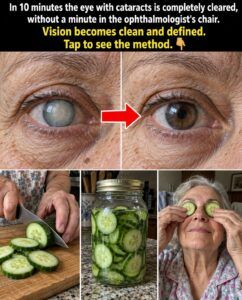
A slice of cucumber can be refreshing, but it cannot reach the lens of the eye or reverse a cataract.
So why does cucumber feel good?
The feeling of relief is real, and that confuses many people. A cold cucumber placed on closed eyelids works, in practice, like a cool compress. It can make the area feel less heavy, less puffy, and more rested for a few minutes.
But feeling better doesn’t mean seeing better. That’s the trap. If you remove the cucumber and notice your eyes are more comfortable, that doesn’t prove the cataract has improved. It only indicates that the cold was pleasant.

And that’s not a bad thing. It just needs to be put in its proper context: temporary relief, not eye treatment.
What science does say about cataract removal
The medical reality is clear: currently, surgery is the only proven way to remove a cataract. During the procedure, the ophthalmologist removes the cloudy lens and replaces it with an artificial intraocular lens.
According to the NEI, this surgery typically lasts about an hour, and the vast majority of people experience improved vision afterward. In fact, it’s reported that approximately 9 out of 10 patients see better following the operation.

Yes, research is underway to find non-surgical treatments. However, the most recent studies are still experimental. That is, they are promising, but they don’t yet equate to a readily available home remedy.
Why “before and after” photos don’t prove a cure
Shocking images of eyes supposedly “cured” with cucumber are circulating online. But a photo is not a medical examination. Lighting, contrast, eye position, camera angle, and even editing can completely change the appearance.
Furthermore, a cataract cannot be diagnosed with a photo taken with a cell phone. An eye exam, ideally with pupil dilation, is necessary to evaluate the lens and rule out other vision problems.

In other words: a viral photo may impress, but it doesn’t replace a real eye exam.
Blurred vision after 60: it’s not always cataracts
This point is very important. Many people feel like they are “seeing through a cloud” and assume it’s cataracts. Sometimes it is, but not always. There are several possible causes of blurred vision, and each requires different attention.
| Possible cause | What you may notice | What usually requires |
|---|---|---|
| Cataract | Blurry vision, halos, dull colors | Eye exam |
| Incorrect graduation | Difficulty focusing | Lens examination |
| Dry eye | Ardor and fluctuating vision | Evaluate the ocular surface |
| Macular degeneration | Problems with central vision | Retinal examination |
| Diabetic retinopathy | Variable changes in vision | Retinal examination |
| Glaucoma | It can progress without early symptoms | Eye measurement and examination |
The truth is that waiting too long with home remedies can delay a useful diagnosis. And when the cause is identified late, sometimes valuable time has already been lost.
What can you do if the cataract is still mild?
Not all cataracts require immediate surgery. In early stages, many people can continue to function well with some simple adjustments. The NEI recommends measures that help make the most of available vision, although they don’t eliminate the cataract.
Useful options at home and in your daily routine
- Use brighter lighting for reading or cooking.
- Try sunglasses or anti-reflective lenses to reduce glare.
- Update your eyeglass or contact lens prescription.
- Use magnifying glasses for small tasks.
- Avoid driving at night if the glare bothers you a lot.
These measures do not cure cataracts, but they can make daily life more comfortable while the ophthalmologist monitors its progression.
When to consider surgery and stop waiting
Surgery is usually considered when cataracts interfere with everyday activities such as reading, driving, cooking, or recognizing faces. This does not mean that surgery should be performed as soon as the first cloudiness appears.
However, it’s also not advisable to wait indefinitely if your vision is already limiting your life. The decision depends on how much it affects your routine and what the specialist observes during the examination.
The goal is not to operate out of fear, nor to wait out of habit: the goal is to preserve the best possible vision with the least unnecessary delay.
Habits that do help take care of eye health
If you want to do something truly beneficial for your eyes, it’s best to focus on measures that are medically sound and make practical sense. The NEI links factors such as diabetes, smoking, sun exposure, and prolonged use of certain steroids to an increased risk of cataracts.
Smarter habits than a viral cure
- Get regular eye exams after age 60.
- Control your diabetes well, if you have it.
- No smoking.
- Wear sunglasses when outdoors.
- Consult if your vision starts to interfere with your daily life.
These steps don’t promise a “new sight” in ten minutes, but they do help protect what really matters: your long-term vision.
What to do today if you suspect cataracts
If you notice blurred vision, halos, difficulty seeing at night, or less vibrant colors, don’t just wait for it to “go away on its own.” You can follow this simple plan:
- Note what symptoms you have and when they started.
- Check if you wear glasses and if your prescription might be outdated.
- Avoid trying remedies inside the eye, such as juices, infusions, or homemade mixtures.
- Schedule an eye exam with pupil dilation.
- Tell the specialist how your vision affects your daily life.
This approach is safer and far more effective than relying on a viral solution. Furthermore, it provides the physician with the information needed to better guide treatment.
When to seek urgent care
Age-related cataracts usually progress gradually. A sudden loss of vision should not be dismissed as “normal.” There are symptoms that require prompt attention.
Seek medical help promptly if you experience severe eye pain, very red eyes with decreased vision, flashes of light, a sudden appearance of numerous floaters, or a curtain-like shadow over your vision. Even after cataract surgery, these signs warrant immediate contact with a specialist.
Conclusion
Cucumber can be refreshing and even pleasant on closed eyelids, but it doesn’t eliminate a cataract or restore lost vision. A cataract is inside the eye, in the lens, and the only proven way to remove it today is through surgery.
The good news is that not all cataracts require immediate surgery. In the meantime, there are simple steps you can take to improve your vision and increase your comfort. The most important thing is not to mistake temporary relief for real treatment.
If your vision is blurry, the most valuable thing isn’t in the refrigerator. It’s knowing what’s happening inside your eyes.
Frequently Asked Questions
Can putting cucumber on your eyes remove a cataract?
No. The cataract is inside the lens, and a slice of cucumber on the eyelids cannot reach or remove it. Surgery is the only proven way to remove it.
Why do my eyes feel more rested after using cucumber?
Because cold can provide a temporary feeling of relief, like a cool compress. This can make the eyelids feel less heavy, but it doesn’t mean the cataract has improved.
Do all people with cataracts need surgery immediately?
No. Many people can wait while they use better lighting, change their prescription, or adjust their habits. Surgery is usually considered when cataracts already interfere with daily life.
Medical Advice: This content is for informational purposes only and is not a substitute for a professional eye exam. Do not put cucumber, juices, infusions, or homemade preparations in your eyes. If you experience sudden vision loss, severe eye pain, very red eyes with decreased vision, new flashes of light, or curtain-like shadows, seek urgent medical attention.


