
Waking up with blurry vision, needing more light to read, or noticing that faces are no longer easily distinguishable can be incredibly frustrating. At that moment, any home remedy promising to “fix” your eyesight in a day sounds tempting, especially if it’s marketed as a quick and natural solution. The problem is that cataracts don’t work that way, and relying on a pantry mix can delay the care that actually helps. The good news is that there are safe and effective ways to manage this problem, and at the end of this article, I’ll tell you the detail that confuses many people after age 60.
The cataract is not on the surface of the eye
A cataract occurs when the lens, the eye’s natural lens, becomes cloudy. This clouding prevents light from entering clearly, causing blurred, dull, or dazzling vision. It’s not dirt stuck to the eye or a coating that can be washed off with food.
And here’s the important point: a homemade mixture, however nutritious, cannot make a cloudy lens clear. The cataract is inside the eye, not on it. That’s why viral photos promising a dramatic transformation in just a few days don’t prove that a drink or a breakfast has cured anything.
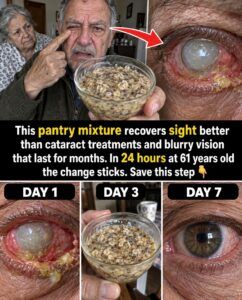
Cataracts are not cleaned from the outside; they are evaluated and treated with a real medical approach.
Are oats, seeds, and fruits good? Yes. Do they cure cataracts? No.
Oats, seeds, nuts, and fruits can be part of a healthy diet. They provide fiber, healthy fats, vitamins, and other nutrients that benefit the body overall. But that doesn’t mean they have a direct effect on eliminating an existing eye disease.
This is a very common mistake on social media: confusing healthy food with medical treatment. They are different things. Just because something is good for your health doesn’t automatically make it a solution for cataracts.

Studies and recommendations from institutions like the National Eye Institute are clear: there is no clinical evidence that a homemade mixture removes an existing cataract, much less in 24 hours.
Surgery is the only way to remove a cataract.
This is the most important part to remember. When a cataract significantly impairs vision, the only way to remove it is through surgery. In the procedure, the cloudy lens is removed and replaced with an artificial lens.
That doesn’t mean everyone with cataracts needs surgery right away. In the early stages, some measures can be quite helpful: more light, anti-reflective lenses, magnifying glasses, or a new prescription. But when reading, driving, or watching television becomes difficult, it’s worth talking to an ophthalmologist about surgery.

According to the National Eye Institute, about 9 out of 10 people see better after cataract surgery. The exact result depends on the overall health of the eye, but in most cases the improvement is noticeable.
So why might someone feel like they see better the next day?
Because not all blurred vision is due to cataracts. And this is a very common misconception. Sometimes vision changes due to the prescription of eyeglasses, dry eyes, lighting, or other illnesses that also affect eyesight.
In older adults, the most common causes of low vision include cataracts, glaucoma, age-related macular degeneration, and diabetic retinopathy. Therefore, a perceived improvement after taking a mixture does not necessarily mean that the lens has actually cleared.

What an improvement can and cannot mean
A subjective feeling of seeing slightly better can be due to temporary changes, improved lighting, or even eye strain. But that doesn’t prove that a cataract has disappeared.
However, when an ophthalmologist confirms a cataract through an examination and then observes that the opacity is no longer present, then we are talking about a genuine clinical finding. Images from the internet are not a substitute for that evaluation.
| Situation | What could it mean? |
|---|---|
| “Today I see a little more clearly” | It may be a temporary variation |
| The new prescription improves vision | There was a refractive component |
| A photo shows a “cleaner” eye | It does not demonstrate a cure. |
| The ophthalmologist confirms that there is no longer a cataract. | Requires medical evaluation |
A viral photo does not diagnose a cataract
A red, white, painful eye, or one with excessive discharge, can indicate many things, but it doesn’t, on its own, confirm a cataract. A cataract is confirmed with an eye exam, not with a picture shared on social media.
After age 60, the National Eye Institute recommends a dilated eye exam every one to two years. This exam helps detect cataracts and other silent diseases that can damage vision without showing any early signs.
Dilation allows for a better view of the eye’s internal structures. This provides far more information than trying to compare an eye to viral photos or miracle cures.
Diabetes and blurred vision: a combination that deserves attention
If a person has diabetes, it’s unwise to assume that all blurred vision is due to cataracts. The retina can also be affected. Diabetic retinopathy damages the blood vessels in the retina and, in advanced stages, can cause blurred vision, floaters, and vision loss.
Furthermore, the National Eye Institute notes that people with diabetes are two to five times more likely to develop cataracts, and may develop them at a younger age. Therefore, regular medical checkups are even more important for this group.
The reality is simple: if there is diabetes and changes in vision, the helpful thing is not to look for a “secret ingredient”, but to maintain glucose control and eye exams.
What you can do while waiting for an appointment
If the cataract is mild, there are practical measures that can make daily life easier while you wait for a medical evaluation. They won’t cure the cataract, but they can reduce discomfort and help you see better on a daily basis.
Helpful steps starting today
- Use brighter lights for reading, cooking, or sewing.
- Update your lens prescription if it no longer helps you as it used to.
- Try lenses with anti-reflective coating, especially if you drive at night.
- Use magnifying glasses if you need to read small print.
- Notice which activities are becoming more difficult and write them down to tell your ophthalmologist.
These changes do not replace medical care, but they can greatly improve comfort while deciding whether surgery is necessary.
Don’t confuse a healthy diet with eye treatment
A balanced diet remains important after 60. Fruits, vegetables, legumes, whole grains, adequate protein, and healthy fats benefit the entire body. But a healthy diet is not a substitute for cataract treatment.
In fact, a simple rule can help you spot dubious promises: the faster and more specific the promise of a cure, the more caution it deserves. “It’s part of a healthy lifestyle” is reasonable. “Regain your sight in 24 hours” is not.
And there’s something even more important: never put oats, honey, seeds, lemon, herbs, or oils in your eye. Even if an ingredient is edible, that doesn’t make it sterile or safe for eye use.
You can’t always put what you eat in your eye; that difference can prevent a serious injury.
Surgery is not always urgent, but it should be well planned.
Receiving a cataract diagnosis doesn’t mean you need surgery right away. In many people, the doctor can wait until vision really interferes with daily activities. According to the National Eye Institute, waiting doesn’t usually make later surgery more difficult.
This avoids two common mistakes: ignoring the problem for years or thinking that any small cataract requires immediate surgery. The right decision depends on how much it’s affecting your daily life.
If you are already having trouble reading, distinguishing steps, driving at night, or recognizing faces, it is worth talking to a specialist about the next step.
Signs that do need prompt attention
Age-related cataracts usually progress slowly. Therefore, a sudden loss of vision should not automatically be attributed to a cataract. There are symptoms that require urgent medical attention.
- Intense eye pain.
- Very red eye with decreased vision.
- Sudden flashes of light.
- Sudden appearance of many floating spots.
- Sensation of shadow or curtain over vision.
If any of these signs appear, don’t wait to see if a home remedy “works.” Seek medical attention as soon as possible.
Conclusion: the real secret isn’t in the pantry
A breakfast of oatmeal, seeds, and fruit can be healthy, but there’s no evidence that it eliminates cataracts or restores vision within 24 hours. A cataract is a clouding inside the eye, and when it interferes with daily life, the only treatment that truly removes it is surgery.
After age 60, the most helpful approach isn’t to chase viral remedies, but rather to correctly identify the cause of blurred vision. Sometimes a new prescription or better lighting is all it takes; other times, a more thorough evaluation is needed to detect cataracts, glaucoma, macular degeneration, or retinal problems.
That’s the detail many people overlook: not every change in vision is a cataract, and not every cataract resolves with patience or diet. Timely checkups can make a big difference.
Frequently Asked Questions
What food eliminates cataracts?
None of these treatments have been proven to eliminate an existing cataract. A healthy diet helps the body overall, but the only way to remove a cataract is through surgery.
Can a waterfall disappear on its own?
No. Age-related cataracts don’t disappear on their own or with drinks, seeds, oatmeal, or homemade vitamins. If they are mild, they can be managed temporarily with visual aids, but the cataract is still there.
Why is my vision blurry if I don’t have cataracts?
There are several possibilities, such as changes in prescription, dry eyes, glaucoma, macular degeneration, or diabetic retinopathy. An eye exam will determine the actual cause.
Medical disclaimer: This content is for informational purposes only and is not a substitute for professional medical advice. Do not put food or homemade preparations in your eyes, and do not discontinue prescribed treatments without medical advice. If you experience sudden vision loss, severe eye pain, or redness with decreased vision, seek immediate medical attention.


