
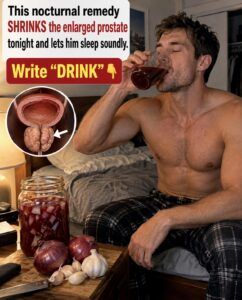
Waking up once, twice, or more during the night to use the bathroom can exhaust anyone and ruin a good night’s sleep the next day. That’s why a homemade drink that promises to “shrink the prostate” sounds tempting when the night already feels endless. The problem is that this promise usually sells false hope, not real results. And even worse: drinking liquids right before bed can actually make the problem worse. But there’s a smarter way to approach this, and at the end, I’ll tell you the detail that almost no one considers, and that can change your nights.
First: not every “enlarged prostate” means the same thing
Benign prostatic hyperplasia, or BPH, is a non-cancerous enlargement of the prostate gland. It is very common in men over 50 and becomes more frequent with age.
The prostate gland surrounds part of the urethra, the tube through which urine exits the body. When it enlarges, it can compress this passage and obstruct urine flow. This explains symptoms such as a weak stream, difficulty starting urination, dribbling at the end of the urine stream, or a feeling of incomplete bladder emptying.
And here’s the important part: BPH is not the same as prostatitis. Prostatitis is inflammation of the prostate gland and can have other causes, including infections. Confusing them leads to incorrect solutions.
Can onions and garlic shrink the prostate overnight?
The short answer is there isn’t enough clinical evidence to support that claim. While onions and garlic can be part of a healthy diet, there are no solid studies demonstrating that a homemade drink with these ingredients reduces an enlarged prostate overnight.
The NIDDK, a reliable medical source, notes that researchers have not established that diet or nutrition plays a specific role in preventing prostate problems. That doesn’t mean eating well doesn’t matter. It means we shouldn’t turn common foods into imaginary treatments.

It’s one thing to support general health; it’s quite another to promise a medical effect that has not been proven.
The detail that changes everything: drinking before bed can increase visits to the bathroom
This is the point many publications overlook. If the main problem is waking up at night, drinking a large glass of liquid right before bed can be counterproductive. Instead of helping, it can fill your bladder more and increase the urge to urinate.
The NIDDK indicates that, depending on the case, a professional may recommend reducing fluid intake a few hours before bedtime. However, this is not about dehydration. It’s about better distributing hydration throughout the day.

If you have heart failure, kidney disease, or another condition that requires specific instructions, you should follow your doctor’s recommendations. Not all bodies handle fluids the same way.
Nocturia does not always mean an enlarged prostate
Getting up to urinate at night is called nocturia. It can be related to BPH, but on its own, it doesn’t confirm that the prostate is the cause. Drinking habits, caffeine, alcohol, medications, and other urinary problems also play a role.
That’s why it’s important to observe the complete pattern. It’s not just about how many times you get up, but also how much urine comes out, the quality of the stream, and whether it’s difficult to start.

Signs worth watching
If you notice any of these changes, it may be helpful to discuss them with a healthcare professional:
- Slower or weaker flow during the day.
- Difficulty initiating urination.
- Feeling of not emptying the bladder completely.
- Frequent urinary urgency.
- Waking up several times during the night.
- Dribbling after urinating.
Chronic urinary retention can develop silently. That is, some people become so accustomed to an increasingly weak stream that they believe “it’s just a sign of getting old.” But this isn’t always normal.
Coffee, alcohol, and other nighttime acts of sabotage
Before buying another medication, it’s worth reviewing what you consume in the afternoon and evening. Caffeine can worsen bladder control in some people, and alcohol can increase urine production.
In fact, many times the problem isn’t just the prostate. It’s the combination of delayed urination, stimulants, and a sensitive bladder.
A helpful strategy is to keep a simple log for three days. This is much more helpful than simply saying “I go to the bathroom a lot” without any further details.
3-day practical log
Write down the following:
- Time for the last coffee or caffeinated tea.
- Amount of fluids after dinner.
- If you drank alcohol.
- Time of the last time you urinated before going to sleep.
- How many times did you wake up during the night?
- Whether you urinated a lot or only a small amount.
That little log gives your doctor a much clearer picture of what’s going on. And yes, it can reveal habits that seem innocent but are ruining your sleep.
What is studied for HPB
When symptoms are bothersome, treatment depends on their severity, the size of the prostate, and other health factors. Not everyone needs the same treatment.
Options may include monitoring, lifestyle changes, medications, and, in some cases, procedures. The American Urological Association recommends certain medications for men with moderate to severe symptoms, depending on the individual case.
| Treatment | What are you doing | When can it help |
|---|---|---|
| Alpha blockers | They relax the muscles of the prostate and bladder neck | When there is difficulty urinating or a weak flow |
| 5-alpha reductase inhibitors | They can slow growth or reduce prostate size | In selected patients with an enlarged prostate |
| Monitoring and changes in habits | They help control mild symptoms | When the problem is not yet serious |
The key point is this: medications can help, but they don’t work overnight. And they should never be started or stopped because of what you saw on social media.
A more sensible evening plan starts several hours before you go to bed
If you’ve already been evaluated for urinary symptoms, there are simple measures that can improve your nights. They’re not magic, but they can be helpful when applied consistently.
The goal isn’t to drink less water all day. The goal is to drink it better.
Practical steps you can start today
1. Distribute most of your fluids throughout the day.
2. Avoid large glasses right before going to sleep.
3. Reduce caffeine in the afternoon and evening.
4. Limit alcohol, especially near bedtime.
5. Empty your bladder before going to bed.
6. Keep a record of symptoms for several days to detect patterns.
These changes may seem small, but they often make a real difference when nocturia is related to habits and not just the prostate.
Be careful with some cold and allergy medications.
This point is especially important in older men. The NIDDK warns that certain cold or allergy medications can contribute to difficulty urinating in some people.
That’s why it’s a good idea to bring a complete list of everything you take to your appointment: prescription medications, over-the-counter products, supplements, vitamins, and herbal remedies.
Don’t stop taking anything on your own. Sometimes the problem isn’t the prostate itself, but a combination of medications that are worsening the symptoms.
How to really investigate an enlarged prostate
A viral photo cannot diagnose BPH. When symptoms are present, medical evaluation may include a medical history, physical examination, blood and urine tests, and in some cases, ultrasound or other tests.
If the doctor suspects that the bladder is not emptying completely, they may also measure post-void residual urine, which is the amount of urine remaining after urination. This helps determine if there is indeed an obstruction.
The important question is not whether a drink “sounds natural,” but whether it actually explains your symptoms.
When you shouldn’t expect
There are signs that require immediate medical attention. If you feel your bladder is full and suddenly can’t urinate at all, that could be acute urinary retention and needs urgent evaluation.
Also seek help promptly if you experience blood in your urine, fever, chills, significant pain, or a rapid worsening of symptoms. In these cases, it’s not worth “trying” a homemade remedy first.
Viral promise versus what we really know
The difference between helpful advice and a misleading promise is significant. Here’s a simple comparison:
| Affirmation | What the evidence indicates |
|---|---|
| A drink shrinks the prostate tonight | It has not been proven |
| Onion and garlic rapidly reduce BPH | There is insufficient clinical evidence |
| Drinking before bed prevents you from waking up | The opposite can happen |
| Nocturia always means an enlarged prostate. | Not necessarily |
| Alpha blockers may improve urinary flow | Yes, in appropriate patients |
The lesson is clear: a food can be healthy without becoming a treatment. And a viral remedy can sound convincing without solving the real problem.
Conclusion
There is no evidence that a nighttime drink with onion, garlic, or other ingredients will shrink the prostate in a single night. If you wake up frequently to urinate, reviewing the timing and amount of fluids, caffeine, alcohol, and medications you consume may be more helpful than adding another drink before bed.
If you also notice a weak stream, difficulty starting, or a feeling of incomplete emptying, it’s best to seek medical evaluation. While there are established treatments for BPH, the first step is always to understand the underlying cause of the symptoms.
Frequently Asked Questions
What drink shrinks the prostate quickly?
There is no proven beverage that reduces an enlarged prostate overnight. If treatment is truly necessary, there are specific medical options available for certain patients.
Why do I get up so many times to urinate?
It could be due to BPH, but also to fluid habits, coffee, alcohol, medications, or other urinary problems. Nighttime frequency alone does not identify the cause.
What should I do if I have less and less force in the jet of water?
A persistently weak urine stream warrants medical evaluation, especially if it’s difficult to start or you feel like you’re not emptying your bladder completely. If you suddenly stop urinating altogether, seek urgent medical attention.
Medical disclaimer: This content is for informational purposes only and is not a substitute for professional medical advice. Do not change or stop taking any medication on your own. If you are unable to urinate or experience severe pain, seek medical attention immediately.


