
As the years go by, it is common to notice small changes in vision. In the late afternoon, letters may look less defined, eyes get tired after a long time in front of a screen, and headlights at night may bother more than before.
In this scenario, a well-known ingredient has sparked curiosity: **guava leaves**.
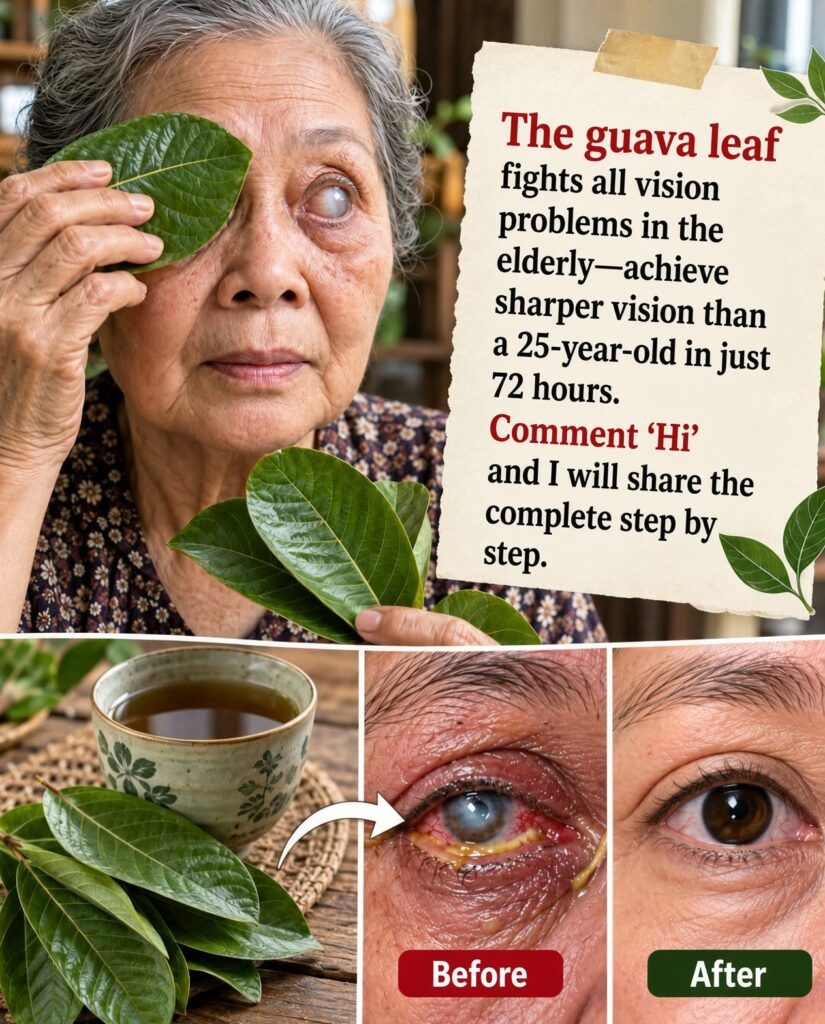
On social media, they sometimes appear alongside impressive claims, like “recovering vision” or making an elderly person’s eyes see like at 25. These promises, however, go far beyond what scientific evidence allows us to claim.
That does not mean the plant is uninteresting.
Guava leaves contain different plant compounds, including flavonoids and other antioxidants. That is why they have been studied in various areas. The important question is understanding **what we know, what is still being researched, and how to use them without putting your eyes at risk**.
## Why Can Vision Change with Age?
The eyes are extremely complex structures. To see clearly, we need proper interaction between the cornea, lens, retina, optic nerve, muscles, and tear system.
With aging, some natural changes can occur.
The lens gradually loses some of its flexibility, making near vision harder. Tear production or quality can also change, favoring a feeling of dryness, burning, or grittiness in the eyes.
In addition, conditions like cataracts, glaucoma, macular degeneration, and diabetes-related changes become more frequent with advancing age.
That is why **persistent blurry vision should not be automatically attributed to aging**.
## What Is in Guava Leaves?
Guava leaves (*Psidium guajava*) present plant compounds of scientific interest, including:
– flavonoids;
– tannins;
– phenolic compounds;
– carotenoids in certain concentrations;
– other substances with antioxidant activity studied in the laboratory.
Antioxidants participate in protecting cells against so-called **oxidative stress**, a process that occurs naturally in the body and is associated with the aging of various tissues.
That is precisely where much of the interest in guava leaves comes from.
However, there is a huge difference between discovering antioxidant activity in laboratory studies and demonstrating that a tea can **reverse cataracts, glaucoma, or vision loss in humans**.
So far, it is not appropriate to make that promise.
## Can Guava Leaf Improve Vision?
It is better to approach the question from another angle.
No isolated food works like an “reset button” for the eyes. A varied diet, however, provides important nutrients for maintaining eye health throughout life.
Green vegetables, colorful fruits, eggs, fish, and other food sources can provide nutrients like vitamins A, C, and E, zinc, lutein, zeaxanthin, and essential fatty acids.
Guava leaves can be part of traditional dietary habits, but **they should not replace nutritious foods, eye exams, or prescribed treatments**.
This detail is especially important after 60.
## Antioxidants and Eye Aging
Imagine our cells as tiny structures working continuously for decades.
Over this period, normal metabolic processes produce reactive molecules. The body has its own mechanisms to deal with them, and antioxidants obtained from food also participate in this balance.
That is why diets rich in fruits and vegetables are often associated with general health.
However, consuming more antioxidants does not automatically mean seeing better.
When a person has blurry vision from cataracts, retinal changes, glaucoma, or another structural problem, a tea cannot simply correct the cause.
The best strategy is to combine **good nutrition, protective habits, and eye care follow-up**.
## Tired Eyes at the End of the Day: What Can Help?
Many people believe that temporary worsening of vision during the afternoon necessarily means their eyes are “aging rapidly.”
Not always.
Long periods in front of a phone or computer can reduce blink frequency. Air conditioning, fans, and dry environments also favor tear evaporation.
The result can be:
– burning;
– gritty feeling;
– heavy eyelids;
– temporary difficulty focusing;
– greater light sensitivity;
– vision that fluctuates during the day.
In these cases, some simple attitudes are usually more relevant than looking for a miracle ingredient.
Taking breaks during screen use, blinking consciously, maintaining adequate lighting, and talking to a professional when symptoms persist are good starting points.
## And the Bother with Headlights at Night?
This is another sign frequently mentioned by older people.
Headlights that seem to form large halos, increased glare, or growing difficulty driving at night can have several explanations.
Dry eye and changes in glasses prescription are relatively simple possibilities. However, **cataracts and other eye conditions can also cause similar symptoms**.
That is why, if driving at night is becoming progressively harder, it is worth scheduling an eye evaluation instead of trying to compensate for the problem with homemade recipes alone.
## How to Prepare Guava Leaf Tea?
For those who already use guava leaves as a traditional drink and want to include them occasionally in their diet, a simple preparation is enough.
### Ingredients
– 3 to 4 well-washed guava leaves;
– approximately 250 ml of water.
### Preparation
Heat the water until it starts to boil.
Turn off or lower the heat, add the leaves, and let infuse for approximately **5 to 10 minutes**.
Then strain and let it reach a comfortable temperature before drinking.
There is no need to prepare an extremely concentrated infusion. Stronger does not necessarily mean more beneficial.
## Does Overboiling Destroy All the Benefits?
This claim also deserves care.
Temperature and preparation time can modify the concentration of certain plant compounds, but saying that a few extra seconds of boiling “completely destroy” the leaf’s effect is an exaggerated simplification.
For culinary use, a moderate infusion is a practical alternative.
The most important thing is not to turn small differences in preparation into miracle rules.
## A Very Important Warning: Do Not Put Guava Tea in Your Eyes
Here is a fundamental distinction.
**Drinking an infusion and applying a homemade preparation directly to the eyes are completely different things.**
Teas prepared in the kitchen are not sterile. Even when the leaves look perfectly clean, microorganisms or particles can remain in the liquid.
Therefore, avoid:
– dripping guava leaf tea into your eyes;
– washing your eyes with the infusion;
– placing leaves directly on the eyeball;
– replacing prescribed eye drops with homemade recipes.
Products intended for inside the eyes must follow specific sterility standards.
## The Diet That Really Deserves Attention for the Eyes
Instead of relying on a single plant, think about the whole plate.
A diversified eating routine can include dark green vegetables, carrots, pumpkin, tomatoes, citrus fruits, guava, eggs, fish, legumes, seeds, and oilseeds.
These foods offer different vitamins, minerals, fats, and plant pigments.
Variety matters precisely because **no single ingredient alone provides everything the body needs**.
## Other Important Habits After 60
Eye health also depends on factors that don’t fit in a cup of tea.
Properly controlling blood sugar and blood pressure, when necessary, can be particularly important. Using UV protection, avoiding smoking, and having periodic eye evaluations are also part of care.
Those who spend many hours in front of screens can also try the well-known **20-20-20** strategy: approximately every 20 minutes, look for about 20 seconds at something about 6 meters away.
It is a small break to relax focusing effort.
## When to Seek Care Quickly?
Some visual changes should not wait for tea, rest, or dietary changes.
Seek medical evaluation promptly in situations like:
– sudden vision loss;
– suddenly very blurry vision;
– light flashes that appear suddenly;
– sudden appearance of many spots or “floaters”;
– feeling of a curtain or shadow covering part of vision;
– intense eye pain;
– very red eye accompanied by visual change;
– double vision that appeared suddenly.
These signs can have causes that require urgent evaluation.
## So, Are Guava Leaves Worth It?
Guava leaves are interesting from a nutritional and phytochemical point of view and have a long history of traditional use.
But there is an important difference between **supporting wellness habits** and **treating an eye disease**.
There is no basis for promising that a guava leaf infusion will make a 60, 70, or 80-year-old person see again like at 25.
The most sensible path is much less spectacular — and much more useful: varied nutrition, eye protection, adequate rest, health condition control, and eye care follow-up.
The guava leaf can be just a small part of that routine.
### Conclusion
When vision starts to change, it is natural to look for simple alternatives that might help. And traditional ingredients like guava leaves certainly spark curiosity.
If consumed properly, an infusion can be part of a varied diet. However, its possible benefits should not be confused with the ability to recover lost vision or treat cataracts, glaucoma, and other diseases.
For aging eyes, **true care does not depend on a single leaf, but on the combination of good habits and professional follow-up**.
**Notice:** this content is for informational purposes only and does not replace diagnosis, guidance, or medical treatment. People who use medications, have chronic diseases, are pregnant or breastfeeding should talk to a health professional before using plant preparations regularly.


