
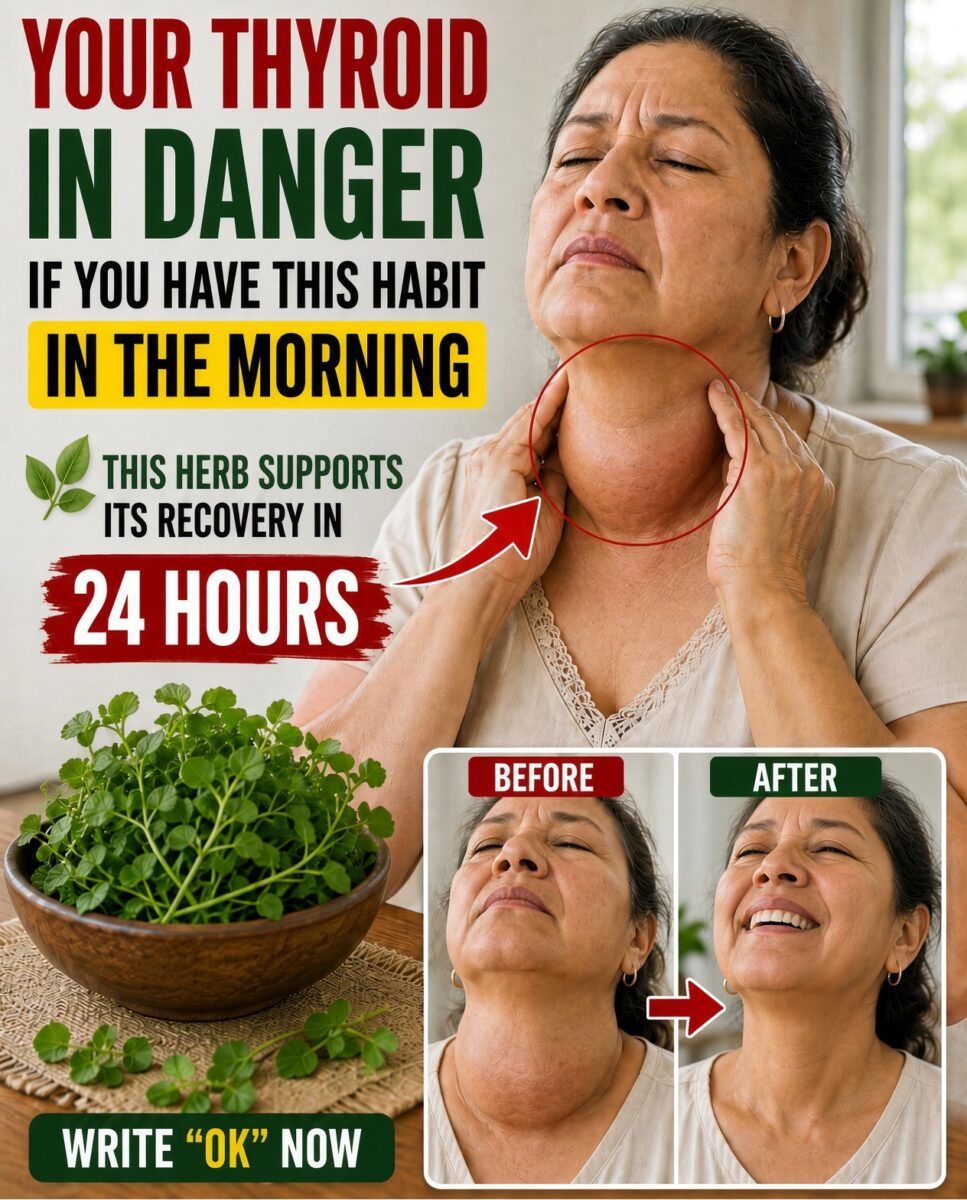
Many people experience something uncomfortable: they wake up tired, look in the mirror at a slightly swollen neck, or feel they need coffee every morning to get going — but prefer to tell the family it’s “just age things.” That resignation can make them overlook important habits, especially when they already take thyroid medication. The good news: there’s no miracle herb that “recovers the thyroid in 24 hours” — but there are simple changes to the morning routine worth knowing. And later we’ll see one of the easiest breakfast mistakes to make.
The morning habit that deserves more attention
When we talk about the thyroid, it’s tempting to blame one food or one plant. But the issue is usually more complex.
For some people using levothyroxine, one especially important detail is how and when they take the medication. Food, coffee and certain supplements can change its absorption if taken too close to the dose.
That’s why taking the pill quickly and immediately following it with the coffee, breakfast or certain supplements isn’t a habit to improvise. The routine depends on the medication’s form and the instructions received — don’t change schedules or doses based on what you read online. Follow your doctor’s instructions.
Routine checks: taking the medication with coffee → better as indicated, usually with water; constantly changing the schedule → keep a consistent professional routine; combining it with supplements unchecked → ask about the right interval; doubling a dose on your own → ask what to do about a forgotten dose; stopping it when feeling better → keep the indicated follow-up.
Coffee, calcium and iron: small details that can matter
Here’s the part that surprises many families: it’s not always the “bad” food causing the problem. Sometimes the timing is what needs reviewing.
Calcium and iron, for example, can interfere with levothyroxine absorption when taken too close to it. Coffee deserves attention too.
This doesn’t mean a person with hypothyroidism is forbidden from coffee or calcium foods. It means organizing the schedule properly. A practical routine: identify exactly which medication you use and review its instructions; always take it as your doctor indicated; ask how long to wait before breakfast and coffee; if you take calcium, iron, antacids or multivitamins, ask what spacing you need; keep consistent schedules day to day; inform your doctor before making major supplement or diet changes.
The truth is simple: a small correction in breakfast organization can be wiser than buying a supposed “thyroid remedy” advertised on social media.
Is there really an herb that recovers the thyroid in 24 hours?
Let’s be very clear: no herb can guarantee thyroid function recovery in 24 hours. Posts presenting a plant as an immediate substitute for medical follow-up oversimplify a problem that can have different causes.
A plant used as food or infusion isn’t automatically dangerous either. The problem appears when it’s promoted as a substitute for medications, or when a person starts consuming concentrated extracts and supplements without reviewing possible interactions — especially important after 60, when using several medications at once is common.
Before regularly adding an herb or supplement, review: what plant it contains exactly, what amount it provides, whether it interacts with medications, whether it includes iodine or other minerals in high doses, whether there’s reasonable evidence for the advertised use, and whether the product has a reliable origin. Natural doesn’t automatically mean harmless — nor does it mean it can correct a hormonal imbalance.
Iodine and diet: neither too little nor too much
The thyroid needs iodine to make hormones — and from that came the widespread idea: “if a little is needed, more must be better.” It doesn’t work that way.
Both insufficient and excessive iodine intake can be problematic for certain people. So supplements with large amounts of iodine shouldn’t become a home solution. A varied diet is usually a much more reasonable starting point: varied vegetables and fruits, appropriate protein sources, fish when part of the usual diet, eggs, whole grains, and other foods matching personal needs.
What about broccoli, cabbage and cauliflower? You don’t need to automatically eliminate these foods because of a thyroid problem. Exaggerated restrictions can impoverish a diet that should be varied. If you have a specific thyroid condition or known nutritional deficiency, a professional can help adapt amounts to your situation.
Neck signals you shouldn’t try to solve with home remedies
A photo like the ones circulating on social media — a person with a large neck swelling followed by an “after” image — can suggest that a drink or herb can make the problem disappear quickly. That conclusion isn’t safe.
An enlarged neck has different causes and shouldn’t be assumed to necessarily come from the thyroid. Pay special attention to: a new lump in the neck, progressive volume increase, persistent voice changes, discomfort or difficulty swallowing, a feeling of neck pressure, difficulty breathing.
Here it’s not worth waiting to check whether an infusion “works.” A professional evaluation determines what’s really happening.
A friendlier morning routine after 60
Now the practical part. You don’t need to turn every morning into an endless list of prohibitions — the important thing is establishing sustainable habits.
On waking, start by exactly respecting your medications’ instructions. If you take levothyroxine, organize breakfast, coffee and supplements according to the instructions you’ve received. Then think about the whole day: keep a varied diet, hydrate properly, and move within your possibilities.
And here’s the promised detail: the most useful habit isn’t adding a secret herb to your breakfast — it’s reviewing what you already do every day. The timing of a pill, the coffee right after it, a seemingly harmless supplement, or frequent routine changes may deserve far more attention than any viral recipe.
Myths and realities about the thyroid
“One herb recovers the thyroid in 24 hours” → no such scientific guarantee exists. “Natural means it can’t harm” → plants and supplements can have effects and interactions. “Eliminate all cruciferous vegetables” → no such general prohibition exists. “More iodine strengthens the thyroid” → excess can also be problematic. “If I feel well I can stop the pill” → never change a medication without professional guidance. “Every neck lump is the thyroid” → different causes require evaluation.
Frequently asked questions about thyroid habits
Can I drink coffee if I use thyroid medication? You don’t necessarily have to eliminate it. The important thing is checking whether there should be an interval between your medication and coffee.
Can an herb replace my medication? You shouldn’t substitute a prescribed medication with an herb, tea or supplement without first talking to the professional handling your case.
What if I notice my neck is growing? Don’t try to determine the cause from internet photos. A lump or abnormal neck swelling deserves professional evaluation, especially if it’s growing or comes with breathing or swallowing difficulty.
This article is for informational and educational purposes only and is not medical advice. Please consult a qualified healthcare professional before making changes to your diet or health routine.


