
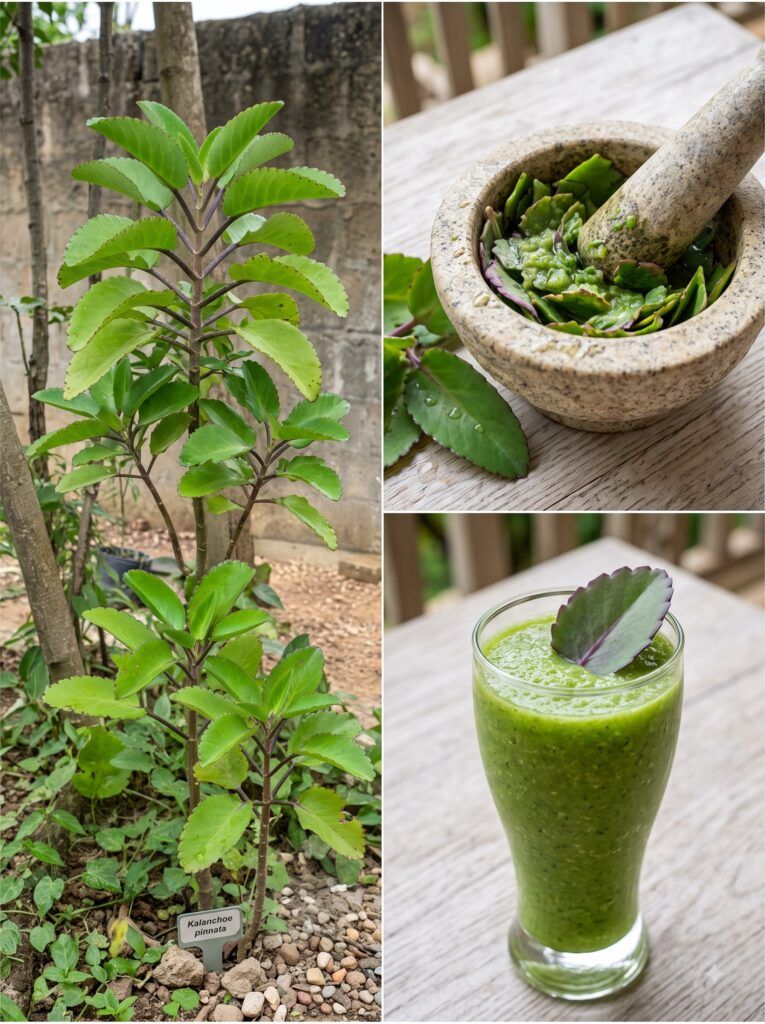
Have you ever heard of a plant called Miracle Leaf or Leaf of Life?
Known botanically as Kalanchoe pinnata (also called Bryophyllum pinnatum), this succulent plant has been used traditionally in different parts of the world for a variety of health-related purposes.
People have used its leaves in traditional preparations for concerns such as:
Stomach discomfort and ulcers
Blood sugar
Blood pressure
Headaches
Toothache
Minor bleeding
Itchy or irritated skin
Sleep and relaxation
But there is an important question:
Does Miracle Leaf really do all of these things?
And more importantly, is it safe for everyone?
Let’s take a closer look at its traditional uses, the scientific evidence, and the precautions you should know.
What Is Miracle Leaf?
Miracle Leaf, commonly known as Leaf of Life, is a succulent plant belonging to the Kalanchoe genus.
It is recognized by its thick, fleshy leaves and its ability to produce small plantlets along the edges of its leaves.
Because the plant is easy to propagate and grows in many tropical and subtropical regions, it has become part of traditional herbal practices in several cultures.
Researchers have identified numerous naturally occurring compounds in Kalanchoe pinnata, including flavonoids, phenolic compounds, triterpenes, and other phytochemicals.
These compounds are one reason scientists have investigated the plant for antioxidant, anti-inflammatory, antimicrobial, and other biological activities.
However, much of the evidence remains preclinical, meaning it comes from laboratory experiments or animal studies rather than large human clinical trials.
1. Miracle Leaf and Stomach Health
One of the traditional uses of Miracle Leaf involves digestive and stomach problems.
Experimental studies have investigated extracts of Kalanchoe pinnata for potential gastroprotective and anti-ulcer effects.
Some findings suggest that compounds in the plant may influence mechanisms involved in protecting the stomach lining and regulating gastric secretions.
This could help explain why the plant has been used traditionally for stomach discomfort.
However, having an effect in an experimental model is not the same as proving that the plant can heal an ulcer in humans.
If an ulcer is caused by H. pylori, appropriate medical testing and treatment are particularly important. Herbal preparations should not be used as a substitute for prescribed treatment.
2. It May Support Healthy Blood Sugar Levels
Another area of interest is blood sugar regulation.
Laboratory studies have examined Miracle Leaf extracts for their ability to interact with enzymes involved in carbohydrate digestion, including alpha-amylase and alpha-glucosidase.
These enzymes help break down carbohydrates into sugars that can be absorbed by the body.
Because some diabetes medications also affect carbohydrate digestion, researchers have become interested in whether plant compounds could influence similar pathways.
However, this does not mean that drinking Miracle Leaf tea has the same effect as diabetes medication.
Most of the available evidence is preliminary, and more human research is needed.
If you take medication for diabetes or already experience low blood sugar, consuming concentrated herbal preparations without professional guidance may be risky.
3. Could Miracle Leaf Support Blood Pressure?
Blood pressure is another area researchers have investigated.
Some laboratory studies suggest that compounds from Kalanchoe pinnata may interact with biological pathways involved in blood-pressure regulation, including pathways associated with the angiotensin-converting enzyme (ACE).
This is interesting because the renin-angiotensin system plays an important role in blood pressure.
But once again, laboratory activity does not automatically translate into a clinically meaningful effect in humans.
If you already take blood-pressure medication, combining it with a plant preparation that may influence blood pressure could potentially increase the risk of dizziness or excessively low blood pressure.
4. Miracle Leaf and Toothache
In traditional medicine, Miracle Leaf has also been used for toothache and other forms of oral discomfort.
Researchers have investigated Kalanchoe pinnata for anti-inflammatory and analgesic activity.
These properties may help explain its traditional use for painful or inflamed areas.
However, toothache often has an underlying cause such as tooth decay, gum disease, infection, or an abscess.
Applying a plant preparation may temporarily change the sensation of pain without addressing the underlying problem.
If tooth pain persists, becomes severe, or is accompanied by swelling or fever, dental care is important.
5. Could It Help With Headaches and Relaxation?
Some traditional practices use Miracle Leaf for headaches and relaxation.
Experimental research has investigated possible analgesic and sedative effects of compounds found in Kalanchoe species.
Some plant constituents may interact with pathways involved in the nervous system, which has led researchers to investigate potential effects on pain perception and relaxation.
But evidence that Miracle Leaf can reliably treat headaches or improve sleep in humans remains limited.
Headaches can also have many different causes, ranging from dehydration and stress to migraine or other medical conditions.
A recurring or unusually severe headache should not simply be treated with an herbal preparation.
6. Traditional Use for Minor Bleeding
Another traditional application of Miracle Leaf involves the topical use of crushed leaves or plant preparations on minor wounds.
Some experimental research has investigated the plant’s potential hemostatic and wound-healing properties.
Certain plant compounds may influence processes involved in blood clotting and tissue repair.
However, this should not be interpreted as meaning that Miracle Leaf can safely stop significant bleeding.
For a serious wound, heavy bleeding, or an injury that does not stop bleeding with appropriate first aid, seek medical attention immediately.
7. Itchy or Irritated Skin
Miracle Leaf has also been traditionally used on irritated or itchy skin.
Laboratory research has investigated anti-inflammatory and antihistamine-related effects of Kalanchoe pinnata extracts.
These findings may provide a scientific explanation for some traditional applications involving minor skin irritation.
Nevertheless, eczema, allergic reactions, infections, and other skin conditions can have very different causes.
Before applying a plant preparation to damaged skin, remember that natural products can also cause irritation or allergic reactions in some individuals.
How Is Miracle Leaf Traditionally Used?
Traditional preparations vary depending on the region and the purpose.
Some people use the leaves to prepare a tea or other oral preparation, while others crush the leaves and apply the resulting juice or paste to the skin.
However, there is no universally established medical dose for Miracle Leaf.
That is an important point.
The concentration of active compounds can vary depending on:
The plant species
The part of the plant used
Growing conditions
Harvesting
Preparation method
Amount consumed
Because of this variation, homemade preparations should not be treated as standardized medicines.
Is Miracle Leaf Safe for Everyone?
This is perhaps the most important part of the discussion.
“Natural” does not automatically mean “safe.”
Kalanchoe species contain biologically active compounds, and some species contain bufadienolides, compounds that may affect cardiac function.
The safety profile can therefore depend on the species, preparation, concentration, and amount consumed.
Possible concerns associated with oral use may include:
Nausea
Vomiting
Stomach discomfort
Dizziness
Excessive drowsiness
Low blood pressure
Other potentially serious effects with concentrated preparations
People with heart conditions should be particularly cautious with oral preparations.
Pregnant or breastfeeding individuals should also avoid medicinal use unless specifically advised by a qualified healthcare professional.
People taking medication for blood pressure, blood sugar, or heart conditions should discuss herbal products with their healthcare provider before using them regularly.
Miracle Leaf: Food, Traditional Remedy or Medicine?
This distinction matters.
A plant can have interesting biological properties without being a proven treatment for a disease.
For Miracle Leaf, many of the findings that attract attention come from:
Traditional use → laboratory research → animal studies → preliminary evidence
But the final step—high-quality human clinical evidence—is still limited for many of the popular health claims.
Therefore, it is more accurate to say that Miracle Leaf has potential that researchers are investigating rather than saying it can cure ulcers, diabetes, hypertension, toothache, headaches, or other medical conditions.
The Bottom Line
Miracle Leaf, also known as Leaf of Life, is a fascinating traditional medicinal plant that has attracted scientific interest.
Research has explored its potential:
Gastroprotective effects
Anti-inflammatory activity
Analgesic effects
Antioxidant properties
Effects on carbohydrate-digesting enzymes
Possible effects on blood-pressure pathways
Wound-healing activity
But many of these findings come from laboratory or animal research.
More high-quality human studies are needed to determine whether these effects translate into meaningful health benefits in people.
So, while Miracle Leaf may have an interesting place in traditional herbal medicine, it should not automatically be considered a replacement for proven medical treatment.
And remember:
Herbal remedies can have biological effects—and that means they can also have side effects or interact with medications.
Use caution, especially with concentrated oral preparations.
This article is for educational purposes only. It is not intended to diagnose, treat, cure, or prevent any disease.


