
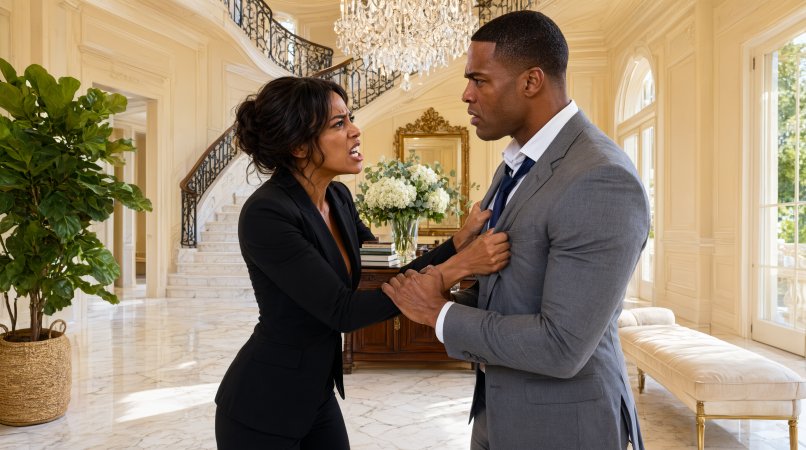
“My Mother-in-Law H\*t My Two-Year-Old Daughter—So I Sl\*pped My Silent Husband Three Times and Walked Out…
The sound of Diane Bennett’s palm striking my two-year-old daughter’s face silenced the room, stopped a birthday livestream, and ended my marriage in less than three seconds.
Lily’s head snapped sideways.
Her tiny body twisted in Diane’s grip, one yellow sock slipping halfway off her foot.
Diane had yanked her from the booster seat after a plastic bowl tipped over—an accident caused when Diane’s shouting made Lily flinch.
For a heartbeat, my daughter made no sound.
She simply stared across the dining room at me, her blue eyes wide with the terrible confusion of a child who had been hurt by someone she had been taught to trust.
Then she screamed.
The red outline of Diane’s fingers began rising on her left cheek.
“Maybe now you’ll learn not to spill food,” Diane said.
It was her sixty-second birthday.
We were in the Chicago condo she had ruled for thirty years, surrounded by white roses, crystal wineglasses, and a chocolate cake my sister-in-law had ordered from a bakery in River North.
Brown soup dripped from Lily’s overturned bowl onto the ivory rug.
Five relatives watched through Brooke’s livestream.
In the room, no one moved to take Lily from Diane.
The only sound was the cheerful birthday music playing from a speaker beside the cake, grotesquely bright against my child’s first broken sob.
My husband, Jason, sat six feet away.
He had seen everything.
His fork was suspended above his plate, a piece of steak still caught between its tines.
He looked from his mother to our sobbing child.
Then his gaze dropped to the smartphone beside his glass.
He did not stand.
He did not say Lily’s name.
“Jason,” I said.
His lips parted.
“Mom just lost her temper.
Don’t make this—”
I crossed the room and sl\*pped him.
His glasses flew from his face and landed in his soup.
Before he could turn back, I sl\*pped him a second time.
Then a third—one for every year I had waited for him to defend us.
His sister Brooke gasped.
Her phone, which had been broadcasting Diane’s birthday dinner live, disappeared beneath the table.
Jason held his swelling cheek and stared at me as if I were the dangerous person in the room.
“You’re thirty-two years old,” I told him.
My voice sounded calmer than I felt.
“You can’t wash your own plate.
You can’t tell your mother no.
And you can’t protect your wife or your daughter.
By Diane’s rules, shouldn’t somebody h\*t you every time you fail?”
“You psychotic little—” Diane released Lily and lunged at my hair.
I stepped aside.
Diane’s hip struck the table, and her arm swept the birthday cake onto the floor.
White frosting exploded across her silk slippers.
She collapsed against a chair, howling that I had @ttacked her.
Brooke pointed at me.
“You came into our family and ruined everything!”
I barely heard her.
I caught Lily before she fell, pressed her face against my neck, and picked up the canvas bag I had hidden behind the entry bench that morning.
Jason saw it.
His expression shifted.
“Why is that bag packed?” he asked.
That was the first useful question he had asked in three years.
I looked back at the wrecked table.
Diane was crying over her hip.
Brooke was wiping soup from her dress.
Jason was still sitting down.
“From tonight on,” I said, “anyone who touches my daughter will answer for it.”
Then I walked out.
Jason followed me only as far as the hallway.
“Emily, come back.
Mom’s blood pressure—”
The elevator doors closed on him.
Fifteen minutes later, a pediatrician at an urgent-care clinic in Lincoln Park examined Lily beneath unforgiving fluorescent lights.
Lily clung to my sweater with both fists while Dr.
Howard measured the swelling and gently checked her jaw and neck.
“How did this happen?” he asked.
“Her grandmother struck her across the face.”
His pen stopped.
“Write exactly that,” I said.
“Please document the shape of the mark, the swelling, and Lily’s reaction when anyone reaches toward her.”
He studied me for a moment, then nodded.
He wrote: blunt-force injury to the left cheek, consistent with an open-handed strike.
He explained mandatory reporting requirements.
I told him I understood and that I wanted a copy before we left.
In the hallway, I photographed every page of the medical report.
Then I opened a password-protected album on my phone and uploaded the images.
The report did not become Exhibit One.
It became Exhibit Thirty-Eight.
Ahead of it were photographs of bruises Diane had called “discipline,” a picture of the vase Jason had smashed during a drunken argument, screenshots of Brooke’s insults, and a close-up of the chemical cracks across my hands after Diane made me scrub her kitchen with industrial cleaner.
For three years, they had mistaken my silence for surrender.
Standing beneath the clinic lights with my daughter trembling against my chest, I finally understood what my silence had really been.
It had been evidence gathering.
And the next morning, I was going to give all of it to the most ruthless family-law attorney in Chicago…
—
Thirty-eight exhibits.
Three years of silence.
And Emily is just getting started.
What do you think Diane and Jason will do when they find out what she’s been building this whole time?
Comment **”NEXT”** if you want Part 2 — it’s in the comments below.
* * *
PART 2
* * *
Part 2 ⬇️
My phone lit up before I even reached the parking lot.
Jason: *Mom is in serious pain.
You need to come back and apologize.*
I stared at the screen.
Lily was still shaking against my shoulder.
I turned my phone face-down and kept walking.
By midnight, there were nineteen messages.
Not one of them asked how Lily was.
At 2 a.m., Brooke posted to her Facebook story.
A photo of Diane sitting in an armchair with an ice pack, eyes red, looking frail.
The caption read: *”Attacked in her own home on her birthday.
Pray for my mother.”*
Within an hour, two hundred people had shared it.
My name was in the comments.
So was Lily’s.
I sat on the edge of the hotel bed with Lily finally asleep beside me and read every word.
Then I opened my email and found something I had not expected.
It was from a woman named Carol Simmons.
The message was three sentences long.
*”I was watching the livestream tonight.
I recorded everything from the moment Diane grabbed Lily.
I don’t know you, but I have a granddaughter the same age.
Tell me where to send the file.”*
My hands went still.
Brooke had hidden her phone when I sl\*pped Jason.
But she had forgotten that five other people were still watching.
I typed back one word: *Here.*
What Carol’s recording revealed — and what the attorney said when she watched it the next morning — changes everything.
👉 Click the link below to read the full story.
What happens next will leave you speechless.
* * *
PART 3
* * *
Her name was Ruth Callahan, and she had been practicing family law in Chicago for twenty-six years.
Her office was on the fourteenth floor of a building on West Madison, and when I walked in at nine the next morning with Lily asleep in the stroller and a manila folder under my arm, her assistant looked at the folder and then at me and said, “She’s ready for you.”
Ruth was standing at her window when I came in.
She turned, looked at Lily, and looked at my face.
“Sit down,” she said.
“Show me what you have.”
I set the folder on the desk and opened it.
She didn’t speak for eleven minutes.
She turned pages slowly, stopping twice — once at the photograph of Lily’s bruised arm from fourteen months ago, and once at the medical report from the night before.
She picked that one up and read every line.
“Blunt-force injury,” she said.
“Consistent with an open-handed strike.” She set it down.
“And you have thirty-seven other documents like this.”
“Thirty-seven others, yes.”
“How long have you been building this?”
“Since the third month of my marriage.”
Ruth looked at me over the top of her reading glasses.
“What made you start in the third month?”
“Diane threw a ceramic mug at Lily’s baby monitor,” I said.
“She was four months old.
She was sleeping.
The mug didn’t hjt her.
But I thought — if I ever need to leave, I want to be believed.”
Ruth was quiet for a moment.
“And Carol Simmons’s recording?”
I took out my phone and pressed play.
The audio was clear.
You could hear Diane shouting about the soup.
You could hear the sharp sound of the impact.
You could hear the half-second of silence before Lily screamed.
And then you could hear Diane’s voice, perfectly audible, saying: *”Maybe now you’ll learn not to spill food.”*
Ruth listened to the whole thing without moving.
When it ended, she folded her hands on the desk.
“Emily,” she said, “I want you to understand something.
What you have here is not a divorce file.
What you have here is a custody case that is already over.”
—
Jason called at ten-fifteen, while I was still in Ruth’s office.
I let it ring.
He called again at ten-seventeen.
Ruth raised an eyebrow.
“Husband?”
“Yes.”
“Don’t answer it today.
Don’t answer anything today.” She slid a single sheet of paper across the desk.
“Sign this.
I’ll have the emergency protective order filed before noon.”
My pen was already moving.
Jason’s third call came at ten-twenty-one.
This time he left a voicemail.
Ruth’s assistant played it on speaker at Ruth’s request, so she could assess the tone.
*”Emily, I’ve spoken to a lawyer.
You need to understand that what you did last night was @ssault.
Mom has a witness.
Brooke has it on video.
If you don’t come home today and apologize, we’re going to pursue this.
And we’ll make sure you don’t get unsupervised time with Lily.
Think about what you’re doing.”*
The voicemail ended.
Ruth’s assistant stopped the recording.
“He just threatened to use a video as evidence,” Ruth said.
She almost smiled.
“The same video that shows his mother striking a two-year-old.”
“Brooke hid her phone when I sl\*pped him,” I said.
“She started recording again after that.”
“So her video begins after the strike on Lily.”
“Yes.”
“And Carol Simmons’s recording captures everything before that.”
“Yes.”
Ruth picked up her pen.
“Then let them file.
I would enjoy that very much.”
—
The protective order was granted at 1:47 p.m.
I was sitting in a coffee shop two blocks from Ruth’s office, feeding Lily a small container of applesauce, when my phone buzzed with the confirmation.
Ruth’s message read: *Diane Bennett is prohibited from contact with Lily pending the hearing.
Jason has been served.
Call me at three.*
Lily looked up at me with applesauce on her chin.
“It’s okay,” I told her.
“We’re okay.”
She held out the spoon.
I took it and gave her another bite and did not cry until she looked back down at her cup.
—
Jason appeared at the hotel at four o’clock.
I knew because the front desk called to tell me.
I had asked them to call if anyone came asking for my name.
I told the desk clerk I was not available.
Then I called Ruth.
“He’s at the hotel,” I said.
“Is Lily with you?”
“Yes.
We’re in the room.”
“Stay there.
He cannot legally compel you to open that door.
If he causes a disturbance, call the front desk and ask them to contact the police.
Do not go down.
Do not speak to him through the door if he comes up.”
“He’ll come up.”
“Then let him knock.
You don’t owe him a conversation.”
He knocked at 4:22.
Three times, evenly spaced.
“Emily.” His voice was quieter than I expected.
“I know you’re in there.
I just want to talk.
I’m not — I’m not here to fight.”
Lily was on the bed behind me, arranging a small pile of crackers into a line.
She didn’t look up.
“Emily, please.
Mom is really shaken.
She didn’t mean for it to go that far.
She’s been under a lot of stress and she—”
“She’s been under stress,” I said, through the door.
A pause.
“I know how that sounds.”
“Jason, you’ve been served with a protective order.
You need to leave.”
“I just want to see Lily.”
“Call Ruth Callahan’s office.
Her number is in the paperwork.”
“Emily—”
“Call Ruth Callahan’s office,” I said again.
“Goodbye, Jason.”
He stood outside the door for another four minutes.
I know because I watched the shadow under the gap.
Then the shadow moved away.
—
The hearing was scheduled for twelve days later.
In those twelve days, three things happened that I had not planned for.
The first was Brooke.
She called on day four, and I almost didn’t answer.
But Ruth had told me to document every contact, so I picked up and put the phone on speaker and set it on the kitchen counter of the apartment I had moved into two days earlier — a two-bedroom on the north side, first floor, with a small yard where Lily could play.
“I need you to know,” Brooke said, “that I didn’t know it was that bad.”
I didn’t say anything.
“I knew Mom was hard on you.
I knew she said things.
But I didn’t know she was — I didn’t know about the bruises.
Jason showed me some of the photos from your file.
His lawyer sent them over.”
“Jason’s lawyer sent you photographs of your niece’s bruises.”
A long silence.
“Yes.”
“And what did you think?”
“I thought—” Her voice broke.
“I thought I should have paid more attention.”
I looked at the phone on the counter.
“Brooke, I’m going to be honest with you.
I don’t know yet whether I can trust you.
But if you’re willing to make a statement about what you saw at that dinner — not just what happened after I sl\*pped Jason, but everything before it — then call Ruth Callahan’s office.”
“You want me to testify against my own mother.”
“I want you to tell the truth about what happened to my daughter.”
Another silence.
Longer this time.
“Okay,” she said.
“Okay.
I’ll call.”
—
The second thing was Carol Simmons.
She drove down from Evanston on day six and sat across from me at a diner on Clark Street with a cup of coffee she didn’t drink.
She was in her late sixties, with short white hair and the careful, watchful eyes of someone who had spent a long time paying attention to things other people missed.
“I have four grandchildren,” she said.
“The youngest is two and a half.” She wrapped both hands around her mug.
“When I heard that sound on the livestream, I knew what it was before I understood what I was seeing.”
“Thank you for recording it,” I said.
“I want to testify,” she said.
“In person.
I don’t want to just send a file.
I want to be in that room.”
I looked at her.
“You don’t know me.”
“No,” she said.
“But I know what I heard.
And I know that little girl didn’t make a sound for almost two full seconds after it happened.” She set down her mug.
“That’s the part that kept me up all night.
That silence.
Children that age cry immediately when they fall down.
That silence meant something different.”
I had to look at the window for a moment.
“I’ll have Ruth call you,” I said.
“Good.” Carol picked up her coffee at last and took a sip.
“I cleared my schedule for the hearing date.
Whatever day it is, I’ll be there.”
—
The third thing was Jason’s lawyer.
His name was Derek Paulson, and on day nine he sent Ruth a settlement proposal.
Ruth called me while I was putting Lily down for her nap.
“They want to settle,” she said.
I eased the door to Lily’s room closed and walked to the kitchen.
“What are they offering?”
“Joint custody, alternating weeks.
Diane Bennett to have supervised visitation only, supervised by Jason, no third-party supervision required.
Child support at the state minimum.
You retain the apartment.
Jason keeps the condo.”
I sat down at the kitchen table.
“Ruth,” I said.
“Diane supervising herself through Jason is not supervision.”
“I know.”
“He didn’t protect Lily when he was sitting six feet away.
He’s not going to protect her when his mother is alone with her in that condo.”
“I know that too.”
“What do we have?”
“We have the medical report.
We have thirty-seven prior exhibits.
We have Carol Simmons, who will testify in person.
We have Brooke Bennett, who called my office this morning and gave a voluntary statement.
And we have a voicemail in which Jason threatened to use a video as evidence — a video that begins after the incident with Lily and therefore shows nothing relevant to the child’s safety.”
I was quiet.
“Emily,” Ruth said.
“We don’t have to settle.”
“No,” I said.
“We don’t.”
—
On the morning of the hearing, Diane Bennett walked into the courtroom in a charcoal blazer and low heels, moving carefully, as if her hip still hurt.
She sat beside Derek Paulson and did not look at me.
Jason sat next to her.
He had a new pair of glasses.
He looked at me once, briefly, and then looked at his hands.
The judge was a woman named the Honorable Patricia Osei.
She had been on the family court bench for fourteen years.
She read through the submitted materials for six minutes before she looked up.
“Ms.
Callahan,” she said.
“Your client has submitted thirty-eight exhibits.”
“That is correct, Your Honor.”
“And a video recording of the incident that prompted this filing.”
“Yes, Your Honor.
Recorded by a third-party witness who was observing the livestream in real time and had no prior relationship with my client.”
Judge Osei looked at Derek Paulson.
“Counselor, does your client dispute the authenticity of the recording?”
Paulson glanced at Diane.
“Your Honor, we would argue that the recording lacks context and that the incident has been characterized in a manner that—”
“I’ve listened to the recording,” Judge Osei said.
“I don’t need it characterized.
I need to know if your client disputes that it is authentic.”
A pause.
“No, Your Honor.”
“Thank you.” She made a note.
“I’d like to hear from the third-party witness.”
Carol Simmons walked to the front of the courtroom in a navy dress and sat down in the witness chair as if she had been waiting twelve days for exactly this moment.
She described what she had seen on the livestream.
She described the sound.
She described the two-second silence before Lily screamed.
She described the words Diane had spoken immediately after.
Derek Paulson cross-examined her for nine minutes.
He asked whether she had a personal relationship with me.
She said no.
He asked whether she had any reason to misrepresent what she had seen.
She said no.
He asked whether she understood that a birthday dinner could be a stressful environment.
Carol Simmons looked at him steadily.
“I understand that a birthday dinner is not a reason to strike a two-year-old across the face.”
Paulson sat down.
—
Then Diane spoke.
She had asked to address the court directly, and Judge Osei had permitted it.
Diane stood, smoothed her blazer, and turned slightly so she was facing both the judge and the room.
“I want to be clear,” she said, “that I love my granddaughter.
What happened was a moment of frustration.
I had been cooking all day.
The soup had already stained the rug.
Lily had been fussing since we sat down.
I reacted poorly, and I am sorry for that.
But Emily has always been determined to drive a wedge between this family, and this—” she gestured at the room, “—is the result of that campaign.
She has been building a case against me since before Lily could walk.
That tells you everything about her intentions.”
She sat down.
The courtroom was quiet.
Judge Osei looked at Diane for a long moment.
Then she looked at me.
“Mrs.
Bennett,” she said — using my married name for the first and last time — “would you like to respond?”
Ruth touched my arm.
I stood.
“Diane is right that I’ve been documenting since before Lily could walk,” I said.
“Exhibit Seven is a photograph of Lily’s left arm, taken when she was nine months old, after Diane grabbed her during a car seat argument.
Exhibit Twelve is a recording of Diane telling an eighteen-month-old that she was stupid for being afraid of the dark.
Exhibit Twenty-Two is a photograph of my hands after Diane required me to clean her kitchen with industrial-strength bleach solution without gloves.” I paused.
“I didn’t build this case because I wanted to destroy a family.
I built it because I was afraid that one day something would happen that I couldn’t undo.
And then it did.”
I sat down.
Diane’s jaw was tight.
She leaned toward Paulson and said something in a low voice.
He put his hand on her arm.
Judge Osei was already writing.
—
She ruled forty minutes later.
Primary physical custody to Emily.
Jason to have parenting time on alternating weekends, supervised for the first six months by a court-appointed family advocate — not by Diane, not by Brooke, but by a neutral third party who would file reports with the court.
Diane Bennett was prohibited from unsupervised contact with Lily until Lily turned five, at which point the matter could be reviewed.
Any violation of that order would result in Jason’s parenting time being suspended immediately.
Jason was ordered to attend a parenting course.
Diane was referred to the mandatory reporting agency that Dr.
Howard had already contacted the night of the birthday dinner.
Derek Paulson was already on his phone when Judge Osei left the bench.
Jason sat very still.
Diane stood up slowly.
She looked across the room at me — not at Ruth, not at Carol, not at the judge’s empty chair.
At me.
“You have no idea what you’ve done to this family,” she said.
“I know exactly what I’ve done,” I said.
“I protected my daughter.”
Diane’s mouth opened.
Then it closed.
She picked up her bag and walked out.
Her heels were very loud on the floor, and then they weren’t, and then the door swung shut behind her, and the room was quiet.
—
Jason caught up with me in the hallway.
Ruth was two steps behind me, but she stopped when Jason held up his hand — not toward me, just toward the space between us.
“I’m not going to fight the ruling,” he said.
I waited.
“I want you to know that.” He looked older than he had twelve days ago.
The new glasses didn’t fit his face quite right.
“I’m not going to make this harder than it already is.”
“Okay,” I said.
“I just—” He stopped.
Started again.
“The night at the clinic.
When you said you’d been waiting three years for me to defend you.” He looked at the floor.
“I’ve been thinking about that every day since.”
“I know.”
“I don’t know how to fix it.”
“You can’t fix it,” I said.
“But you can be better for Lily.
That’s the only thing that matters now.”
He nodded once.
He didn’t say anything else.
He walked back toward the courtroom doors, and I watched him go, and I felt — not relief, not anger, not satisfaction.
Something quieter than all of those.
Something that had been waiting a long time to be set down.
—
Carol Simmons was waiting near the elevator.
She had her coat over her arm and her bag on her shoulder, and when she saw me she smiled — not a big smile, just a small, certain one.
“How do you feel?” she asked.
“Tired,” I said honestly.
“Good tired or bad tired?”
I thought about it.
“Good tired.”
She nodded.
“Good.” She pressed the elevator button.
“I’d like to meet Lily sometime.
When things settle.
No pressure.”
“I’d like that,” I said.
The elevator opened.
We rode down together without talking, which felt exactly right.
—
That evening, I gave Lily a bath in the new apartment.
She sat in three inches of warm water and moved a plastic duck back and forth between her hands, very seriously, as if the duck had somewhere important to be.
The mark on her cheek had faded to almost nothing.
Dr.
Howard had said it would be gone within two weeks.
“Duck,” Lily said.
“Duck,” I agreed.
She held it out to me.
I took it and quacked it twice, and she laughed — the full-body laugh of a two-year-old, head thrown back, completely unguarded, the laugh of a child who does not yet know that the world can be frightening, because the person responsible for keeping it safe has been doing her job.
I wrapped her in a towel and held her against my chest and stood in the small bright bathroom of our new apartment, and I thought about thirty-eight exhibits, and three years of silence, and a woman named Carol Simmons who had stayed up all night because of a two-second silence she couldn’t stop hearing.
I thought about Ruth saying: *It’s done.*
I thought about Diane’s heels on the courtroom floor, getting quieter, and then gone.
Lily patted my cheek with one damp hand.
“Mama,” she said.
“Yeah,” I said.
“I’m here.”
And I was.
Completely, finally, without reservation.
I was here.
—
Some people stay silent because they’re afraid.
Emily stayed silent because she was ready.


