
You brush your hair, glance at the brush, and again, you see more hair than you’d like. Then you notice your part is a little wider, try to fix your hairstyle, and still feel like your scalp is showing too much. This is frustrating, exhausting, and makes any “miracle” remedy sound tempting, especially after 60, when hair tends to thin. But a homemade concoction can’t reverse in minutes a change that occurs within the follicle. The good news is that there are safer and more realistic ways to address this, and you’ll eventually see a simple sign that can help you distinguish between a cosmetic issue and one that should be checked out soon.
Why hair can thin after 60
Age changes the hair growth cycle. Over the years, follicles can produce thinner, shorter, and fewer strands. Additionally, after menopause, the decrease in estrogen can affect hair density and make the part appear wider.
The American Academy of Dermatology explains that female pattern hair loss typically appears between the ages of 40, 50, or 60, and is often noticeable as thinning on the top of the head. But that doesn’t mean all hair loss has the same cause. And here’s the key point: if you don’t know why your hair is thinning, copying a recipe from the internet can waste valuable time.
Other factors may also be involved, such as:
- Family history
- Thyroid problems
- Some medications
- Significant physical stress
- Recent surgeries or illnesses
- Significant weight loss
- Hairstyles that are too tight
- Specific nutritional deficiencies
The Mayo Clinic notes that hair loss can be gradual or sudden, and that its causes include genetics, age, hormonal changes, illness, medications, and stress. Therefore, before considering ways to stimulate hair growth, it’s important to understand what’s really happening.
Onion juice: what a study showed and what it didn’t
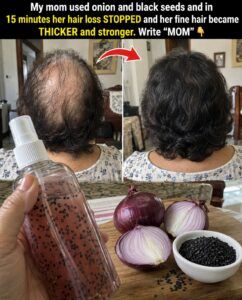
Onions are often presented as a tried-and-tested home remedy. The reality is more nuanced. A small study published in 2002 evaluated raw onion juice in people with alopecia areata, a condition characterized by localized bald patches. Participants applied the juice twice a day for two months. In some cases, visible growth began after about two weeks. It wasn’t instantaneous, and certainly didn’t happen in 15 minutes.

But that’s not all. That study was small, it was conducted on young people, and it analyzed alopecia areata, not the typical thinning of menopause or old age. That means we can’t take that result and assume it will work the same way for a woman in her 60s, 70s, or 80s with diffuse hair loss.
New hair needs time to grow. It can’t appear several centimeters from one minute to the next, no matter how “powerful” a hair mask may seem.
And what about the black seed? The evidence remains limited.
When people talk about “black seed,” they’re usually referring to Nigella sativa , also known as black cumin. It’s important to correctly identify the ingredient, because on social media, names are sometimes mixed up and different seeds are confused.

Nigella sativa contains thymoquinone, a compound that has been studied for its potential biological effects. However, clinical research on hair growth is still limited. There are small studies with topical preparations, but no solid, high-quality evidence shows that applying seeds or oil to the scalp will cause hair to grow back thick and strong within minutes.
And there’s another important detail: “natural” doesn’t mean “harmless.” Memorial Sloan Kettering has reported cases of contact dermatitis after topical use of pure Nigella sativa oil . In other words, it can irritate the skin in some people.
Therefore, using more doesn’t make the mixture more effective. Sometimes it just makes it more aggressive.

Falling, breaking, and thinning are not the same thing
This distinction avoids many false expectations. Not every hair you see in your brush has fallen out from the root, and not every visible scalp means the same thing. Hair can shed at the end of its cycle, break due to mechanical damage, or thin gradually from the follicle.
| What you observe | What could be happening |
|---|---|
| Full length of hair on the brush | Root detachment |
| Many short, split hairs | Stem breakage |
| Central stripe getting wider | Possible loss of female pattern |
| Round areas without hair | It is necessary to rule out alopecia areata |
| Frontal line receding with redness | Early evaluation is recommended. |
The AAD explains that in hereditary hair loss, follicles can gradually miniaturize, producing increasingly thinner strands. This won’t be reversed in 15 minutes. A hair mask can leave hair softer, shinier, or heavier, giving the impression of greater volume. But this visual improvement doesn’t mean that the number of active follicles has actually increased.
How to try onions without irritating your scalp
If you still want to experiment with onions as a cosmetic treatment, do so with modest expectations and prioritize your skin’s tolerance. The key is not to “endure” the burning sensation, but to prevent your scalp from becoming inflamed and worsening the problem.
First, apply a small amount to a small area of skin and wait to see if any burning, redness, itching, or swelling occurs. If there is no reaction, use it only on a healthy scalp and for a short time. Then, wash with a mild shampoo.
And here’s an important warning: you don’t need to mix it with lemon, alcohol, baking soda, or irritating essential oils. Combining harsh substances can further sensitize your skin.
- Do not apply it to wounds, scabs, or previous irritation.
- Don’t rub hard thinking that it “penetrates better”.
- Do not use it if you are allergic to onions.
- Do not sleep with a preparation that already causes burning.
- Do not store homemade mixtures for many days.
- Do not use concentrated black seed oil if you have already had a reaction before.
If it burns intensely, remove it. Burning does not mean that the follicle is “waking up.” It means that the skin is getting upset.
What does have better support for female weight loss
When it comes to female pattern hair loss, there’s a big difference between an experimental remedy and an option that has been specifically studied. The American Academy of Dermatology notes that minoxidil is one of the most recommended treatments for this type of hair loss, and that starting early often yields better results.
That doesn’t mean you should buy it without first investigating the cause. A dermatologist can examine your scalp and, if necessary, order tests to rule out hormonal problems, deficiencies, diseases, or infections. The goal isn’t to mask the symptom, but to treat the underlying cause.
Meanwhile, there are simple habits that help protect the hair you still have:
- Avoid very tight hairstyles.
- Reduce the use of irons and extreme heat.
- Gently untangle.
- Use conditioner to reduce friction and breakage.
- Include enough protein in your diet.
- Don’t take iron, biotin, or other supplements without knowing if you really need them.
The truth is this: taking care of your hair doesn’t always mean putting more products on it. Sometimes it means removing damage.
The sign in front of the mirror that you shouldn’t ignore
A monthly photo can be much more helpful than checking your hair brush every day. Take a picture of your center part in the same lighting and from a similar angle. If over time you notice that the part widens, your scalp shows more, or your ponytail loses thickness, it’s worth consulting a stylist.
The most important fact is not how many hairs you see today, but whether the pattern changes progressively.
It is also advisable to seek medical evaluation if any of these signs appear:
- Sudden loss of large amounts of hair
- Completely unpopulated round areas
- Intense pain or itching
- Crusts or discharge
- Eyebrow loss
- Rapidly retreating front line
- Persistent redness around the follicles
Mayo Clinic recommends consulting a doctor, especially if the hair loss is sudden, localized, or significantly greater than usual. This makes sense: the sooner the cause is identified, the more treatment options are available.
Practical steps you can take starting today
If you’re worried about thinning hair, start with what’s most useful and measurable. You don’t need to do ten things at once. You need a simple, consistent plan.
First, take a picture of your center part today. Repeat this once a month in the same lighting. Second, observe if you see any hair loss, breakage, or thinning. Third, check if your hairstyle, heat styling, or dyes are doing more harm than good. Fourth, ensure you eat a diet with enough protein, and if you suspect a deficiency, consult a doctor before taking supplements. Fifth, schedule an evaluation if the change is gradual or you’re genuinely concerned.
The most important thing is not to normalize a hair loss that continues to progress. Sometimes the problem seems “only cosmetic,” but the pattern tells a story worth listening to.
Conclusion
Onions have one small but interesting study, and Nigella sativa is still being researched. But that’s a far cry from proving that a homemade mixture can stop hair loss or transform fine hair into thick hair in 15 minutes.
After 60, a widening part deserves more than just changing remedies every week: observe the pattern, treat your scalp gently, maintain a healthy diet, and look for the cause as hair loss progresses. You can try a home remedy if your skin tolerates it, but don’t let a dramatic promise delay a checkup when your hair continues to thin.
Frequently Asked Questions
Can onions stop hair loss in 15 minutes?
No. There is no evidence that they stop any type of hair loss in that amount of time. The available study was small and observed results after weeks of repeated use, not minutes.
Does black seed oil thicken hair?
Clinical evidence is still too limited to say for sure, especially in older women with female pattern hair loss. Furthermore, the oil may cause irritation or dermatitis in some people.
What should I do if my part is widening?
Take regular photos and consult a dermatologist. A widening part is one of the most common patterns of female hair loss, and early treatment usually yields better results.
This content is for informational purposes only and does not replace the assessment, diagnosis, or personalized recommendations of a healthcare professional.


