
Papaya and mango leaves have a long history of traditional use, but they should not be described as proven cures for infections, high blood pressure, liver disease, or other medical conditions. Human evidence is limited for many of the claims commonly found online. The recipes below are presented as traditional herbal preparations, not medical treatments.
Papaya Leaf and Mango Leaf: Why Are They Used Traditionally?
Papaya and mango trees are common in tropical regions, where their fruits are widely consumed. Less commonly, their leaves have also been used in traditional preparations.
Papaya leaves contain various plant compounds, including flavonoids, phenolic compounds, and enzymes. Papaya leaf preparations have attracted scientific interest, particularly for their potential antioxidant and other biological activities.
Mango leaves also contain polyphenols and other plant compounds. Traditionally, young mango leaves have been infused or boiled in water and consumed as a herbal drink.
However, there is an important distinction between traditional use and proven medical treatment. A laboratory study or traditional practice does not automatically mean that drinking a leaf tea can treat a disease in humans.
Instead of thinking of these drinks as “cures,” it is more accurate to view them as traditional beverages that may provide plant compounds as part of an overall healthy lifestyle.
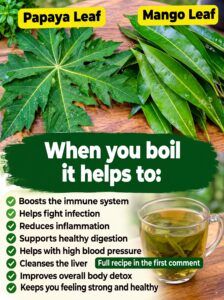
1. Simple Papaya Leaf Tea
One of the easiest ways to prepare papaya leaves is as a mild herbal infusion.
Ingredients
- 2–3 young, fresh papaya leaves
- 2 cups of water
- Optional: a small amount of honey for taste
How to Prepare
- Wash the papaya leaves thoroughly under running water.
- Remove damaged or excessively tough portions.
- Cut the leaves into smaller pieces.
- Bring 2 cups of water to a boil.
- Add the leaves.
- Reduce the heat and simmer for approximately 5–10 minutes.
- Strain the liquid and allow it to cool to a comfortable temperature.
- Add a little honey if desired.
Traditional Uses
Papaya leaf tea is traditionally consumed as a plant-based beverage and is sometimes promoted for digestion, antioxidant support, and general wellness.
There is not enough high-quality human evidence to conclude that papaya leaf tea can cure infections, detoxify the liver, or treat high blood pressure.
2. Mango Leaf Infusion
Mango leaves can also be prepared as a simple infusion.
Ingredients
- 4–6 young mango leaves
- 2 cups of hot water
Preparation
- Wash the leaves carefully.
- Cut or tear them into smaller pieces.
- Place them in a cup or teapot.
- Pour freshly boiled water over the leaves.
- Cover and steep for about 10 minutes.
- Strain before drinking.
This preparation is milder than prolonged boiling and allows you to make a simple herbal infusion without adding other ingredients.
Why Do People Drink Mango Leaf Tea?
Traditional preparations of mango leaves are sometimes associated with:
- Antioxidant support
- Digestive wellness
- General hydration
- Traditional support for metabolic health
Mango leaves contain polyphenolic compounds, but more human research is needed before specific therapeutic effects can be established.
3. Papaya Leaf and Mango Leaf Herbal Tea
If you want to combine the two leaves, a simple tea can be prepared using small quantities of each.
Ingredients
- 1–2 young papaya leaves
- 2–3 young mango leaves
- 3 cups of water
Method
- Wash both types of leaves thoroughly.
- Cut them into smaller pieces.
- Bring the water to a boil.
- Add the leaves.
- Simmer gently for approximately 5 minutes.
- Turn off the heat and allow the mixture to stand for another 5 minutes.
- Strain before serving.
Because both leaves can have a strong and somewhat bitter flavor, you do not need a large quantity to make the drink.
If the taste is unpleasant, it is better to make the preparation weaker rather than adding a large amount of leaves.
4. Papaya Leaf Tea With Ginger
Ginger is commonly used in traditional beverages and can make the bitter flavor of papaya leaves easier to tolerate.
Ingredients
- 1–2 young papaya leaves
- 2–3 thin slices of fresh ginger
- 2 cups of water
- Optional: honey
Preparation
- Wash the papaya leaves and ginger.
- Slice the leaves into smaller pieces.
- Add everything to a saucepan with 2 cups of water.
- Bring to a gentle boil.
- Simmer for 5–8 minutes.
- Strain into a cup.
- Allow it to cool slightly before adding honey.
What Does This Combination Offer?
Ginger contains compounds such as gingerols that have been studied for their biological activity. Papaya leaves also contain various plant compounds.
Together, they make a flavorful herbal beverage, but this combination should not be considered a treatment for infections, inflammation, or other diseases.
5. Mango Leaf Tea With Lemon
For people who find plain mango leaf tea too earthy, lemon can provide a fresher flavor.
Ingredients
- 3–5 young mango leaves
- 2 cups of water
- 1–2 teaspoons of fresh lemon juice
- Optional: a small amount of honey
Preparation
- Wash the mango leaves thoroughly.
- Add them to 2 cups of boiling water.
- Simmer for approximately 5 minutes.
- Turn off the heat and let the tea cool slightly.
- Strain.
- Add fresh lemon juice.
- Add a little honey if desired.
Tip: Add lemon after cooking rather than boiling the lemon juice together with the leaves.
This drink can be enjoyed as an occasional herbal beverage rather than as a replacement for medical treatment.
Can Papaya Leaf and Mango Leaf Really “Detox” the Body?
This is one of the most common claims associated with herbal leaf drinks.
Your body already has sophisticated systems for processing and eliminating waste, particularly the liver and kidneys. There is currently no strong evidence that drinking papaya or mango leaf tea “cleanses” or “detoxifies” these organs in the way social-media posts often claim.
That does not mean the leaves have no interesting compounds. It simply means that claims such as:
“This tea removes toxins from your liver”
or
“Drink this to completely detox your body”
go beyond what current evidence can support.
A better description is that these leaves contain plant compounds with antioxidant activity that are being studied for their potential biological effects.
Can These Leaves Help With High Blood Pressure?
Mango leaves and papaya leaves are sometimes promoted online as natural remedies for high blood pressure.
However, high blood pressure should not be self-treated with herbal tea.
If you have hypertension, prescribed medication, dietary changes, physical activity, sleep, and regular monitoring are much more important than relying on a leaf preparation.
Some plant compounds may affect blood pressure or interact with medications, which is another reason to be cautious with concentrated herbal preparations.
What About Infections and Inflammation?
Laboratory research has investigated extracts from papaya and mango leaves for various biological activities, including antioxidant and antimicrobial effects.
But there is a major difference between:
“An extract showed activity in laboratory research”
and
“Drinking this tea treats an infection in humans.”
The second statement requires good clinical evidence.
Therefore, papaya or mango leaf tea should not replace antibiotics, antiviral treatment, medical evaluation, or other treatment prescribed for an infection.
How Often Can You Drink These Herbal Teas?
There is no universally established medical dosage for homemade papaya-and-mango-leaf tea.
For this reason, it is better to think of these preparations as occasional herbal beverages rather than daily medicinal treatments.
Avoid making the tea extremely concentrated or consuming large quantities simply because a recipe claims that “more is better.”
If you experience nausea, abdominal discomfort, diarrhea, dizziness, rash, or another unusual reaction, stop drinking it.
Who Should Be Careful With Papaya and Mango Leaf Preparations?
Extra caution is appropriate for:
- Pregnant or breastfeeding women
- Young children
- People taking prescription medications
- People with chronic liver or kidney conditions
- People with diabetes or blood-pressure problems
- People with known allergies to papaya, mango, or related plants
For these groups, it is best to ask a healthcare professional before using concentrated leaf preparations regularly.
Also, never use an herbal tea as a substitute for medication that has been prescribed for a medical condition.
How to Choose and Wash the Leaves
If you decide to prepare these leaves as a traditional beverage, cleanliness matters.
Choose leaves that are:
- Fresh and undamaged
- Free from visible mold
- Free from insects
- Not unusually discolored
- Grown in an area where pesticides or other chemicals are not likely to contaminate the leaves
Wash the leaves thoroughly before preparation.
Do not collect leaves from roadsides, heavily sprayed gardens, or areas where you cannot determine what chemicals have been used.
Final Thoughts
Papaya leaf and mango leaf have interesting histories in traditional herbal practices, and both contain naturally occurring plant compounds that researchers continue to investigate.
Simple preparations such as papaya leaf tea, mango leaf infusion, papaya leaf with ginger, mango leaf with lemon, or a mild combination of both leaves can be prepared at home as traditional herbal beverages.
However, popular claims that these drinks cure infections, lower high blood pressure, cleanse the liver, eliminate toxins, or detox the entire body are not supported by sufficiently strong human evidence.
The safest approach is to enjoy these preparations in moderation, use them as a complement to a healthy lifestyle, and seek appropriate medical care when you actually have symptoms or a diagnosed condition.


