
Finding a lump in your neck after age 60 can be alarming, especially when the internet promises quick fixes that sound miraculous. The problem is that an enlarged thyroid doesn’t always mean the same thing, and trying to “reduce” it with home remedies can delay the important step: finding out what’s causing it. Furthermore, the size of the gland and its hormones don’t always correlate, so a photo or a mirror won’t tell the whole story. The good news is that there are clear steps to better understand it, and at the end of this article, you’ll find a key point that many people overlook.
An enlarged thyroid does not always mean a diseased thyroid.
The thyroid is a small gland located in the front of the neck. Its job is to produce hormones that help regulate metabolism, energy, and various bodily functions.
When the entire gland increases in size, it’s called a goiter. But here’s the most common misconception: goiter is not the same as hyperthyroidism.
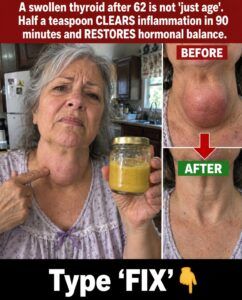
A person can have an enlarged thyroid gland and still produce normal, too low, or too high hormone levels. Therefore, simply looking at the neck is not enough to determine how the gland is functioning.
Outward appearance can be deceiving; hormones can only be understood through studies.
What can cause a swollen thyroid?
There is no single cause. A visible swelling in the neck can be due to goiter, thyroid nodules, inflammation of the gland, or various thyroid disorders.

In some regions, iodine deficiency in the diet can contribute to goiter. However, that doesn’t mean that taking extra iodine on your own is a good idea.
There are also autoimmune causes. In Hashimoto’s disease, the immune system attacks the thyroid gland and can lead to hypothyroidism. In Graves’ disease, it can overstimulate the thyroid, causing it to enlarge.
And here’s another important point: not every lump in the neck is thyroid-related. That’s yet another reason not to diagnose it based solely on a photo.

Why there isn’t a solution in 90 minutes
The idea that half a teaspoon of a spice, oil, or homemade mixture can reduce thyroid inflammation in 90 minutes lacks solid clinical support. There is no serious evidence that it shrinks a goiter or normalizes hormones that quickly.
Thyroid function is controlled by a complex hormonal system, most notably TSH and T4. If the gland produces too little hormone, a homemade mixture won’t replace it. If it produces too much, it won’t reliably correct the imbalance either.
And if the problem is a nodule, the real question is not how to “reduce” it at home, but what exactly that nodule is.

The truth is that real changes in the thyroid are not usually resolved with shortcuts, but with correct diagnosis and proper follow-up.
TSH and T4 say more than any photo of the neck.
When a thyroid problem is suspected, blood tests help determine how the gland is functioning. One of the most commonly used tests is the TSH test, and T4 may also be measured, in addition to other tests depending on the case.
Imagine two people with similar necks. One may have high TSH and low hormone levels, while the other has low TSH and high hormone levels. The necks may look similar, but the internal problem is entirely different.
| Assessment | What does it contribute? |
|---|---|
| Observe and feel the neck | It can detect an increase in volume or mass |
| TSH | It helps to assess the regulation of thyroid function |
| T4 | It provides information about circulating thyroid hormone |
| Ultrasound | It allows the study of size, structure, and nodules. |
| Before and after photo | It does not demonstrate hormonal normalization. |
This point is essential: hormones are not visible in a photograph.
Thyroid nodules are common and often benign.
Thyroid nodules are relatively common, and their frequency increases with age. Most are benign, meaning that finding one does not automatically mean it is cancerous.
But that doesn’t mean it should be ignored or treated with home remedies before its nature is known. Ultrasound allows doctors to see if there is one or more nodules, their size, and other characteristics that help guide the next step.
Based on these findings and the clinical context, the healthcare professional can decide whether monitoring is sufficient or if further testing is needed. In some cases, a fine-needle aspiration biopsy is requested.
When can a biopsy be used?
Not all nodules require a biopsy. The decision depends on the size, the appearance on ultrasound, and other clinical factors.
A fine-needle aspiration biopsy allows cells to be obtained from the nodule for analysis. This helps distinguish lesions that can be monitored from those that require more attention.
Therefore, a new lump after age 60 deserves evaluation, even if it’s painless. The absence of pain doesn’t mean it’s safe to ignore it.
Be careful about taking iodine on your own.
Hearing that the thyroid needs iodine might lead you to think that more iodine will always help. But it doesn’t work that way. The body does need iodine to produce thyroid hormones, but too much can also disrupt the gland’s function in susceptible individuals.
This is especially important if a thyroid condition is already present. Therefore, it’s not advisable to start taking iodine drops, concentrated seaweed extract, or high-dose supplements without first identifying the cause of the problem.
What seems “natural” is not always harmless, especially when it comes to hormones.
The thyroid does not need to be “detoxified”
The idea that certain drinks or juices “cleanse” the thyroid sounds appealing, but it doesn’t reflect how this gland actually works. The thyroid doesn’t accumulate dirt that needs to be eliminated with a quick fix.
A balanced diet does contribute to overall health. Adequate protein, fruits, vegetables, whole grains, and appropriate intake based on individual needs can all be part of a good plan.
But no single food guarantees that TSH and T4 levels will return to normal. If there is a hormonal imbalance, it’s essential to first identify it.
Symptoms such as fatigue or weight gain do not confirm the diagnosis
Hypothyroidism can be accompanied by fatigue, cold intolerance, dry skin, constipation, and weight gain. However, these symptoms are nonspecific.
Fatigue can also be related to anemia, sleep problems, medications, heart disease, and many other causes. Weight gain alone does not necessarily indicate a thyroid disorder.
On the other hand, hyperthyroidism can cause weight loss, tremors, palpitations, and hot flashes. The correct way to distinguish between them is not to choose a different prescription for each symptom, but to measure thyroid function.
If you are already taking levothyroxine, do not replace it with a homemade mixture.
Levothyroxine replaces thyroid hormone when the body doesn’t produce enough. A spice blend cannot reliably fulfill that function.
If your test results remain abnormal while you’re taking the medication, it doesn’t automatically mean it’s stopped working. Sometimes the dosage needs adjusting, and other times the way you take it interferes with its absorption.
Calcium, iron, and some herbal supplements can affect the results. Therefore, it’s advisable to inform your healthcare provider about everything you consume.
Do not change the dose or stop taking the medication because of a social media photo.
What you can do during the next seven days
If you notice a change in your neck, you don’t need to check it twenty times a day. Instead, you can follow simple steps that do provide useful information.
- Take a photo in good light to remember what it looked like at the beginning.
- Note when the change appeared and if it has grown.
- Record if there is pain, pressure, difficulty swallowing, or changes in voice.
- Make a list of medications and supplements you currently use.
- Gather previous TSH, T4 or ultrasound studies, if you already have them.
It’s also worth noting if you’ve experienced weight changes, tremors, constipation, fatigue, palpitations, or intolerance to cold or heat. This isn’t because it diagnoses the problem at home, but it’s very helpful during a consultation.
Signs that warrant prompt medical attention
Most thyroid problems are not an emergency. Even so, there are signs that shouldn’t be ignored.
- New lump that grows progressively.
- Difficulty swallowing.
- Persistent pressure in the neck.
- Hoarseness that is not improving and does not appear to be due to a cold.
- Rapid neck growth.
These signs don’t automatically mean cancer. There are benign causes that can also produce them. But they are reasons to have the neck examined instead of trying to reduce it externally.
If significant difficulty breathing occurs, especially if it progresses rapidly, seek urgent medical attention. In this scenario, the priority is to ensure safe breathing and identify the underlying cause.
Practical steps to communicate more clearly with your doctor
Specific information is more helpful than general concern. If you prepare some details before the appointment, the diagnosis can progress more quickly.
First, note when you noticed the increase in volume. Then, observe whether it changes size or stays the same. It’s also a good idea to record if there is pain, hoarseness, difficulty swallowing, or a feeling of pressure.
Next, make a list of all medications, vitamins, and supplements. This includes iron, calcium, herbal products, and anything else you use “for your thyroid.”
Finally, ask if you need to repeat the tests or have an ultrasound. Based on the results, the healthcare professional will decide whether monitoring is sufficient or if further testing is required.
Conclusion
A visibly enlarged thyroid gland after age 60 shouldn’t be ignored, but neither should it be treated blindly with remedies that promise results in 90 minutes. The size of the gland and its hormone production are related, but different.
TSH and T4 tests help assess function. Ultrasound allows for the study of structure. And if a nodule with certain characteristics appears, further studies may be needed. That’s the right approach to understanding what’s really going on.
The key that many people overlook is this: you don’t need to “reset” your thyroid. You need to understand why it changed.
Frequently Asked Questions
Does an enlarged thyroid gland mean hypothyroidism?
Not necessarily. An enlarged thyroid can be accompanied by low, normal, or high function. Tests, especially TSH and T4, help determine how well it’s working.
Can a homemade mixture normalize hormones in 90 minutes?
There is no solid clinical evidence to support that result. Treatment depends on the underlying cause of the hormonal imbalance.
Does a thyroid lump mean cancer?
No. Many thyroid nodules are benign. Even so, a new nodule warrants evaluation to determine whether it only needs monitoring or further testing.
Medical disclaimer: This content is educational and general, and does not replace an assessment, diagnosis, or individualized recommendations from a healthcare professional.


