
Why Should We Have a Snake Plant at Home?
Looking for an indoor plant that is beautiful, easy to care for, and suitable for almost any room?
The snake plant, commonly known as Sansevieria or mother-in-law’s tongue, is one of the most popular choices for homes and offices.
With its tall, upright leaves and striking green patterns, this hardy plant can add a natural touch to bedrooms, living rooms, offices, and other indoor spaces.
But its popularity isn’t only about appearance.
Snake plants have interesting characteristics that have made them a favorite among indoor plant lovers. They are remarkably resilient, require relatively little watering, and use a form of photosynthesis known as Crassulacean Acid Metabolism (CAM).
So, what makes the snake plant worth having at home?
Let’s take a closer look.
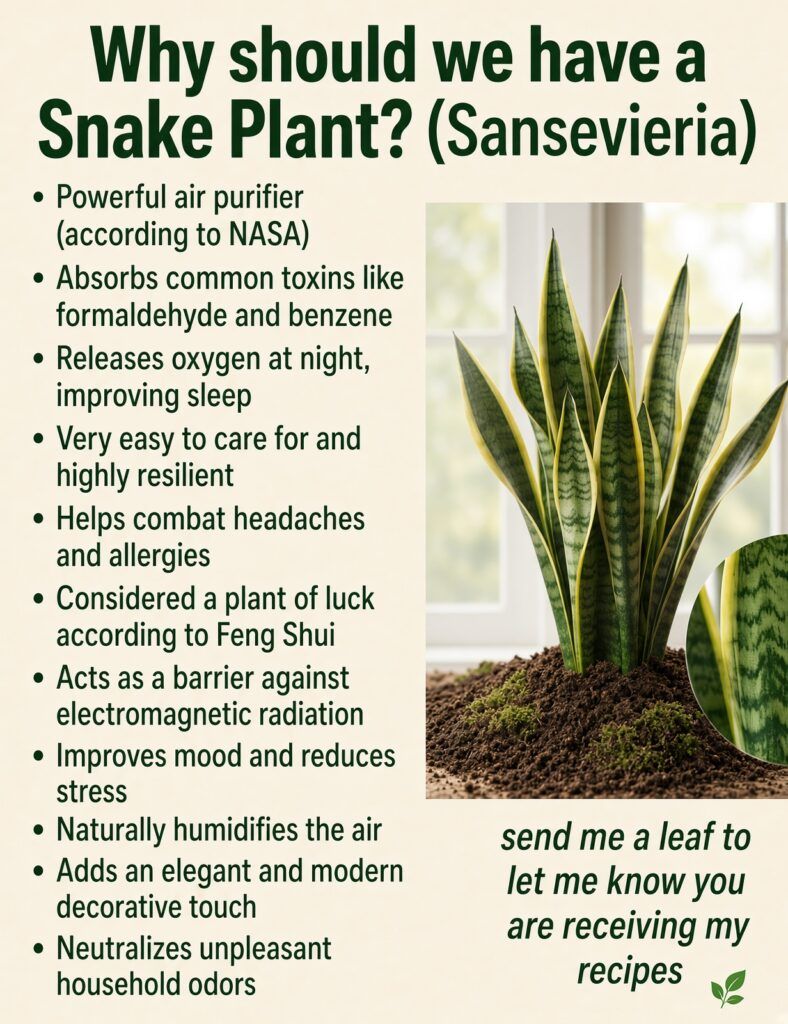
1. Snake Plants Are Extremely Easy to Care For
One of the biggest reasons people love Sansevieria is its low-maintenance nature.
If you sometimes forget to water your plants, a snake plant may be a good choice.
Snake plants generally tolerate periods of dryness and can grow under a range of indoor lighting conditions. They are also relatively resistant to neglect compared with many other popular houseplants.
The most common mistake is actually overwatering.
Because snake plants have thick leaves and underground rhizomes that store water, constantly wet soil can cause root problems.
For healthy growth:
- Use well-draining soil.
- Choose a pot with drainage holes.
- Allow the soil to dry between waterings.
- Avoid leaving the roots sitting in water.
- Provide bright, indirect light when possible.
2. It Can Be a Beautiful Addition to Your Home
Sometimes, the simplest reason to have a plant is that it makes your home feel more inviting.
Snake plants have long, sword-shaped leaves that grow vertically rather than spreading widely. This makes them especially useful for decorating corners, shelves, bedrooms, entryways, and workspaces.
Different varieties can feature combinations of:
- Dark green
- Light green
- Yellow
- Silver
- Striped patterns
Their upright shape also gives a room a clean and modern appearance without taking up too much floor space.
3. Snake Plants Have Been Studied for Indoor Air Pollutants
One of the most famous claims surrounding snake plants comes from research associated with NASA’s work on houseplants and indoor air pollution.
NASA-supported research investigated whether common houseplants could remove certain pollutants from sealed experimental chambers. The studies found that plants could reduce compounds such as formaldehyde and benzene under those controlled conditions.
However, there is an important detail.
A sealed laboratory chamber is very different from a normal home.
Later research has pointed out that the amount of plants required to produce a meaningful effect in a typical indoor environment could be impractically large.
Therefore, it is more accurate to say that snake plants have air-pollutant removal potential under certain conditions, rather than calling them a replacement for ventilation or an air purifier.
4. Snake Plants Have an Interesting Nighttime Photosynthesis Cycle
Here’s one of the most interesting things about snake plants.
Unlike many conventional houseplants, Sansevieria uses CAM photosynthesis.
CAM plants are adapted to conserve water by opening their stomata and taking in carbon dioxide primarily during the nighttime. The carbon is then used during the daylight portion of the photosynthetic cycle.
This is why snake plants are often described as plants that can exchange gases at night.
You may see claims online that this automatically improves sleep quality. However, there is not strong evidence that simply keeping a snake plant in a bedroom will noticeably improve a person’s sleep.
Still, its nighttime gas-exchange behavior makes it a fascinating houseplant for bedrooms and other indoor spaces.
5. It Can Bring More Greenery Into Your Bedroom
Because snake plants are relatively easy to maintain, many people choose to keep them in bedrooms.
A small snake plant on a dresser or a larger one near a window can create a calm, natural atmosphere.
Plants also provide a visual connection to nature, which is one reason indoor greenery is often used in interior design and wellness-oriented spaces.
Just remember that a plant should be considered part of your room’s environment, not a medical treatment for insomnia or other sleep problems.
6. Snake Plants Are Surprisingly Resilient
Another major benefit of Sansevieria is its ability to tolerate less-than-perfect conditions.
It can often survive periods of:
- Irregular watering
- Lower indoor light
- Dry indoor air
- Busy schedules
- Minimal maintenance
This makes it particularly attractive to beginners.
If you are new to houseplants and want something that doesn’t require constant attention, a snake plant can be a practical place to start.
7. It Can Help Create a More Natural Indoor Environment
Adding plants to your home can make an indoor space feel more connected to nature.
A single snake plant can transform an otherwise empty corner into a small green focal point.
Try placing one:
In the bedroom: beside a window or dresser
In the living room: next to a sofa or cabinet
In the office: beside your desk
In the entryway: near a bright wall
In the bathroom: where lighting conditions are appropriate
The tall leaves also work well with modern, minimalist, and natural interior styles.
8. What About Headaches, Allergies, and Stress?
You may see snake plant posts claiming that the plant can fight headaches, allergies, stress, or other health problems.
These claims should be treated carefully.
There isn’t sufficient evidence to consider a snake plant a treatment for headaches or allergies.
However, having greenery around your living space can contribute to a pleasant environment, and some people simply find caring for plants relaxing.
If you regularly experience headaches, allergy symptoms, breathing problems, or significant stress, it’s better to address the underlying cause rather than relying on a houseplant.
9. What About Electromagnetic Radiation?
Another popular claim is that snake plants can protect your home from electromagnetic radiation produced by phones, Wi-Fi routers, computers, and other electronic devices.
There is not good evidence that a snake plant acts as a meaningful barrier against everyday electromagnetic radiation.
So, while you can certainly keep a Sansevieria beside your computer or router as decoration, it shouldn’t be considered an electromagnetic shield.
This is an important distinction when discussing the potential benefits of indoor plants.
10. Snake Plants Are Often Associated With Good Luck
Beyond science and plant care, snake plants also have cultural and decorative significance.
In some traditions, snake plants are associated with good luck, protection, positive energy, or prosperity.
For people who enjoy Feng Shui or symbolic home decoration, a healthy green plant can be an attractive addition to a living space.
These are cultural beliefs rather than scientifically established health effects, but they can still be meaningful to people who enjoy incorporating symbolism into their homes.
How to Care for a Snake Plant
Keeping Sansevieria healthy is relatively simple.
Light
Snake plants can tolerate lower-light conditions, although brighter indirect light generally supports stronger growth.
Avoid exposing them to intense, hot direct sunlight for long periods because the leaves can become damaged.
Water
Let the soil dry out between waterings.
Overwatering is one of the most common problems with snake plants.
Soil
Choose a well-draining potting mix. A cactus or succulent-style mix can work well because it allows excess water to drain away.
Pot
Always use a container with drainage holes.
Temperature
Keep your plant away from freezing temperatures and cold drafts.
Is a Snake Plant Safe for Pets?
There is one important safety point that pet owners should know.
According to the ASPCA, snake plants (Sansevieria trifasciata) are toxic to cats and dogs if ingested. The plant contains saponins and may cause symptoms such as nausea, vomiting, or diarrhea.
If you have a curious cat or dog that likes chewing plants, keep your snake plant somewhere out of reach.
Snake Plant Benefits: What Should You Really Expect?
Snake plants are popular for good reasons.
They are:
- Easy to maintain
- Attractive and versatile
- Suitable for many indoor spaces
- Relatively tolerant of dry conditions
- Interesting because of their CAM photosynthesis
- Associated with indoor-air research
- Useful as a natural decorative element
- Popular in wellness and Feng Shui-inspired interiors
At the same time, it’s important not to expect a single houseplant to dramatically clean your entire home, cure headaches, treat allergies, improve sleep, or block electromagnetic radiation.
Research supports some interesting biological properties of indoor plants, but the real-world effect depends on factors such as plant species, room size, ventilation, light, pollutant concentration, and the number of plants present.
Final Thoughts
So, why should you have a snake plant at home?
Perhaps the biggest reason is its combination of beauty, resilience, and fascinating biology.
Sansevieria can add an elegant touch of greenery to your home while requiring relatively little care. Its unusual nighttime gas-exchange pattern also makes it one of the more interesting plants to keep indoors.
Just remember: a snake plant should complement good indoor-air practices such as proper ventilation and regular cleaning—not replace them.
And if you have pets, place it somewhere they cannot chew on it.
A beautiful plant, minimal maintenance, and a fascinating connection to nature—it’s easy to see why the snake plant has become a favorite indoor companion. 🌿


