
High blood sugar is frightening, and rightly so: it can appear suddenly, make you feel out of control, and fill your head with doubts, especially if you already have diabetes or take several medications. Amid this worry, social media often promises quick fixes with red onion, as if a single food could correct a dangerous reading in minutes. The problem is that relying on this type of remedy can delay what actually works and, worse, give you a false sense of security. But that’s not all… at the end, you’ll see what to really do when your blood sugar meter reads high and how to interpret those numbers without falling for myths.
The viral idea sounds simple, but glucose doesn’t work that way.
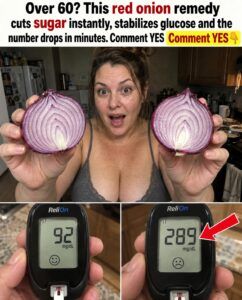
When someone sees a photo with a blood sugar level of 289 mg/dL and another with 92 mg/dL, it’s easy to assume there was an immediate “cure.” However, a single image doesn’t prove that both measurements are from the same person, the same time, or the same context. And in healthcare, context makes all the difference.
Blood glucose levels fluctuate for many reasons: recent food intake, fasting, stress, infection, medication, hydration, and physical activity. Therefore, a single reading doesn’t tell the whole story. The truth is, a blood glucose level of 289 mg/dL warrants serious attention, not a viral remedy.
Does red onion lower blood sugar?
Red onions are indeed a healthy food. They provide water, fiber, and plant compounds that can be part of a balanced diet. However, supporting a healthy diet is one thing, and using them as a treatment for hyperglycemia is quite another.
To date, there is no solid evidence that eating red onions or preparing a home remedy with them can safely and quickly lower blood glucose from 289 to 92 mg/dL in minutes. This doesn’t mean onions are “bad”; it means they are not insulin, a substitute for medication, or a cure for a metabolic emergency.
What some studies have shown
Here’s an important point. Some studies on plants and foods have found potential effects on glucose, but that doesn’t mean they’ll work the same way in real life. In research, a substance can show activity in cells, animals, or small trials, and still not produce a significant clinical change in people.

Institutions like the NCCIH have reviewed supplements and “natural” products used for diabetes. Their conclusion is cautious: some show promising signs, but the results are variable, and for most, there is insufficient evidence to replace medical treatment. In other words, “might help a little” does not mean “lowers 200 points in minutes.”
Quick comparison: myth vs reality
To make it clearer, here’s a simple comparison:
| Viral promise | What is really known |
|---|---|
| Onions lower blood sugar instantly. | It has not been proven |
| It can reduce from 289 to 92 mg/dL in minutes | There is no reliable clinical evidence |
| Replaces medications | No |
| It can be part of a healthy diet | Yeah |
| Diet and exercise help with control | Yeah |
The difference is enormous. And understanding it can prevent dangerous decisions.

Why a rapid fall isn’t always good news
Especially after age 60, the goal isn’t to “lower the number at all costs.” Too rapid a reduction can lead to hypoglycemia, or dangerously low blood sugar. And that’s also risky.
Hypoglycemia can cause tremors, sweating, intense hunger, dizziness, weakness, confusion, and difficulty walking. If severe, it can even lead to loss of consciousness or seizures. In older adults, it also increases the risk of falls and injuries.
The real goal is not to show off a nice number, but to keep glucose within a safe range for your body.

After age 60, monitoring should be individualized.
Not all older adults need the same glucose target. One 70-year-old may be active, independent, and have few health conditions. Another may have kidney disease, be taking multiple medications, or have a history of hypoglycemia. Treating them both the same would be a mistake.
That’s why doctors adjust the plan according to age, functional status, diet, medications, and other illnesses. Clinical evidence shows that overly strict goals can do more harm than good for some people.
Can a person with diabetes eat red onions?
Yes, in general, you can. Red onions can be part of balanced meals and add flavor without needing to add much sugar or fat. There’s no need to see them as medicine; they’re simply a useful ingredient.
It can be included in preparations such as:
- salads
- soup
- beans
- sautéed vegetables
- stews
- egg
- chicken or fish
The key lies in the complete feeding pattern, not in a single food.
What really helps control glucose
Diabetes is best managed with sustained strategies, not quick fixes. This includes proper nutrition, appropriate physical activity, sufficient sleep, stress management, and medication when indicated.
According to medical reviews and clinical guidelines, these habits help maintain glucose, blood pressure, and cholesterol within better ranges, as well as reduce the risk of long-term complications. That’s the less spectacular, but more effective, part.
Habits that do make a difference
- Eat more consistent portions throughout the day
- Choose more vegetables, adequate protein, and fiber.
- Walk or move regularly, according to your physical condition.
- Take the medications as prescribed
- Check glucose using the correct technique
- Attend regular medical check-ups
What to do if your glucometer reads high
If a high number appears, don’t panic, but don’t ignore it either. There are simple steps that can help you better interpret the result.
Practical step-by-step guide
1. Repeat the measurement. Wash and dry your hands thoroughly before measuring. Sometimes food residue or incorrect technique can affect the result.
2. Note the context. Write down if you were fasting, what you ate, if you exercised, if you were sick, and what medications you took.
3. Do not change doses on your own. Do not double insulin or medications without a plan previously indicated by your healthcare professional.
4. Stay hydrated. Dehydration can worsen the feeling of discomfort when blood sugar is high.
5. Seek help if the numbers persist. If your glucose remains very high or you feel unwell, contact your medical team.
6. Go to the emergency room if you experience severe symptoms. Vomiting, confusion, abnormal breathing, extreme drowsiness, or significant deterioration will not be resolved with onions or home remedies.
Beware of “natural” supplements
An onion in your food is not the same as a capsule, powder, or concentrated extract. Supplements can have much higher doses, interact with medications, or cause adverse effects. Just because something is “natural” doesn’t automatically make it safe.
Furthermore, some people with diabetes are also at risk of kidney disease, so any product that promises to lower blood sugar should be carefully reviewed. The safest recommendation is not to replace proven treatments with products lacking sufficient evidence.
The one-shot trap
A picture showing two glucose readings can be shocking, but it doesn’t prove a cure. It doesn’t tell you if there was food, exercise, insulin, illness, a measurement error, or simply two different times of day.
Therefore, to understand true glucose control, a pattern over several days is more important than a single striking reading. Hemoglobin A1c, which shows the average glucose level over the past few months, is also helpful.
A single figure is impressive; a complete record informs.
Conclusion
Red onions can be part of a healthy diet, but there is no reliable evidence that they lower blood sugar in minutes or safely reduce glucose from 289 mg/dL to 92 mg/dL. Diabetes management depends on sustained healthy habits, medical monitoring, and, when necessary, appropriate medication.
If your blood sugar is high, the helpful question isn’t “What miracle cure will lower it instantly?” but rather “Why is it rising, and what can I safely do to stabilize it?” That’s the path that truly protects your health.
Frequently Asked Questions
Does red onion cure type 2 diabetes?
No. It can be part of a healthy diet, but it does not cure diabetes or replace medication or medical follow-up.
Does a reading of 92 mg/dL mean I no longer have diabetes?
Not necessarily. A single reading only shows a specific moment in time. Diagnosis and monitoring are assessed using a pattern of measurements and tests, such as hemoglobin A1c.
Can I take natural supplements along with my diabetes medication?
You shouldn’t assume they’re safe just because they’re natural. Some can interact with your medications or cause adverse effects. It’s best to consult your healthcare professional before using them.
Medical notice: This content is for informational purposes only and is not a substitute for professional medical advice. If you have very high blood sugar, severe symptoms, or questions about your medications, seek medical attention.


